
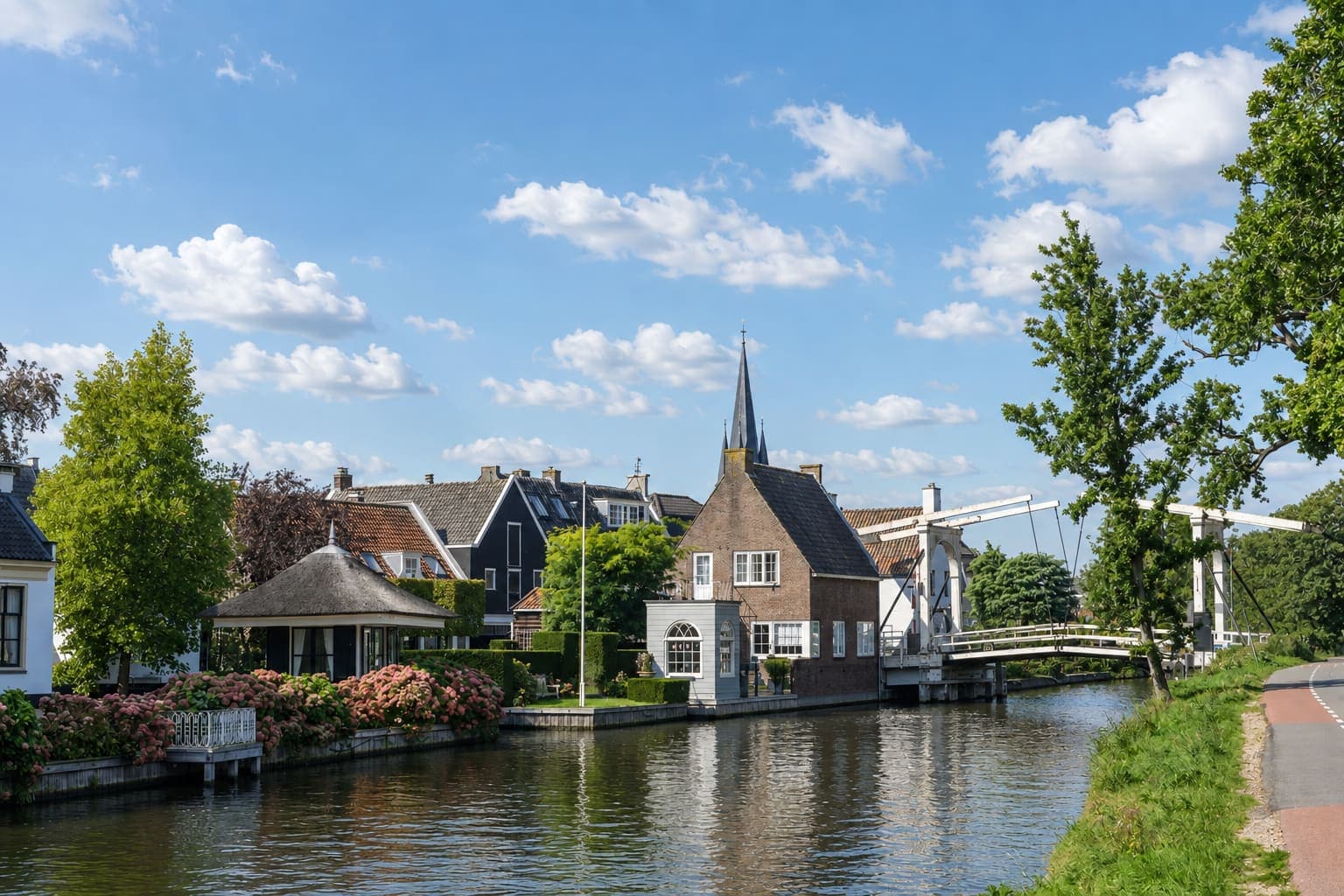
Utrecht · approx. 20 km from Utrecht
Sealant work in Breukelen
Breukelen lies on the Vecht, with historic country estates and country houses along the water, and behind them ordinary residential neighbourhoods on peat ground. Those are two worlds for sealant work: by the water there are rules about what is allowed, in the neighbourhoods behind it the settling ground determines how wide a joint has to be.
Since 1959
Experience and craftsmanship from Utrecht
Clear communication
Short lines, clear agreements
100% satisfaction
We only leave once you are satisfied
Lasting quality
Top-quality materials for a long-lasting result
What matters in Breukelen
Country estates next to ordinary neighbourhoods
Historic buildings and country estates along the Vecht, a village centre with older buildings, and post-war residential neighbourhoods on peat ground.
Along the Vecht there are buildings and country estates with timber window frames, sash windows and glazing that has often been in place for decades; with a listed building or a conservation area, what is allowed comes first and only then what goes in. In the village centre there is mixed building of varying age. The post-war residential neighbourhoods lie on peat ground that is compacting, and there you see the consequences in the junctions: joints that come away on one side or crack down the middle. Anything in there from before 1994 is suspected of containing asbestos until testing shows otherwise.
What is special about Breukelen is that the two tasks literally lie side by side. On the Vecht every building is different, you measure per window frame, and the question of what is allowed is just as important as what is possible. A few hundred metres further on there are rows of identical houses where it is precisely the ground that determines the work. We approach those two differently and do not lump them together under one price per metre.
Along the Vecht the road is narrow, with limited opportunity to stop and sometimes a set time window; we arrange that in advance. At country estates the drive is often long and we can park on the premises, although the ground there is not always suitable for equipment. In the post-war neighbourhoods parking is plentiful and free, and we park right outside the door.
Twenty kilometres from our base, about half an hour. Perfectly doable for a bathroom or a set of window frames. For larger buildings on the Vecht we schedule several days in a row, because equipment that stays in place is cheaper than setting up twice. We are happy to combine Breukelen with Maarssen or Kockengen on the same route.
What we do in Breukelen
- Bathroom, sanitary & kitchenSealing of sanitary ware, showers, baths, washbasins and kitchens.
- Window frames & glazingNeat, durable sealant work around window frames and glass.
- Facades & structural jointsFacade joints, connection joints and expansion joints in floors and walls.
- Swimming pool & wellnessSealant work in swimming pools, saunas, steam rooms and spas.
- Renovation & maintenanceSealant work during renovation, repairs and periodic maintenance.
- Specialist sealant workFor specific requirements and specialist applications.
You will hear from us within 15 minutes on working days, and the work comes with a 2-year guarantee.
The work here
What we do most often in Breukelen
Joints on peat ground
Peat compacts and settles, and that rarely happens at the same rate everywhere. The deformation that follows from it shows up in the junctions between building components. At the site survey we measure how much movement is to be expected and derive the joint width from that; a wider joint stretches over more millimetres than a tight one.
More about this serviceSash windows on the Vecht
In the historic buildings the glass sits in putty or old glazing sealant that has hardened. With sash windows there is something extra: the moving parts wear and the junctions around them have more to endure than with a fixed window. We first look at what is allowed for a protected building before we choose a product.
More about this serviceBathrooms in the residential neighbourhoods
The post-war houses generally have a bathroom whose sealant is older than the sanitaryware. Dark edges mean mould in the material itself; cleaning removes only the top layer and within weeks it is back. The old joint out, the corner completely dry, and only then a sanitary sealant in.
More about this serviceHow we approach it here
Which sealant on what, and what it costs
The substrate decides the sealant
On the Vecht the flanks are old: painted timber on which the sealant adheres to the paint layer rather than to the timber, and brickwork that is soft and porous enough to draw the binder out of a sealant if no primer goes on. With listed buildings a second requirement is added that has nothing to do with technique: the product has to fit what is allowed and how the building looks. In the post-war neighbourhoods the flanks are more modern (harder brickwork, painted hardwood, sometimes plastic), but there the ground movement determines the choice: on settling ground we choose elasticity over hardness, because a stiff product does not last as long there.
Costs and lead time
The price follows from metres, accessibility and the removal of the old joint. On the Vecht it is bespoke work: every window frame is measured and assessed separately, and with listed buildings there is research beforehand into what is allowed. That takes time, and it appears as a separate item in the quote. In the residential neighbourhoods it goes per metre and the estimate is more predictable; with several addresses in the same street the price per house drops. For buildings dating from before 1994, asbestos testing comes first. For a bathroom we usually allow half a day, plus the curing time.
Two routes
Business or homeowner in Breukelen
For managers of historic property along the Vecht it is about work where the rules are just as decisive as the technique; we find out in advance what is allowed instead of discovering it once it is in. For housing associations and contractors in the post-war neighbourhoods it is about complexes of identical houses on ground that moves, where the joint width should follow from the measured movement. We hand over both with images per address.
For businesses
Contractors, painters, homeowners' associations, property managers and interior fit-out.
See what we do for businessesQuestions from Breukelen
What people in Breukelen ask most often
My building is listed. Is sealant work still allowed?
Usually yes, but not with every product and not without checking. With a listed building or in a conservation area there are requirements on what you change on the outside, and the sealing around the glass falls under that because it determines the appearance. We find out in advance what is allowed. That takes a conversation and sometimes an application, but it prevents something going in that has to come out again, and you pay for that twice.
Why is the joint in my new-build house already cracking?
On peat ground that is not unusual. Peat compacts and settles, and that rarely happens at the same rate everywhere; one part of a facade sinks faster than another. The deformation that follows from it shows up in the junctions. If the joint was chosen too tight for that movement, it cracks down the middle or comes away on one flank. The solution is not to seal harder but wider, based on what we measure.
Does work on a listed building cost more than on an ordinary house?
Yes, and that is not because of the material. There is research beforehand into what is allowed, every window frame is measured separately because no two are the same, and removal goes more slowly because old panes and old timber are fragile. Those are all hours, and they are shown visibly in the quote. What you get for it is that it is right for the building and that you do not have to undo it.
What is a backing rod and do I need one?
It is a round profile that is placed at the back of the joint before the sealant goes in. It does two things: the sealant gets the correct thickness instead of running away to the back, and it adheres only to the two flanks and not to the back. That last point is essential, because a joint that is fixed on three sides cannot stretch freely and cracks. With wider joints on moving ground it is no luxury.
Can you combine it with an address in Maarssen?
Gladly, they lie on the same route along the Vecht. Several addresses in one day means that you pay the fixed part of the price (travelling out, unpacking, clearing up) once instead of per address. That works for neighbours as well as for family in a neighbouring village. When you make your request, say which addresses are involved, and we make it one site survey and one schedule.

