
Homeowners
Sealant work in the kitchen
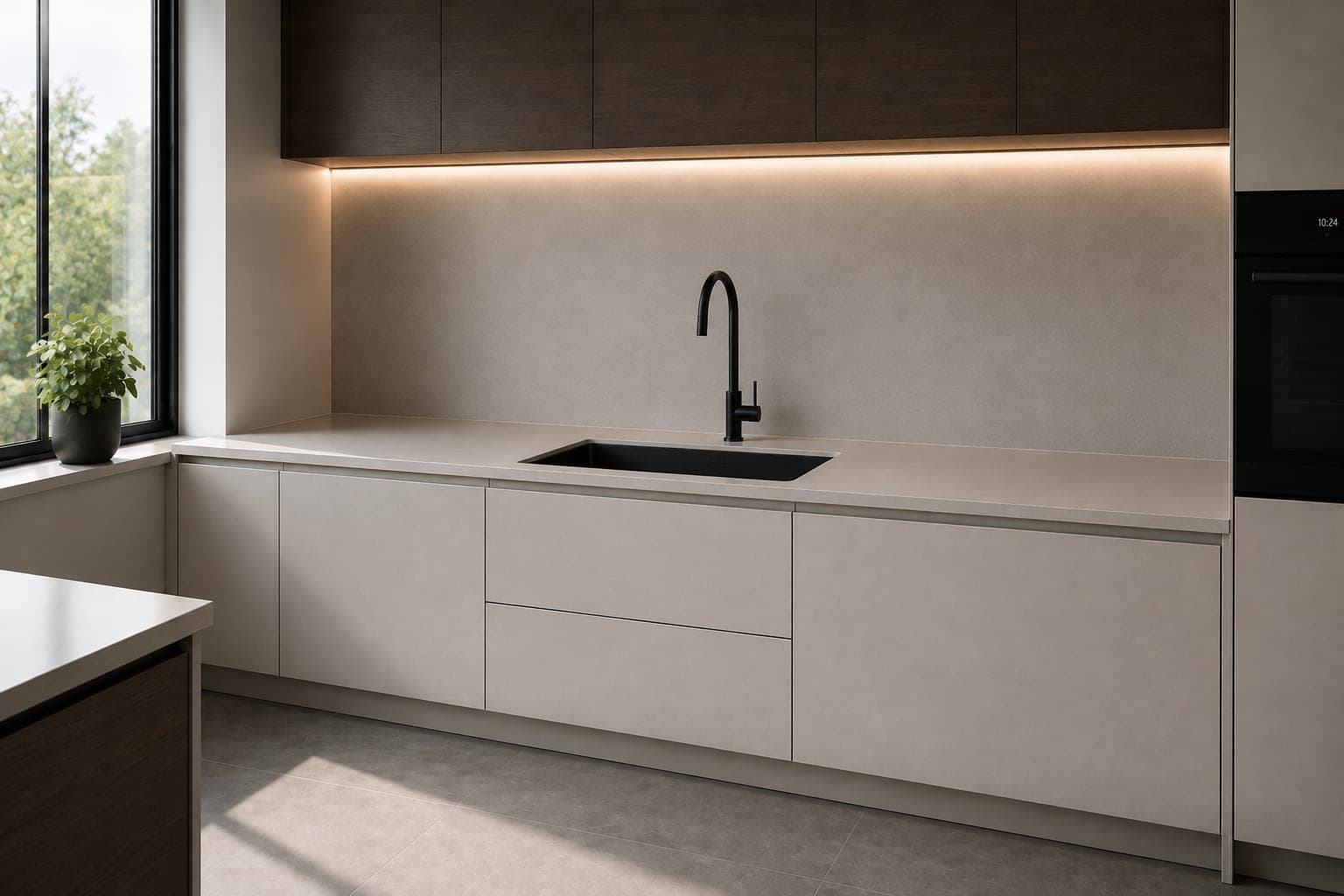
The joint behind the worktop is coming loose, the edge along the sink has gone black or the splashback is pulling away from the wall. We take the old sealant out completely and lay a new joint that can cope with the movement of your worktop.
Since 1959
Experience and craftsmanship from Utrecht
Clear communication
Short lines, clear agreements
100% satisfaction
We only leave once you are satisfied
Lasting quality
Top-quality materials for a long-lasting result
Where it goes wrong
Three joints, three stories
Worktop against the wall
The longest joint and the first to give up. This is where most of the movement ends up, plus steam from the dishwasher.
Splashback and tile edge
Grease, cleaning products and warm air. The edge discolours, comes loose and dirt creeps underneath.
Sink and tap
Standing water, every day. A joint that leaks here makes the worktop swell from underneath.
The technique
Why the joint behind the worktop is the first to come loose
Your worktop stands still, but it does move. A pan off the hob, a dishwasher blowing out steam, hot water from the tap. Material expands when it warms up and shrinks again as it cools.
Every material does that at its own rate. Per degree, plastic expands about six to seven times as much as concrete, and aluminium sits in between. So the joint between two different materials takes the most movement. That is exactly where your sealant joint sits.
That is why a sealant joint may only adhere on two sides: to the worktop and to the wall. If it adheres to the back as well, the middle can no longer stretch with it and it tears. We put backing rod or bond breaker tape behind it, so the sealant only does what it is good at: stretching.
The width counts too. For elastic sealant, 8 millimetres is the minimum. If there is only a hairline between worktop and wall, that is not a sealant joint but a crack posing as one.
Have a look yourself
Is the old sealant letting go along the flank, so neatly along the edge? Then the adhesion has gone and replacing it helps. Is the crack right down the middle of the joint instead? Then the joint is too narrow for the movement. Squeezing in new sealant solves nothing. We would rather tell you that straight away than six months later.
Watch out with your worktop
Natural stone and composite call for a different sealant
Do you have granite, marble or composite? Then ordinary acid-curing silicone sealant does not belong along it. That sealant contains free plasticisers and silicone oil. They soak into the pores of the stone and leave a dark edge along the joint.
The annoying part: you often only see that edge after weeks. And it never comes out again. Polishing does not help, and sanding usually does not either. The trade calls this edge zone staining. In plain language: a permanent dirty shadow on a worktop you paid a lot for.
That is why we use natural stone sealant on stone worktops, in which the plasticisers are chemically bound. Those cannot migrate out. We also leave acid-curing silicones out on bare aluminium, copper, zinc and mirrors, because there the acid attacks the surface.
Not sure what your worktop is made of? Send a photo and a photo of the side with it. Usually we can see it straight away.
How it works
From old edge to a crisp joint
Old sealant out completely
Not over it, but out. Remains of old sealant are the most common reason a new joint comes loose again within a year.
Surface clean, dry and grease-free
In a kitchen there is a thin film of grease everywhere, including where you cannot see it. We degrease and use a primer where needed.
Backing rod where possible
That way the joint adheres on two sides and not on three. On a deep joint behind the worktop that is the difference between two years and two months.
Applying and smoothing off the sealant
The right sealant for your worktop, in one flowing movement. Then smoothed off crisply, so no ridge is left where crumbs can settle.
Curing
Sealant cures at about 2 to 3 millimetres per 24 hours at 20 degrees. The surface feels dry before the core is hard. We tell you how long to leave the joint alone.
What does it cost
You hear the price up front
We charge kitchen work per job, not per hour. So you do not pay for time spent searching. A single joint behind the worktop is a different story from a kitchen where the splashback and the sink are loose as well. That is why we want to see a few photos first.
What is certain: you get the price before we start. Nothing is added afterwards, unless we agree something else together.
Good to know
Questions from the kitchen
Can I paint over the sealant joint in the colour of the wall?
No. Paint does not adhere to silicone sealant, not even special paint. Paint shrinks and comes loose again. If you definitely want paint over it, then acrylic or a paintable hybrid has to go in. But acrylic cannot cope with prolonged water, so we do not do that behind the sink. We would rather choose a sealant colour that suits your worktop.
Is a new sealant joint more hygienic?
Yes, and in a kitchen that is no side issue. A joint that comes loose or cracks catches crumbs, moisture and grease. That sits below the surface, so you cannot clean it away. A closed, smooth joint has no cavity where anything can sit. For wet spots we use sealant with a mould inhibitor in it.
Can I use chlorine on it?
Better not. Chlorine-based and aggressive cleaners wash the mould inhibitor out of the sealant and make the joint porous. After that the build-up comes back faster than before. A mild all-purpose cleaner and a quick wipe dry afterwards works better and lasts longer.
How long can I not use the kitchen?
Cooking is fine. The joint itself has to be left alone until it is hard, and that goes at about 2 to 3 millimetres per 24 hours. For a normal kitchen joint that means: no scrubbing that day and no water against the fresh joint. At handover we tell you exactly how long.
My splashback is loose. Can you still do it?
Sealant is a seal, not an adhesive and not a structural part. If the splashback or a tile is genuinely loose, that has to be repaired first. We tell you that honestly, even if it means we cannot do the job straight away.
What if something is not right?
You get a 2-year guarantee on the work carried out. On natural stone it applies to the adhesion; discolouration in the stone itself we exclude in writing beforehand. What else is and is not covered is stated in the quote. This guarantee is in addition to your statutory rights and does not limit them.
Read more

