
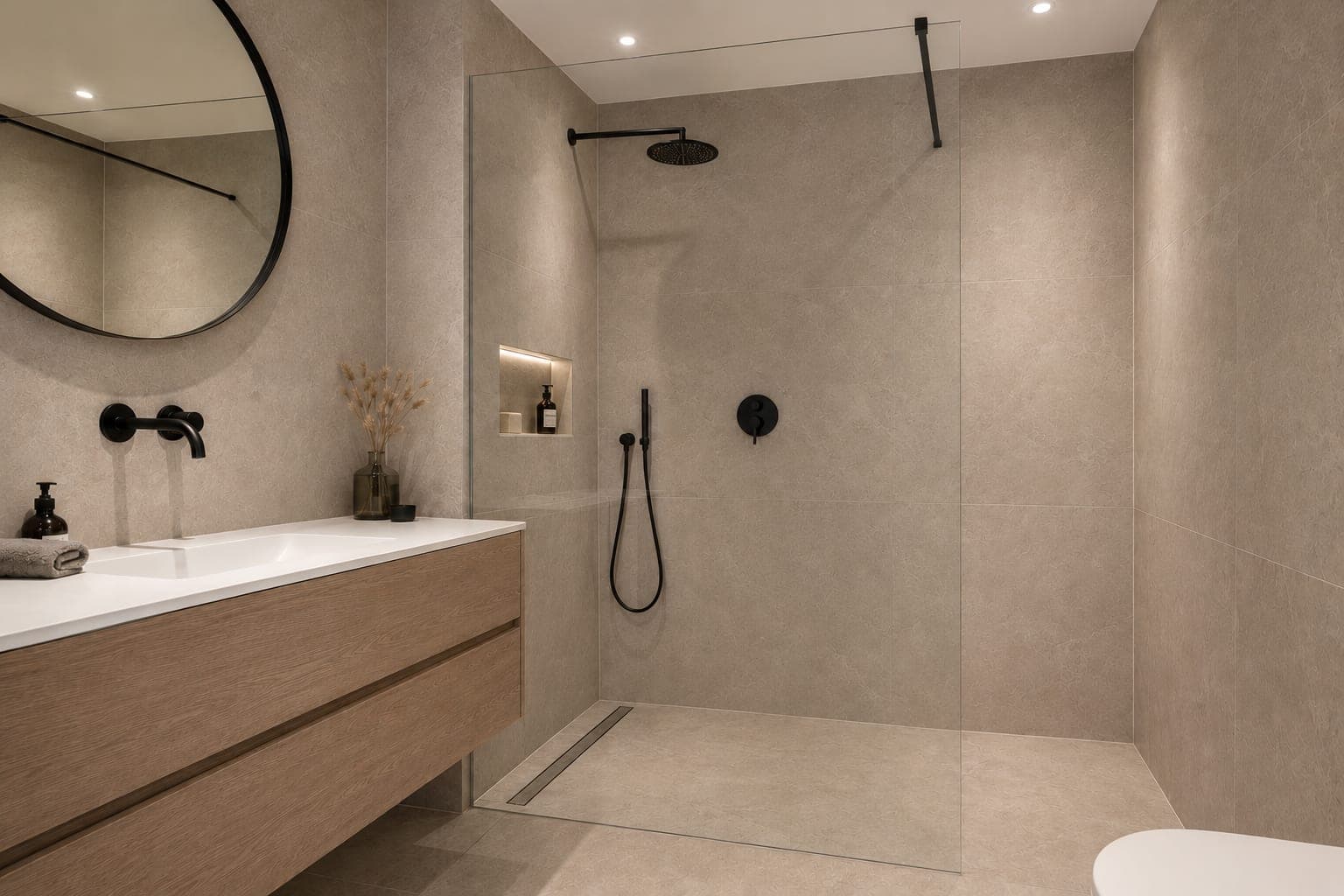
Bathroom, sanitary fittings & kitchen
Sealant work in bathrooms and wet rooms
A sanitary joint is not a finish but a water barrier. It keeps moisture out of the structure and at the same time has to accommodate the movement of tray, tile and wall. We design and apply that joint the way it should be done.
Since 1959
Experience and craftsmanship from Utrecht
Clear communication
Short lines, clear agreements
100% satisfaction
We only leave once you are satisfied
Lasting quality
Top-quality materials for a long-lasting result
Who it is for
Sanitary sealant work. At your home and at your business.
A new bathroom, worn sealant joints or a complete renovation project? We take care of the sealant work. For homeowners and businesses, with clear agreements and attention to the finish. At handover you receive clear videos in which we show what we have done.
Homeowners
Want your new bathroom neatly sealed, or old sealant joints replaced? We take care of the connections around your shower, bath, washbasin and toilet. You know in advance what it costs, and afterwards when you can use everything again.
Bathroom specialists & installers
You fit the bathroom, we take care of the sealant work. We coordinate with the installer or tiler and fit in with your schedule. With our handover videos you see the result, even if you are not there yourself.
Contractors & renovation companies
From a single bathroom to a complete series of homes: we take care of the sealant work in new builds and renovations. We make clear agreements about the schedule and give you a clear picture of the completed work at handover.
Property management & housing associations
A tenant changeover, bathroom renovation or planned maintenance? We coordinate the work with the manager and the residents. You receive clear handover videos, so you can see remotely what work has been carried out.
Hospitality
From the toilets in your café to the dishwashing area of your restaurant: we apply new sealant joints and replace worn sealant work. When scheduling, we take account of your opening hours and the time the sealant needs to cure.
Hotels & holiday parks
Refurbishing one guest bathroom, or tackling the sanitary fittings in several rooms and holiday homes? We plan the work around your occupancy and work in phases where needed. That way the other rooms can stay in use.
Care institutions
In a care setting, daily life simply carries on. We consult with the location about access, working hours and use of the sanitary facilities. We work tidily and are considerate of residents, staff and visitors.
Sport, swimming pool & wellness
From showers to toilets and changing rooms: we match the sealant work to the substrate and the use. Together we plan a suitable time for the work and the curing, so it is clear when the rooms can open again.
Choice of material
Which sealant belongs in a wet room
Silicone or hybrid with fungicide
In bathrooms we use a sealant with a mould-inhibiting agent, the fungicide. That agent is in the sealant itself and slows the growth of mould on the joint. It is not permanent protection, but it makes a difference of years.
No acrylic behind the shower
Acrylic sealant disperses under prolonged exposure to water: the material slowly dissolves and the joint becomes soft and porous. Acrylic is fine on an interior window frame that will be painted over, but does not belong in a wet room. Silicone, on the other hand, cannot be painted over. If paint has to go over it, we choose a paintable hybrid.
Ceramics and natural stone: sealant without free plasticisers
Free plasticisers and silicone oil seep into the pores of natural stone and leave a dark edge along the joint. That edge-zone staining often only becomes visible after weeks and cannot be undone. Polishing does not help. That is why marble, composite and porous ceramics get a natural stone sealant with chemically bound plasticisers. Acetic-cure silicone is kept away from those in any case, as it is from aluminium, zinc, copper and mirrors.
Backing rod behind it, no adhesion on three sides
A sealant joint may adhere to two flanks only. If it is also stuck to the base, the middle cannot stretch and the joint tears open. Behind a joint exposed to water belongs a backing rod of closed-cell PE, 25 to 50 per cent oversized. Wooden strips or PU foam are unsuitable for that.
Dimensions and time
Joint size, curing and when you can shower again
Cross-section of a sanitary joint
Cross-section of the corner between a tiled wall and a shower tray. Between the tiles and the tray is a joint. At the top of the joint sits the sealant, finished concave; below it lies a round backing rod. On the tray stands a thin layer of water.
- Joint width. At least 8 mm wide and 6 mm deep. Any narrower and an elastic sealant cannot accommodate the movement.
- The sealant. Mould-resistant and finished concave, so water runs off instead of standing on it.
- The backing rod. Keeps the sealant off the base, so it adheres on two sides and not on three.
At least 8 mm wide and 6 mm deep
Narrower than 8 mm, an elastic sealant can no longer accommodate the movement. It then tears open in the middle of the joint, which is called cohesive failure. Refilling does not solve that, because the joint was designed too narrow. If a joint comes away along the flank, the problem lies in the preparation or the substrate.
Roughly 2 to 3 mm per 24 hours
At 20 degrees and 50 per cent humidity, sealant cures at roughly 2 to 3 millimetres per 24 hours. For a joint 6 mm deep, 24 hours is therefore tight. Allow two days before anyone showers or hoses down again. On a project we schedule that in, so it does not go wrong on handover day.
For series we indicate per building section when the room can be used again. That is on the work order and goes into the handover file.
Why mould comes back
New sealant does not solve a ventilation problem
We deliver a sealed joint. We do not decide how long moisture lingers in the room. If a bathroom stays wet for hours after showering, sooner or later something will grow on the joint again, however good the sealant is.
The standard: 14 dm³/s in a bathroom
For new builds, the Bbl, the Dutch Besluit bouwwerken leefomgeving (building works decree), requires in article 4.122 an air change rate of 14 cubic decimetres per second in a bathroom. If the installation does not achieve that, or the extraction is switched off, the air stays saturated. At tenant changeover and renovation, that is the first thing we ask. If the ventilation is not right, we say so, even if it makes our job smaller.
Chlorine washes the fungicide out
Chlorine-based and aggressive cleaners wash the mould-inhibiting agent out of the sealant and make the edge porous. After that, the mould comes back faster than before. That applies to cleaning at home and to swimming pool and wellness areas, where chlorine air is permanently present. In those rooms we count on a shorter service life and a tighter inspection schedule.
What we do and do not promise as a result
You get a 2-year guarantee on the work carried out: the joint is sealed and adheres. Mould growth on the sealant is not covered, nor is cleaning with aggressive agents or insufficient ventilation. At handover you receive short maintenance instructions, so everyone knows where they stand. For consumers, this guarantee comes on top of your statutory rights and does not limit them.
Read more

