
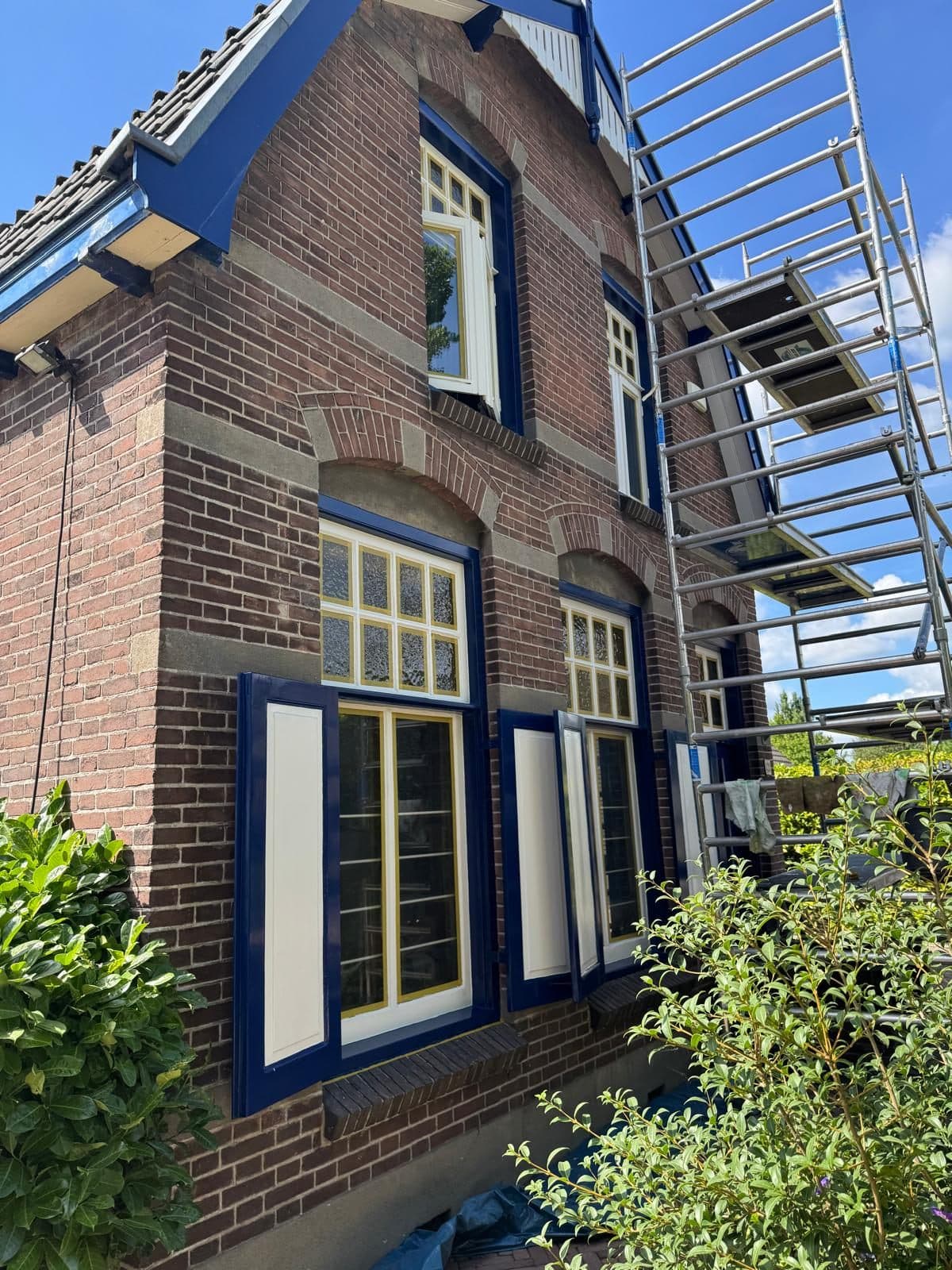
Homeowners
Window frame sealing
Draughts along the window frame, a damp patch under the windowsill or a sealant joint pulling away from the wall. We take the old joint out completely and lay a new one that can handle the movement of the frame.
Since 1959
Experience and craftsmanship from Utrecht
Clear communication
Short lines, clear agreements
100% satisfaction
We only leave once you are satisfied
Lasting quality
Top-quality materials for a long-lasting result
Do you recognise this
When does that sealant joint need to go
There is a draught along the window frame
If you feel cold air where the frame meets the brickwork, there is a gap. The joint has come loose along one of the two flanks. That is called adhesive failure.
The sealant tears down the middle
A tear straight through the middle of the joint is a different story. The joint is then too narrow for the movement it has to accommodate. Refilling does not solve that; widening does.
Damp under the windowsill
A dark edge or flaking paint indoors points to water coming in through the connection joint. Waiting only makes the repair job bigger.
The joint is hard and chalky
Sealant should stay elastic. If you can scrape bits off it with your fingernail, it no longer stretches along and it will crack before long.
Look in winter, not in summer. In the cold the building parts have shrunk and the joint is open at its widest. Only then do you see how big the gap really is.
Why now
What a joint that has come loose costs you
The sealant joint between the window frame and the facade is not a finish. It keeps water out of the structure. If it comes loose, rainwater runs behind the frame and stays there.
In a timber frame, rot then sets in. Often at the bottom, at the bottom rail, where the water collects. Replacing a section of rail or having a frame fitted costs many times more than a new sealant joint.
With plastic and aluminium nothing rots away, but the moisture travels on to the inner leaf of the cavity wall. You see that as damp on the plaster and mouldy skirting boards.
Your paintwork suffers too. Paint on wet timber does not last long. Replacing a sealant joint is the cheapest maintenance there is on a window frame.
Material
Overpaintable sealant or silicone
This is the question that most often goes wrong in do-it-yourself work. Silicone goes in, and a year later the window frame has to be painted.
Silicone sealant cannot be painted over. Paint does not adhere to it, it pulls together and comes loose again. If paint has to go over it, an overpaintable sealant belongs there: acrylic or an overpaintable hybrid.
Acrylic does have a limit. It is not made for prolonged exposure to water, because it slowly dissolves in water. In a spot that really stays wet, silicone or a hybrid belongs.
And there is one material rule that prevents a lot of damage. Silicone that cures with acetic acid does not belong on bare aluminium, copper, zinc, lead, natural stone or concrete. On an aluminium frame it attacks the coating; on concrete it simply loses its adhesion.
We choose the sealant to suit your window frame, your surface and your painting schedule. Do tell us if painting is still to come, and we will take that into account.
Watch for this
The slots in the bottom rail stay open
At the bottom of the bottom rail of a window there are small openings. These are drainage slots. They carry off water that gets into the rebate and they equalise the air pressure in that space.
If they are sealed shut, water stays around the edge of the glass. In insulating glass that attacks the edge seal. The unit fills up and mists on the inside. Then the glass is finished, not the sealant.
The rule of thumb from the facade trade: at least one opening for a rail up to 600 millimetres, two for a longer one. Around 8 millimetres across, or a slot of roughly 5 by 25 millimetres.
In short
If you see that those openings are full of sealant in a house that was sealed before, let us know. We clear them again. We never seal them shut, not even when it looks neater.
Craftsmanship
Width, depth and movement
A connection joint sits between two different materials. Both expand differently in the sun. Plastic moves roughly six to seven times as much as concrete; aluminium sits in between.
That is why this joint in particular has to accommodate a lot of movement. The width follows from that movement, not from what looks good. For an elastic sealant we keep to at least 8 millimetres.
The depth depends on the width: width divided by three, plus 6 millimetres. So a joint 18 millimetres wide becomes about 12 millimetres deep. In the middle the sealant should be thinner than along the flanks.
And a backing rod goes in behind it. A sealant joint may only adhere on two sides, not on three. If it also sticks to the bottom, the middle cannot stretch and it tears on the first cold night. Outdoors we use closed-cell backing rod, because that does not soak up water.
If a previous party laid your joint too narrow, we say so. Refilling it at the same size gives you the same tear a year later.
Older homes
Glazing sealant and putty from before 1994
If your house has been there a while, there may still be old glazing sealant or putty in the rebate. Material from before 1994 is suspected of containing asbestos.
We do not simply cut that out. Cutting out and sanding releases fibres, and that falls under risk class 2. Then the rule is: first an asbestos survey, then a demolition notification, and removal according to protocol by a certified asbestos company.
If in doubt we stop and explain what is needed. That costs you time, but it is the only route that is right. As soon as the old material is gone, we simply seal the window frame.
So scraping it away yourself is not a good idea. Not even with a vacuum cleaner next to you.
What does it cost
You hear the price up front
We price window frames per frame or per linear metre, depending on what is there. The more frames at once, the better the price per frame. Setting up once and travelling out once makes a difference.
What is certain: you get the price before we start. If there turns out to be rot under the old joint, we call you first. We do not carry on and send you a surprise afterwards.
How it goes
From photo to a neat joint
You send a few photos
Through the quote form or by e-mail. One photo of the whole window frame and one close-up of the sealant joint. Do mention roughly what year the house is from.
You get a price
Within 15 minutes on working days. If it is about a lot of window frames, or we have doubts about the surface, we come and look first.
The old joint comes right out
Cutting out down to the surface, remains away, and making the flanks clean, dry and grease-free. Where it is needed we apply a primer. Backing rod in at the right depth.
New joint in, slots clear
The sealant goes in tight and is smoothed off. We check that the drainage slots are open. Sealant cures at about 2 to 3 millimetres per 24 hours, so no sanding or painting for the first few days.
Good to know
Questions we often get
Can I not just run new sealant over the top?
No. New sealant adheres poorly to old, cured sealant. You are then sticking a layer onto something that is already coming loose itself. Within a season the gap is back, only thicker. The old joint has to come out completely.
Can it be done outdoors in winter?
Often yes, but not always. The surface has to be dry and frost-free, otherwise the sealant will not adhere. In wet or freezing weather we would rather move a day than hand over work that does not last.
Can it be painted afterwards?
If you say so up front, yes. Then we lay in an overpaintable sealant. If you say it afterwards, there may be silicone in it and the paint will not hold. So do check it with your painter.
How often should I have this checked?
In the facade trade a check every two years is usual, and the first one within a year of handover. Looking is something you can do yourself: walk along the window frames in winter and watch for gaps and small cracks.
Do you work at height?
Window frames on the first floor and above call for a ladder, scaffolding or a cherry picker. What is needed we determine beforehand, and it is in the price. You will not get a separate item afterwards.
What if something is not right?
You get a 2-year guarantee on the work carried out. What is and is not covered is stated in the quote. This guarantee is in addition to your statutory rights and does not limit them.
Read more

