
Specialist sealant work
Specialist sealant work: the right sealant for each substrate
Natural stone, powder-coated aluminium, plastics, concrete: every substrate calls for a different sealant and sometimes a primer. The wrong choice here is not more expensive but impossible to undo.
Since 1959
Experience and craftsmanship from Utrecht
Clear communication
Short lines, clear agreements
100% satisfaction
We only leave once you are satisfied
Lasting quality
Top-quality materials for a long-lasting result
The core
The substrate chooses the sealant, not the other way round
For an ordinary joint in a bathroom or along a window frame the choice is obvious. As soon as natural stone, bare metal, a mirror or a powder-coated profile is involved, it becomes a trade of its own: then the material decides what may go in, and not whatever happens to be in the cartridge.
What makes this work different from ordinary sealant work is that a mistake here often cannot be undone. A wrong joint in a tiled wall you cut out and do again. A wrong joint on marble leaves behind a dark edge that never comes out.
We work with products from OTTO-CHEMIE and Soudal. Exactly which product goes in differs per substrate and per situation, and that is not hedging but the core of this page.
Specialist finishes
Five types of sealing that take more than a neat joint
These five appear in the strip below our services. They have one thing in common: the joint must not only look neat, it has to do something. Keep air out, stop sound, hold back liquid, stay closed in a fire or take up the movement between two building elements. Below, for each type of sealing: what it is, how we do it and what to look out for.
Airtight sealing
A building rarely loses its heat through the face of a wall, but through the joints in between: around window frames, along the vapour control layer, at service penetrations and where wall and ceiling meet. Airtight sealing is the closing of exactly those connections, so that no air and no moisture can pass. In new build and renovation, and anywhere rooms have to stay separated from one another.
We tie the joint into what is already there: membrane, tape or collar, and over it a sealant that can move with the structure. The connection matters more than the product. If the gap is too wide or too irregular for sealant alone, we say so and a filler or a tape goes in first. A sealant joint is not an airtightness system in its own right.
One open joint behind the finish makes the rest of the work pointless. Air takes the path of least resistance, and warm air that reaches a cold structure settles there as moisture. The envelope is closed at the point where it would otherwise leak, and that is nearly always the connection and not the face itself. That saves cutting into a wall that has already been finished.
Acoustic sealing
Sound follows the same route as air. A partition wall between two offices, two flats or two classrooms can be heavy and well built, but a joint of a few millimetres at the edge simply lets the sound past. Acoustic sealing is the closing of those perimeter connections: wall to floor, wall to ceiling, and around service penetrations and window frames.
We fill the joint over its full depth with a permanently elastic sealant that moves with the structure, so that it does not pull open again at the first shrinkage. In a wide or deep joint a filler goes in first; otherwise the sealant sits only at the front and a cavity is left behind it for the sound to come through.
What matters is that the connection is closed on both sides of the wall, and over its whole length. A joint that is ninety per cent closed is, to sound, an open joint. We often combine this with airtight sealing: the same joints, the same approach, in one pass.
Liquid-tight joints
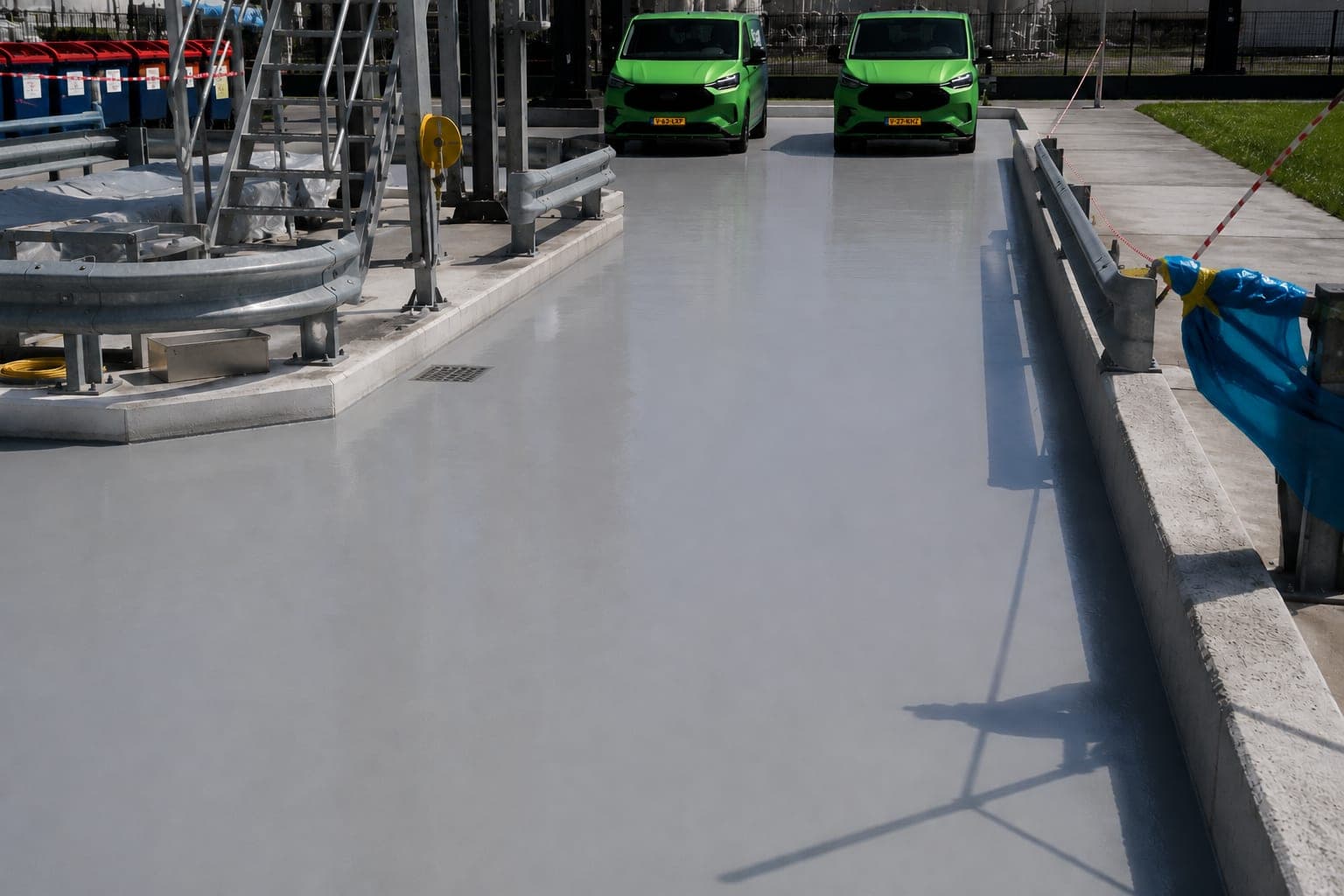
In a workshop, a wash bay, a warehouse, a parking deck or a containment bund, the joint has to do more than be closed. Traffic runs over it, water stands on it, or oil, fuel or a cleaning agent goes across the floor. Liquid-tight joints are joints that stand up to that, in the floor and in the connection to the wall.
We choose the sealant on the basis of what passes over it: traffic, oil, chemicals or standing water. In joints that are walked and driven on, the build-up matters more than the sealant itself: the joint has to take up the movement and carry the load. Where water stands, closed-cell backing rod goes in behind it, because an open cell soaks itself full. A sealant that cannot cope with the agent that goes over it every week will let go sooner or later.
We do the joint work. Assessing a liquid-tight floor is a separate inspection by an inspector, and that is not something we do. We say so up front, so you know where our work stops and where the inspection begins.
Fire-resistant sealing
We apply fire-resistant joints and seals on business projects: the connections of partition walls, the joints around service penetrations and the joints between building elements that have to stay closed in a fire.
Such a joint is not a type of sealant but a tested system: a particular sealant, in a particular build-up, in a particular wall, applied according to the instructions that go with it. Which system goes in therefore depends on the wall and on the fire resistance the building needs.
If that is set out in your specification or in the advice from your fire safety consultant, send it with your request. Then you know in advance where you stand, and we work with the system that belongs to your building rather than with an assumption.
Structural connections
Wherever two building elements meet, a joint appears that moves: window frame against facade, precast concrete against masonry, a parapet against a frame, timber against stone. Every material expands differently in the heat and shrinks differently in the cold, so it is precisely the connection between two different materials that takes up the most movement.
We calculate the joint width from that movement and not by eye, and build the joint up with backing rod and a sealant that can handle the calculated deformation. That keeps the connection closed in summer and in winter, when the building elements have shrunk and the joint stands at its widest.
A crack in the middle of the joint means the joint was designed too narrow; refilling it solves nothing, that joint will crack again. Coming away along the edge has a different cause and calls for a different approach. If a connection is too narrow ever to stay elastic, we say so up front, and not after it has opened for the second time.
Food industry
Food-grade sealant work: the joint has to be cleanable
Hygienic wall panels in a butchery, dairy plant, bakery or commercial kitchen are not sealed all round for the looks of it. An open joint between two panels is exactly the place where moisture and food residue creep in behind and where bacteria and mould settle. The joint should therefore be just as smooth, closed and washable as the panel itself.
What makes this specialist is the load: daily cleaning and disinfecting with agents that an ordinary sanitary sealant is not made for. So what belongs here is a sealant for which the manufacturer expressly declares that it is suitable for the food industry and resistant to those agents, and, where contact with food is possible, a product that has been tested for that. Which one that becomes depends on the room and the cleaning regime; we ask about that at the site survey.
Natural stone
A dark edge on marble never comes out again
Ordinary silicone sealant contains free plasticisers. On a porous stone they draw into the edge zone and cause a dark discolouration there: edge zone staining. The sting is in the delay: often it only shows after weeks, long after the sealant applicator has left.
Polishing does not help, because it is not on the stone but in it. Aggressive cleaning makes it worse. The only solution is prevention: a natural stone sealant with chemically bound plasticisers, and if in doubt a test piece in an inconspicuous spot first.
Sensitive
Marble, travertine, limestone and other porous types. The more open the structure, the faster it draws in.
Also take care
Granite and composite are denser, but there too: first the data sheet, then the cartridge.
Never
Acetoxy silicone. That does not belong on natural stone at all, not even “just quickly”.
Choice of material
Where acetoxy silicone does not belong
Acetoxy silicone sealant is the most common type and on tiling it is fine. On these materials it is not, and with the first three the damage is permanent:
Paint and water
Paintable and water-resistant do not go together
Does paint have to go over it
Then no silicone. Paint does not bond to it and comes off again in flakes. Acrylic or a paintable hybrid belongs in such a spot. Think of a joint along a painted window frame or against a plastered ceiling.
Does water stand on it for long
Then no acrylic. That disperses under prolonged exposure to water. In a wet room silicone or a hybrid with a fungicide in it belongs.
If painting work is planned, agree the order in advance. With paintable sealant we seal first and the painter paints over it; with silicone it is the other way round. The wrong way round means doing it again.
Bespoke work
Tight spots and unusual details
A joint behind a pipe, a connection inside a shaft, a detail in an interior fit-out project that no standard gun can reach: that is part of specialist work too. Usually it is not a question of harder sealing but of being able to get to it first.
In interior fit-out and furniture making the finish comes on top of that. A joint in plain sight has to be crisp and the right colour. We would rather put down a test piece first than end up afterwards with a joint that turned out too light.
Our approach
First the data sheet, then the cartridge
With a request we always ask about the substrate on both sides of the joint, whether there is movement in it, and whether paint has to go over it. For outdoor work the year of construction comes into it, because sealant from before 1994 is suspected of containing asbestos.
On that basis we choose the type of sealant and decide whether a primer is needed. On a sensitive substrate we put down a test piece. The work carried out comes with a 2-year guarantee; what is and is not covered is set out in the quote.
If we are not sure, we say so and check it with the manufacturer. That costs a day and saves a joint that has to come out again.
Frequently asked questions
Questions about choosing a sealant
Which sealant belongs on natural stone?
A natural stone sealant, with chemically bound plasticisers. Ordinary silicone sealant contains free plasticisers that draw into the pores and leave a dark edge, often only visible after weeks and by then impossible to polish out. That is called edge zone staining and it cannot be undone. Marble, travertine and limestone are the most sensitive to it.
Can acetoxy silicone sealant go on anything?
No. Acetoxy silicone does not belong on bare aluminium, copper, zinc, lead, mirrors, marble, natural stone, concrete or polycarbonate. On mirrors it attacks the silver backing, on alkaline concrete it loses its adhesion, and on soft metals it can cause corrosion. If you smell vinegar when you open the cartridge, this is the type you have.
Can I paint over silicone sealant?
No. Paint does not bond to silicone and comes off again in flakes. If paint has to go over it, for instance along a painted window frame or ceiling, acrylic or a paintable hybrid belongs there. The reverse also holds: acrylic is unsuitable for prolonged exposure to water, because it disperses. So in a wet room silicone or a hybrid with a fungicide belongs.
What does ISO 11600 class 25 mean?
That is a test result and not a design value. It says that the sealant withstood 25 per cent deformation under test conditions, not that you may calculate with that figure in a facade. For the dimensions you take the maximum permissible deformation from the manufacturer's data sheet.
Why do you always ask about the substrate?
Because the substrate decides which sealant can go in and whether a primer belongs with it. Powder-coated aluminium, plastics, natural stone, concrete and timber all behave differently. A joint on the wrong substrate lets go, and that costs more than asking about it beforehand.
Do you do sealant work in the food industry?
Yes. Hygienic wall panels, wall-to-floor connections, corners, door frames, skirting boards and service penetrations in production areas, cold stores and commercial kitchens are sealed with a sealant for which the manufacturer declares suitability for the food industry. For each project we record which product was used, with the data sheet and the declaration, so that it fits your hygiene file.
Is a sanitary sealant with a fungicide not enough for a kitchen?
For a domestic kitchen it is. In a commercial kitchen or a production area it is not: there, cleaning and disinfecting agents go over the wall every day that such a sealant is not made for, and where contact with food is possible the manufacturer has to declare suitability for that. That is a different product and a different build-up.
Do you also work in tight or hard-to-reach places?
Yes, that is part of this work. Think of a joint behind a pipe, a connection inside a shaft or a detail that no standard gun can reach. Send a photo of the situation with your request, and the right approach is in the price straight away instead of in a surprise afterwards.
Read more

