
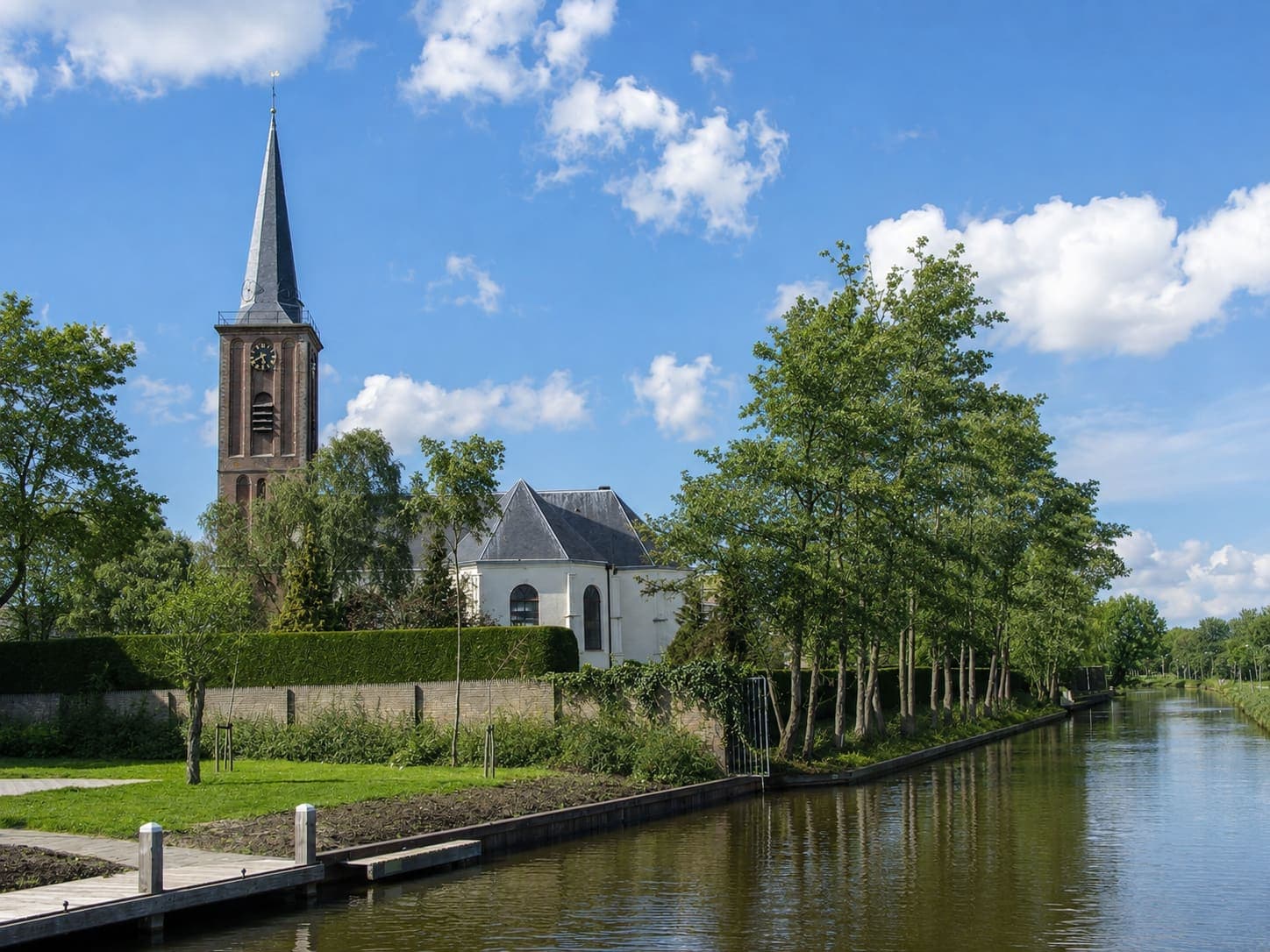
Utrecht · approx. 30 km from Utrecht
Sealant work in Mijdrecht
Mijdrecht lies in a drained lake: land won by pumping peat lakes dry, and which therefore lies metres below sea level (NAP). The ground is soft and moves. For sealant work that is the decisive fact: where a building moves with the ground, the joint has to be able to follow that movement without tearing open.
Since 1959
Experience and craftsmanship from Utrecht
Clear communication
Short lines, clear agreements
100% satisfaction
We only leave once you are satisfied
Lasting quality
Top-quality materials for a long-lasting result
What matters in Mijdrecht
Building below sea level
A village centre with post-war extensions of terraced housing, new build on the edges and a sizeable business park with large-scale industrial units.
The residential districts around the centre are largely post-war and built in series, with rows of identical homes that have the same window frames and the same original sealant. That sealant has now reached the end of its life, and anything dating from before 1994 is suspected of containing asbestos until testing shows otherwise. On the edges stands younger housing where the sealant applied at handover is due for its second life. The business park is strikingly large for a place of this size; there you find industrial units with facade cladding and concrete elements, and the work is about long expansion joints rather than individual joints around window frames.
What makes Mijdrecht different from a village on higher ground is the combination of soft ground and a lot of uniform housing. The ground movement calls for wider joints than you would use on sand; the uniformity, on the other hand, makes the work predictable, because what is going on at one home is going on next door too. That makes commissioning the work together almost automatically attractive here.
In the residential districts parking is no problem: wide streets, parking courts, and we usually stand right outside the door. On the business park we look in advance at the height of the facade and whether equipment can get onto the site. A unit eight metres high calls for an aerial work platform, and whether that can be positioned there determines the lead time more than the sealant work itself. We settle that before we fix a date.
Thirty kilometres by road, about half an hour. For a bathroom or a set of window frames that is fine; for one single joint a minimum charge applies, which you are told in advance. For business work on the business park the distance is not a factor of any significance, because there it is a matter of several consecutive days rather than one visit.
What we do in Mijdrecht
- Bathroom, sanitary & kitchenSealing of sanitary ware, showers, baths, washbasins and kitchens.
- Window frames & glazingNeat, durable sealant work around window frames and glass.
- Facades & structural jointsFacade joints, connection joints and expansion joints in floors and walls.
- Swimming pool & wellnessSealant work in swimming pools, saunas, steam rooms and spas.
- Renovation & maintenanceSealant work during renovation, repairs and periodic maintenance.
- Specialist sealant workFor specific requirements and specialist applications.
You will hear from us within 15 minutes on working days, and the work comes with a 2-year guarantee.
The work here
What we do most often in Mijdrecht
Joints on soft ground
Where the ground moves, a building slowly deforms with it and that shows up at the connections. At the site survey we measure how much movement is to be expected and derive the joint width from that; a wider joint stretches over more millimetres than a tight one. What sealant does not do is hold back a structure. It follows it.
More about this serviceIndustrial units on the business park
Large industrial units have facade cladding or concrete elements that expand considerably in the sun, with joints that run across the full width of the facade. There, adhesion to a smooth, coated surface is the sticking point: an ordinary facade sealant does not get a lasting grip on it. We choose the product for the material and not out of habit.
More about this serviceBathrooms in the terraced housing
In the post-war homes the sealant around the bath and shower is often older than the sanitaryware itself. Dark edges are mould in the material and not on it; it grows back as long as the old joint stays in. We take it out, let the corner dry completely and only then apply a sanitary sealant that can cope with daily use.
More about this serviceHow we approach it here
Which sealant on what, and what it costs
The substrate decides the sealant
At the homes it is usually painted timber or brickwork. On painted timber the sealant adheres to the paint layer and not to the timber underneath, so we check whether that layer is sound and otherwise take it back to sound material. Brickwork from the post-war period is generally hard enough to do without a primer, but the cut face has to be clean and free of dust. On the business park the requirements are different: coated steel and facade cladding are smooth and expand strongly in the sun, which calls for both adhesion and stretch, and concrete elements are alkaline and dusty at the cut face. Because the ground here moves, for everything that sits outside we choose stretch over hardness: a stiffer product does not last as long on this ground.
Costs and lead time
The price follows from metres, accessibility and removing what is there. At homes that last part is often the largest share of the work, especially if the original sealant is still in; it does not come out in one pull. For buildings dating from before 1994, asbestos testing comes before the quote for the work itself. On the business park we charge per metre, which makes the budget predictable. For a bathroom, as a rule allow half a working day. What the sealant needs to cure through is separate from the working time; you get that period when the work is scheduled, so you can count on it.
Two routes
Business or homeowner in Mijdrecht
For businesses on the park here, this is work that is easy to schedule: long runs, repeatable details and a fixed price per metre. We check in advance whether we can work at height with equipment that fits on the site, because that determines the lead time. For managers of housing stock in the centre it is about complexes of identical homes, where one site survey is enough for a whole row. In both cases we hand over images, per address or per facade, of what has been carried out.
For businesses
Contractors, painters, homeowners' associations, property managers and interior fit-out.
See what we do for businessesAlso near Mijdrecht
As the crow flies from the centre. By road it is further.
- Breukelen 10 km
- Woerden 14 km
- Maarssen 14 km
- Amsterdam 17 km
- Alphen aan den Rijn 18 km
Is your town or city not listed? See the whole service area.
Questions from Mijdrecht
What people in Mijdrecht ask most often
What does building below sea level (NAP) mean for my facade?
Mainly that the ground is soft and keeps moving. In a drained lake the ground has gone on subsiding since it was drained, and that process does not stop by itself. A building that stands on it slowly deforms with it, and that deformation shows up in the joints between building components. It does not mean there is something wrong with your house; it means the joints have to be wider than on firm ground and that they are due for replacement sooner.
Is it worth having the whole row done at the same time?
More often here than elsewhere, because the homes were built in series and so are due for replacement at the same time. The fixed part of the price (call-out, unpacking, masking, clearing up) you pay once if we do several addresses on the same day. With three or four homes that makes a noticeable difference per house, and the work goes faster because after the first home we know what we will come across. Mention it when you make your request.
Why a different product on an industrial unit?
Because the material is different and the movement greater. Facade cladding and coated steel are smooth: an ordinary facade sealant does not adhere to them for long. On top of that, large metal surfaces expand considerably in the sun, so the joint between them makes a far greater movement than a joint between two bricks. That calls for a product that both grips that surface and can cope with that stretch. We choose based on material and load, not on what happens to be in the van as standard.
How do I know whether I need joints or something else?
We tell you honestly at the site survey, even if the answer is that sealant is not the solution here. Sometimes a connection should not have a sealant joint but a lead flashing or another building detail, and then we do not solve the problem by putting sealant in; we only postpone it. We would rather say that in advance than have you get the same leak again in two years and pay for the work a second time.
How long do I have to wait after the shower has been sealed?
Two days, and that is chemistry, not caution. Sealant cures from the outside in, roughly two to three millimetres per 24 hours, and a sanitary joint is about six millimetres deep. The outside feels dry after a few hours, while the core is not yet up to strength. Water on it during that period loads the joint precisely when it can least take it. We tell you in advance so you can plan for it.

