
Zuid-Holland · approx. 50 km from Utrecht
Sealant work in Alphen aan den Rijn
In some places in Alphen the ground sinks more than three centimetres a year. Many houses here stand on piles and stay where they are; the garden, the patio and the extension do sink. Every joint in between has to take that difference, and that is where the sealant work here begins.
Since 1959
Experience and craftsmanship from Utrecht
Clear communication
Short lines, clear agreements
100% satisfaction
We only leave once you are satisfied
Lasting quality
Top-quality materials for a long-lasting result
What matters in Alphen aan den Rijn
The house stays put, the garden sinks
Grown fast from the 1950s onwards on soft ground: peat in the polders, sand and clay on the natural levee along the Oude Rijn. Deck-access flats and terraces from the 1960s and 1970s, new build from 1990 onwards south of the railway, and old ribbon developments along the Oude Rijn.
Ridderveld was built from the mid-1960s onwards, with deck-access flats leading the way: bathrooms that are due for their second or third sealant round. Kerk en Zanen was added from 1990 onwards south of the railway, full of plastic window frames whose connection joints are now getting on in years. Oudshoorn, the Hoge and Lage Zijde and the ribbons of Zwammerdam and Aarlanderveen are older and have painted timber. If such a frame dates from before 1994, the glazing sealant is suspected of containing asbestos and we cut nothing out.
Where the ground sinks, the municipality raises the public street. Not private land: that is up to the owner. So the house stays put on its piles while garden, patio and driveway sink away, and the difference in height at the front door grows every year. How wide that joint has to be follows from that movement and not from what the eye finds pretty.
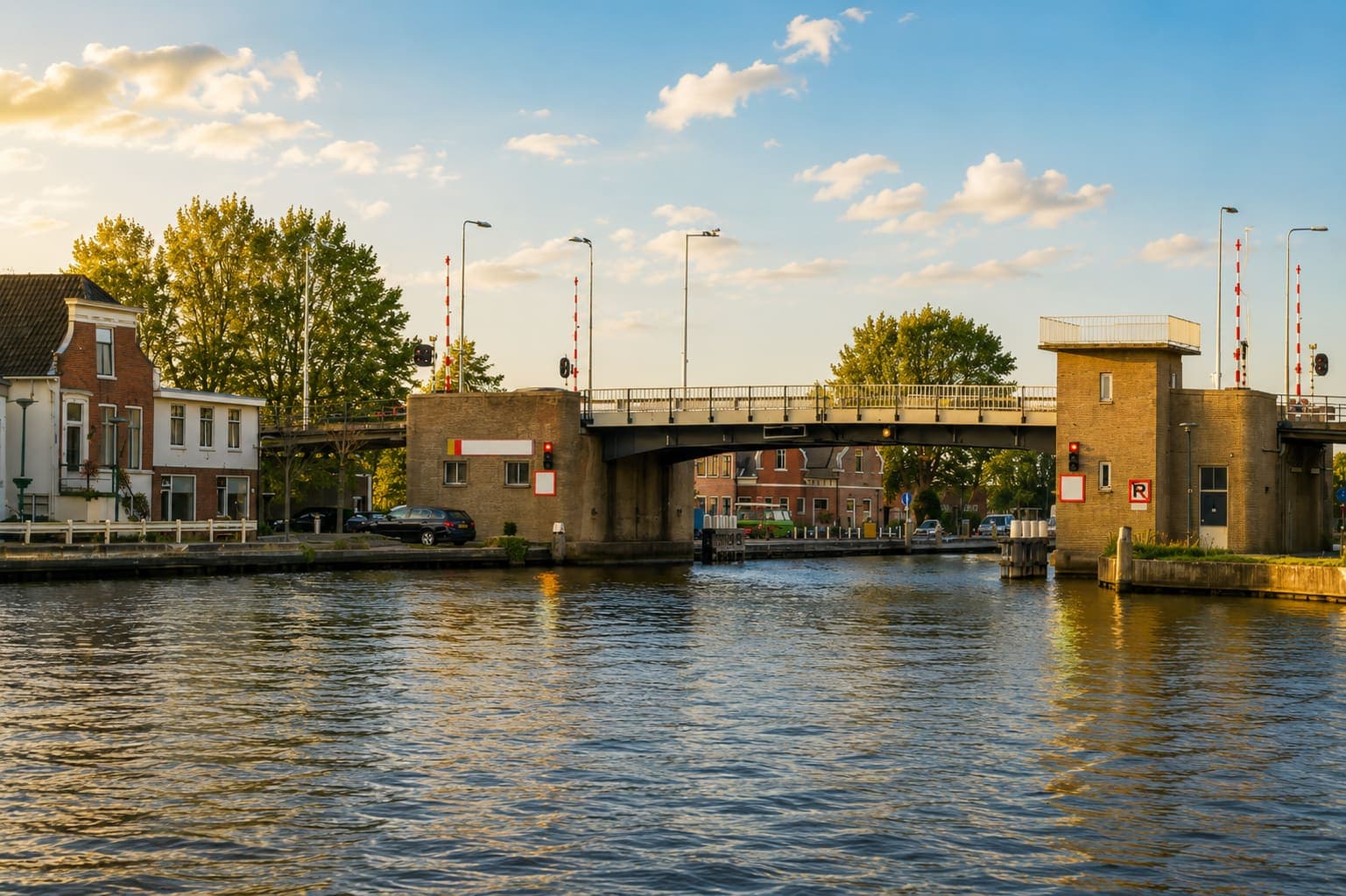
The Oude Rijn cuts the town in two and most of the bridges over it open for shipping. If we are on the wrong bank, a forgotten cartridge costs ten minutes. Boskoop hangs on one lift bridge from the 1930s; beyond it lie narrow nursery roads where you drive at walking pace and cannot simply turn round.
Fifty kilometres or so by road, via the A12 and the N11. That is an ordinary morning drive. Several addresses or rooms are best put in one request: that makes a difference to the price per metre. Send us your measurements and you get a reply within 15 minutes on working days.
What we do in Alphen aan den Rijn
- Bathroom, sanitary & kitchenSealing of sanitary ware, showers, baths, washbasins and kitchens.
- Window frames & glazingNeat, durable sealant work around window frames and glass.
- Facades & structural jointsFacade joints, connection joints and expansion joints in floors and walls.
- Swimming pool & wellnessSealant work in swimming pools, saunas, steam rooms and spas.
- Renovation & maintenanceSealant work during renovation, repairs and periodic maintenance.
- Specialist sealant workFor specific requirements and specialist applications.
You will hear from us within 15 minutes on working days, and the work comes with a 2-year guarantee.
The work here
What we do most often in Alphen aan den Rijn
Extension, patio and driveway
The house stands on piles and stays put. An extension on short piles, a patio or a garden wall sinks along with the peat. All that difference ends up in one joint. Joint width there follows from the movement: at least 8 mm, depth is width divided by three plus 6 mm. Without a backing rod the joint adheres on three sides and cracks.
More about this serviceBathrooms in Ridderveld
The flats and terraces from the 1960s and 1970s are due for their second or third sealant round. Under the old joint there is then usually still a remnant of the previous one, and that has to come out completely before new sealant goes in. Acrylic does not belong here, because it disperses under prolonged exposure to water. So silicone or hybrid with fungicide.
More about this servicePlastic window frames in Kerk en Zanen
The new build from 1990 onwards is full of plastic window frames. PVC expands roughly seven times as much as concrete: 70 to 80 millionths per degree against 10 to 12. The connection joint between frame and facade takes that whole difference and is therefore the first to come loose along the flank. Laid too narrow, no sealant keeps that up.
More about this serviceHow we approach it here
Which sealant on what, and what it costs
The substrate decides the sealant
What comes under the knife here differs by year of construction. The bathrooms from the 1960s and 1970s have glazed tiling: dense and smooth, so the preparation counts for more there than the brand on the cartridge. The new build south of the railway has plastic window frames and powder-coated aluminium facade frames, and no acetoxy silicone goes on bare aluminium. Access deck floors, concrete sills and industrial floors are concrete, and concrete is alkaline. On such a substrate acetoxy sealant loses its adhesion. In the ribbons along the Oude Rijn it is painted timber, and paint does not go over silicone: then it becomes acrylic or a paintable hybrid. If there is natural stone on a worktop or window sill, then natural stone sealant only. Edge-zone staining draws into the pores and never comes out again.
Costs and lead time
The price is per linear metre, with a sliding scale based on the size of the job. Here that sliding scale hangs on the bridges. A single joint therefore works out expensive per metre; a whole deck in Ridderveld or a whole housing block in Kerk en Zanen spreads the costs over many more metres. One single joint carries such a day on its own. The bathrooms of a whole deck in Ridderveld, or the window frames of a whole housing block in Kerk en Zanen, spread it over many more metres. So sign up together with your neighbours, or put all the rooms in one request. You will not read an amount here, because the rates have not been fixed yet; you get a quote on your own measurements. Replacing costs more than new, and in Ridderveld it is almost always replacing: those bathrooms are due for their second or third round, and getting the old sealant out completely is most of the work. Allow for the curing, 2 to 3 millimetres per 24 hours. At home that is two days without showering. For a wash-down area in Boskoop or an industrial floor on the Heimanswetering it means we lay the joint on the day the room is idle anyway. The work comes with a 2-year guarantee. What a guarantee cannot cover is the movement of the structure itself: settlement falls outside the guarantee in our terms and conditions. That is why the quote begins with measuring: how much does it move here, and how wide does the joint then have to be.
Two routes
Business or homeowner in Alphen aan den Rijn
Business sealant work in Alphen sits in three corners. The business parks Rijnhaven, Heimanswetering and Molenwetering: industrial units, concrete floors and connections that move along on sinking ground. Boskoop with its ornamental horticulture: processing rooms, wash-down areas and cold stores, where a joint has to stand up to water and cleaning agents. And housing: painters, contractors and managers of blocks of flats have sealant work in their projects and often outsource it to a specialist. That is what we focus on. If we work as a subcontractor, we apply the VAT reverse charge.
For businesses
Contractors, painters, homeowners' associations, property managers and interior fit-out.
See what we do for businessesAlso near Alphen aan den Rijn
As the crow flies from the centre. By road it is further.
- Zwammerdam 5 km
- Koudekerk aan den Rijn 5 km
- Boskoop 5 km
- Hazerswoude-Rijndijk 5 km
- Bodegraven 8 km
- Gouda 13 km
- Leiden 13 km
- Woerden 15 km
Is your town or city not listed? See the whole service area.
Questions from Alphen aan den Rijn
What people in Alphen aan den Rijn ask most often
The street has been raised and our garden has not. Now there is a joint gaping along the facade.
You can close that, but not just like that. First the question of how much it is still moving: the municipality writes that the ground here sinks more than three centimetres a year in some places, and that movement determines the joint width. If there is now a crack in the middle of the sealant, the joint was designed too narrow. Refilling does not solve that: the joint has to be wider. We seal from 8 to 30 mm. If we measure more, we say so in advance, because above that it is no longer sealant work. Up to 30 mm it is sealant work; above that the joint calls for a different system.
Do you also come to Boskoop, Hazerswoude and Koudekerk?
Yes, those villages have been part of the same municipality since 2014 and lie on the same drive. Boskoop is reached over one lift bridge, though, and beyond it lie narrow nursery roads. If you have several addresses or rooms, put them in one request; that makes a difference to the price per metre.
The joint around our plastic window frames is coming loose everywhere. Is that bad sealant work?
Not necessarily. Coming loose along the flank is called adhesive failure: the sealant comes away from the substrate, and the usual cause is a flank that was not clean or not degreased. That is different from a crack in the middle of the sealant; that points to a joint designed too narrow for the movement. And a plastic window frame moves a lot: PVC expands roughly seven times as much as concrete. So we first look at where it is coming loose, because that determines whether it was down to the preparation or to the size.
How long do I have to wait before I can shower again?
Count on two days. Sealant cures at roughly 2 to 3 millimetres per 24 hours at 20 degrees and 50 per cent humidity, and a sanitary joint is at least 6 millimetres deep. Then switch the ventilation on and keep it on: for a new-build bathroom the requirement is 14 dm³/s. And do not use bleach on the joint. That washes the anti-mould agent out and makes the edge porous.
Since our patio sank, water runs under the back door. Can we seal that sill shut?
The joint along the sill, yes; the little slots in the sill, no. Those openings drain water out of the rebate and equalise the pressure. If you seal them shut, water stays standing in the rebate and in time that wrecks the insulating glass. A sill up to 600 mm should have at least one opening of 8 mm round or 5 by 25 mm. We leave those open.

