
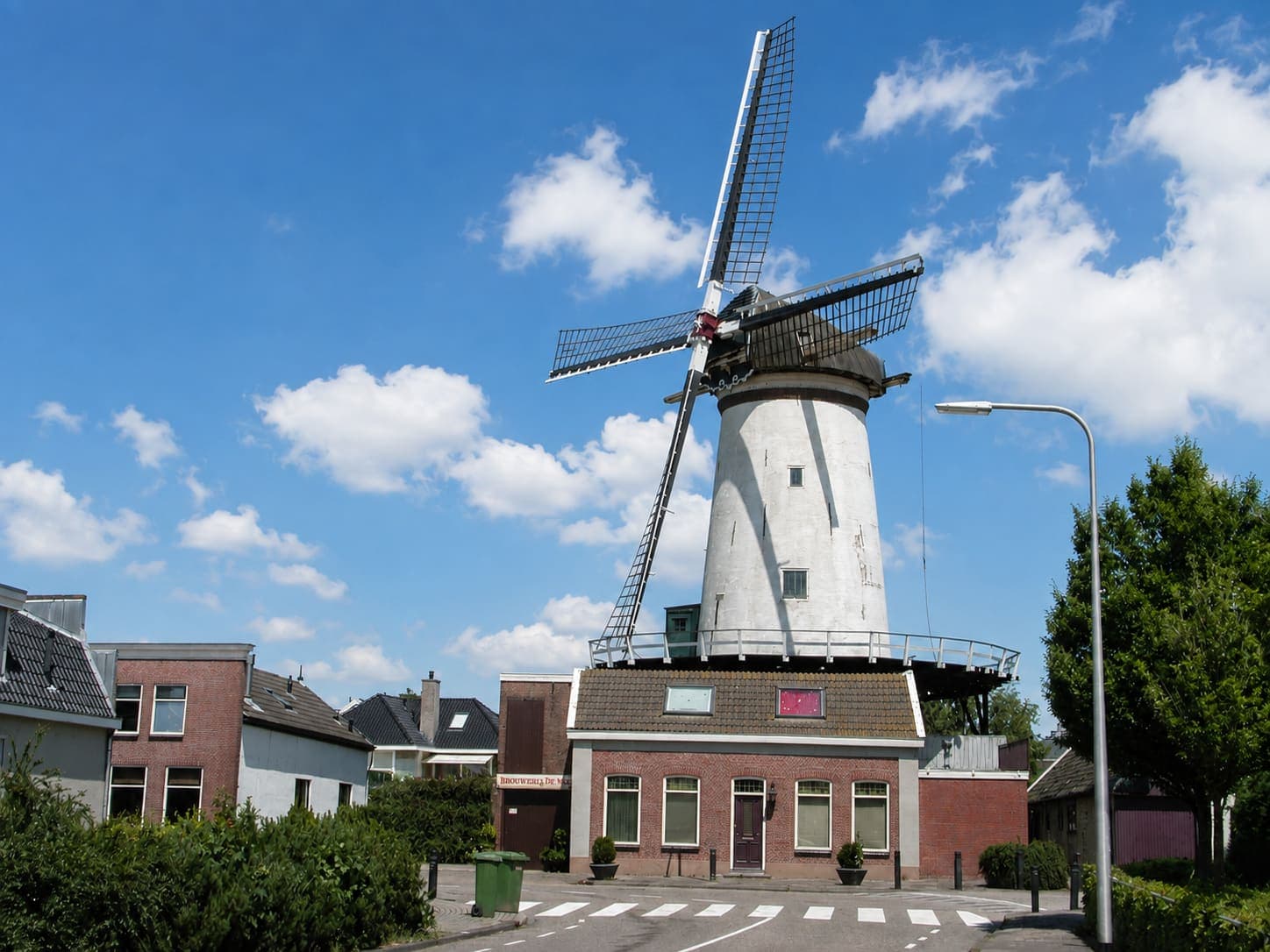
Zuid-Holland · approx. 35 km from Utrecht
Sealant work in Bodegraven
Bodegraven lies in the peat meadow area along the Oude Rijn. Peat compacts: it sinks, year after year, and not everywhere at the same rate. That is not a curiosity but the daily reality of every facade here. How much a building moves determines how wide the joint has to be — and here that is almost always more than on sandy ground.
Since 1959
Experience and craftsmanship from Utrecht
Clear communication
Short lines, clear agreements
100% satisfaction
We only leave once you are satisfied
Lasting quality
Top-quality materials for a long-lasting result
What matters in Bodegraven
Peat sinks, and the facade shows it
Ribbon development along the Oude Rijn, a village centre with older buildings, post-war residential areas and business parks with large-scale buildings.
Along the old ribbon stand buildings of varying age, some founded on timber piles, with timber window frames and old glazing. In the post-war residential areas there are terraced houses whose original facade sealant is well past its service life; anything from before 1994 counts as suspected of containing asbestos until testing shows otherwise. On the business parks the scale is different: long facades with profiled steel cladding or concrete elements, where expansion joints run for tens of metres at a stretch and where a single wrong width takes its toll over that entire length.
The decisive difference from a place on sand is that here the ground itself is moving. With uneven settlement, one side of a facade drifts away faster than the other, and that deformation shows up in the joints. That is why we first measure where and how much movement there is, and derive the joint width from that. A narrow, neat joint that tears open within a year is not a saving but double the work.
In the ribbon along the Oude Rijn the road is narrow and there is little room to park a van without obstructing traffic; we arrange that in advance. In the post-war areas we simply park outside the door. On the business parks we look in advance at the height and at whether an aerial work platform can get onto the site, because that determines both the schedule and the price.
Thirty-five kilometres by road, three quarters of an hour's drive. For a single joint that is on the long side, so a minimum charge applies there, which you are told in advance. For a bathroom, a set of window frames or business work it is perfectly doable. We like to schedule Bodegraven together with Woerden or Harmelen, because they lie on the same route along the Oude Rijn.
What we do in Bodegraven
- Bathroom, sanitary & kitchenSealing of sanitary ware, showers, baths, washbasins and kitchens.
- Window frames & glazingNeat, durable sealant work around window frames and glass.
- Facades & structural jointsFacade joints, connection joints and expansion joints in floors and walls.
- Swimming pool & wellnessSealant work in swimming pools, saunas, steam rooms and spas.
- Renovation & maintenanceSealant work during renovation, repairs and periodic maintenance.
- Specialist sealant workFor specific requirements and specialist applications.
You will hear from us within 15 minutes on working days, and the work comes with a 2-year guarantee.
The work here
What we do most often in Bodegraven
Expansion joints on commercial facades
On long facades, expansion joints sometimes run for tens of metres without a break. Every deviation in width adds up there, and on sinking ground the deformation comes on top of that. We measure the movement to be expected and derive the dimension from that, and work in sections so that the joint stays the same width over its entire length.
More about this serviceConnection joints on houses
On sinking ground, the joint between window frame and brickwork is the place where it first becomes visible. It comes loose on one side or tears through the middle, and then water runs down behind the frame. We take it out, cut the flanks back to a sound substrate and put in a width that matches what we have measured.
More about this serviceBathroom and kitchen
Indoors the ground plays no part, but use matters all the more. Around the shower tray, bath and worktop the sealant is permanently exposed to water and heat. Discolouration in the corners means mould growth in the material itself; cleaning will not get it out. The joint comes out, everything is dried, and a sanitary sealant goes in.
More about this serviceHow we approach it here
Which sealant on what, and what it costs
The substrate decides the sealant
For the choice of sealant, both the flank and the load count here. On houses you encounter painted timber and brickwork: on painted timber the sealant bonds to the paint layer, so if that is loose, the joint comes off with it; on older brickwork the suction can be so high that a primer has to go on first. On the business parks the substrates are different. Concrete elements are alkaline and dusty at the cut face and call for a clean, sometimes pre-treated flank. Coated steel and profiled cladding are smooth and expand strongly in the sun; an ordinary facade sealant does not bond to them permanently. And because the ground moves, in all cases we choose a product with sufficient elasticity rather than the hardest one there is.
Costs and lead time
What you pay is made up of metres, accessibility and the time it takes to remove what is there. For business work with long runs we charge per metre and the budget is predictable; for houses it depends more on what appears from under the old joint. If that dates from before 1994, asbestos testing comes first and you only hear the price for the work after that. A bathroom is usually done in half a day. Curing has its own separate period, independent of the working time; you get that with the schedule so you know when everything can be used again.
Two routes
Business or homeowner in Bodegraven
For us, the business parks here are the most characteristic work: long facades, large-scale elements and expansion joints that run on for tens of metres. That calls for a fixed price per metre and for someone who matches the width to the movement rather than to what was there. We work as a subcontractor within a larger maintenance project or take on the sealant part alone. For managers of housing stock we deliver a visual record per address, so that what was carried out can be accounted for.
For businesses
Contractors, painters, homeowners' associations, property managers and interior fit-out.
See what we do for businessesAlso near Bodegraven
As the crow flies from the centre. By road it is further.
- Woerden 8 km
- Harmelen 12 km
- Gouda 10 km
- Alphen aan den Rijn 9 km
- Montfoort 16 km
Is your town or city not listed? See the whole service area.
Questions from Bodegraven
What people in Bodegraven ask most often
Is my house really sinking, or is that just a story?
In the peat meadow area, subsidence is a measured fact and not a story. Peat compacts when it is drained, and that continues as long as the water level stays low. What it means for your home depends on the foundation: if it stands on piles down into the sand layer, the house stays put while the ground around it sinks. If it does not, it sinks along with the ground — and rarely at the same rate everywhere. Both situations show up in the joints, but in a different way.
Why do you make the joint wider than it was?
Because the width should follow from the movement, not from what happened to be in there. A sealant joint can stretch by a percentage of its own width; if the movement is greater than that, it tears or lets go at a flank. On ground that sinks, the movement is greater than on sand, so the required width is too. We measure that during the site survey and explain why the figure is what it is.
Do you also do commercial buildings on the business park here?
Yes, and that is work for which the drive here is worthwhile in any case. On the business parks it comes down to long facades of concrete or profiled steel cladding, with expansion joints that run on for tens of metres. A fixed price per metre suits that, and the schedule can be set well in advance. We check beforehand whether we can reach the height with what fits on the site, because that determines the lead time more than the sealant work itself.
Can I do it myself with a cartridge from the DIY shop?
For a small indoor job sometimes, outdoors almost never. The difference is not in the application but in the preparation: the old joint completely out, the flanks clean down to a sound substrate, the right width and depth, and a product that suits that substrate and that movement. If one of those four goes wrong, the new sealant lets go and you will soon have two layers to remove instead of one. That costs more than outsourcing it.
Do you charge a call-out fee to Bodegraven?
You see it in advance rather than afterwards: the first fifteen kilometres from our base in Utrecht are included in the price, and the price calculator adds the kilometres beyond that straight away. Thirty-five kilometres is on the long side for one single joint, so a minimum charge applies there; for a bathroom or a set of window frames it is perfectly doable. If you want to keep that item down, combine several jobs in one visit or coordinate with a neighbour. Then we drive once for two addresses and you share those costs.

