
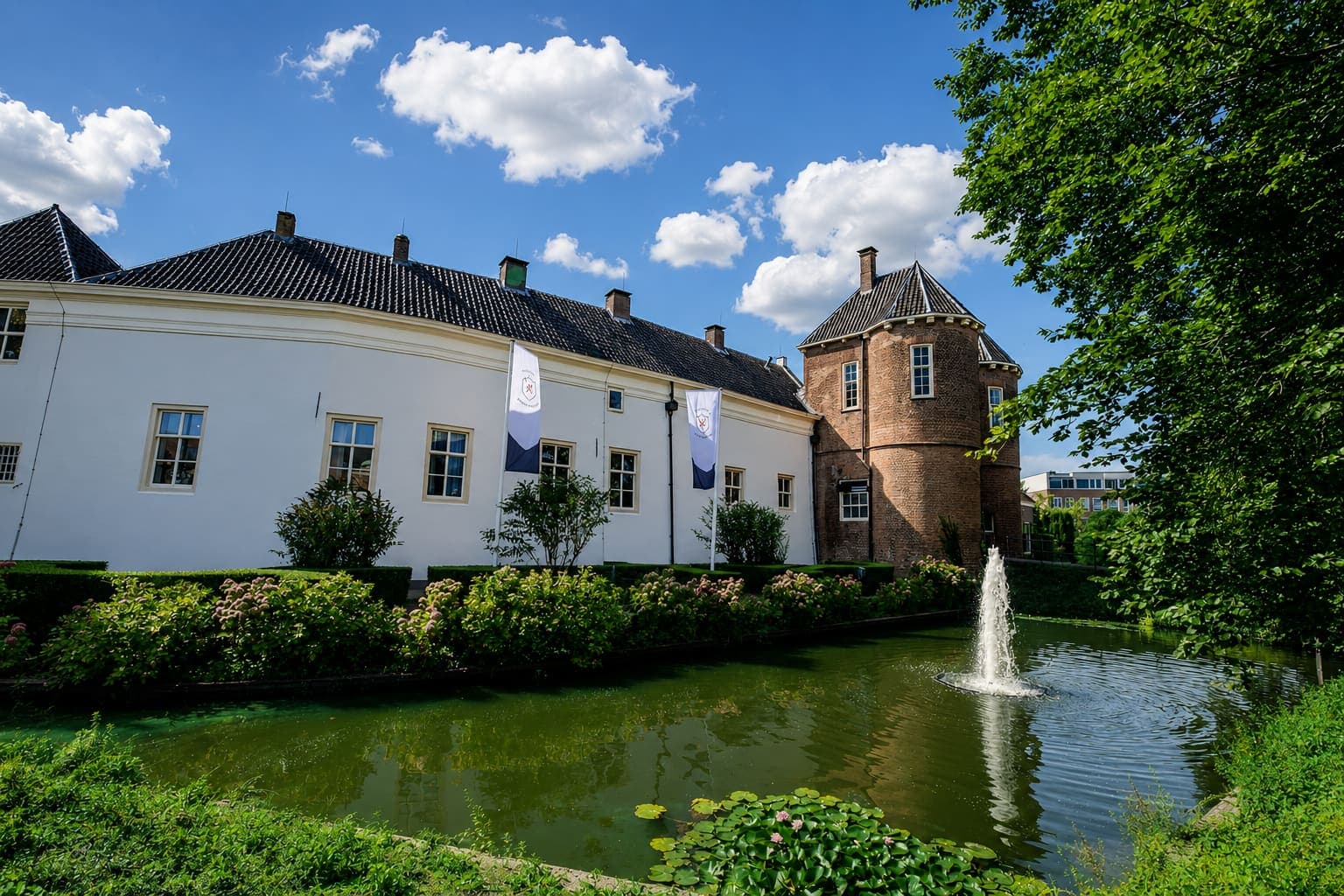
Utrecht · approx. 20 km from Utrecht
Sealant work in Montfoort
Montfoort is a small old town on the Hollandse IJssel, built on peat. For sealant work that combination is trickier than it looks: the historic buildings call for restraint in what you apply, while the sinking ground calls for wider joints. Those two requirements have to come together on the same building.
Since 1959
Experience and craftsmanship from Utrecht
Clear communication
Short lines, clear agreements
100% satisfaction
We only leave once you are satisfied
Lasting quality
Top-quality materials for a long-lasting result
What matters in Montfoort
Historic centre on soft ground
A historic centre with listed buildings and a town gate, ribbon development along the water, and post-war residential neighbourhoods on the edges.
In the historic centre there are buildings with timber window frames, putty and old glazing; parts of it fall under a protected townscape, so what is permitted is established first before we choose a product. The brickwork there is soft and porous and sometimes sits in lime mortar. The post-war neighbourhoods around it were put up in rows and are well past the first replacement round for their facade sealant; anything dating from before 1994 is suspected of containing asbestos until testing shows otherwise. Along the water there is ribbon development where the settlement is most clearly visible in crooked window frames and joints pulling apart.
What sets this place apart is that old buildings on soft ground have undergone more movement than their builders ever foresaw. As a result, window frames are no longer square and joints are unequal in width along their length. That means we cannot work with a single size: within one window the joint can be narrower at the top than at the bottom, and then the sealant thickness follows that shape rather than the other way round.
The historic centre is narrow, partly one-way and has little parking; there we leave the van outside the centre and carry the tools in. Sometimes an exemption is needed to be allowed to stop there briefly, and we arrange that in advance. In the post-war neighbourhoods there is more room and we simply park outside the door. With the ribbon development along the water the road is narrow and stopping needs to be agreed.
Twenty kilometres from our base, about half an hour. Perfectly doable for a bathroom or a set of window frames; for one single joint there is a minimum charge, which you are told in advance. We like to combine Montfoort with Oudewater, IJsselstein or Linschoten, because they all lie within a quarter of an hour of each other.
What we do in Montfoort
- Bathroom, sanitary & kitchenSealing of sanitary ware, showers, baths, washbasins and kitchens.
- Window frames & glazingNeat, durable sealant work around window frames and glass.
- Facades & structural jointsFacade joints, connection joints and expansion joints in floors and walls.
- Swimming pool & wellnessSealant work in swimming pools, saunas, steam rooms and spas.
- Renovation & maintenanceSealant work during renovation, repairs and periodic maintenance.
- Specialist sealant workFor specific requirements and specialist applications.
You will hear from us within 15 minutes on working days, and the work comes with a 2-year guarantee.
The work here
What we do most often in Montfoort
Joints of unequal width
In old buildings on sinking ground, window frames are rarely still square, and then the joint is unequal along its length. We adapt the sealant thickness to that shape instead of keeping to a single size, and where necessary use a backing rod so that the sealant keeps the right thickness everywhere and adheres to two flanks.
More about this serviceGlazing in a protected townscape
In the centre the glass often sits in putty or old glazing sealant that has hardened. Before we choose anything, we find out what is permitted on a protected building; a seal that looks different from what was there may need a permit. Removal is slow because old panes are fragile and not easily replaced.
More about this serviceBathrooms in the residential neighbourhoods
In the post-war houses the sealant around the bath and shower is usually the oldest part of the room. Black edges come from mould in the material, not on it; it keeps coming back as long as the old joint is there. Take it out, let the corner dry out completely and only then apply a sanitary sealant.
More about this serviceHow we approach it here
Which sealant on what, and what it costs
The substrate decides the sealant
In the centre the brickwork is soft and porous and sometimes sits in lime mortar; that sucks the binder out of a sealant that goes on without a primer, so we test the suction before we apply anything. The timberwork is old and painted, and the sealant adheres to the paint layer rather than to the timber underneath; if that layer comes loose, the joint comes off along with it. In rebates around old glass the timber also has to be dry and sound, because nothing adheres permanently to decayed timber. In the post-war neighbourhoods the brickwork is harder and sucks less, but there the moving ground calls for a highly elastic product. So the choice follows from two things at once: the flank and the movement.
Costs and lead time
The quote is made up of metres, accessibility and the time for removal and preparation. In the centre, finding out what is permitted is added to that, and the work itself goes more slowly because old material calls for care. That is shown visibly in the quote rather than hidden in a price per metre. If we cannot park outside the door, we count the walking time in honestly. In the residential neighbourhoods the budget is more predictable and the price per address goes down if several neighbours join in. For anything from before 1994, asbestos testing comes first. A bathroom usually takes half a day.
Two routes
Business or homeowner in Montfoort
For owners and managers of listed property in the centre it is about work where the rules are as decisive as the technique, and where the checking belongs beforehand and not afterwards. For contractors and housing associations in the post-war neighbourhoods it is about complexes of identical houses on ground that is sinking; there the joint width follows from the measured movement. We work as a subcontractor or take on only the sealant part, and hand over per address, recorded in images.
For businesses
Contractors, painters, homeowners' associations, property managers and interior fit-out.
See what we do for businessesAlso near Montfoort
As the crow flies from the centre. By road it is further.
- Oudewater 6 km
- IJsselstein 7 km
- Woerden 7 km
- Lopik 8 km
- De Meern 10 km
Is your town or city not listed? See the whole service area.
Questions from Montfoort
What people in Montfoort ask most often
My window frame is crooked. Can you fill that up with sealant?
Filling up is exactly what you do not want. Sealant is not a filler but a seal that has to be able to follow movement; a thick plug of sealant in a crooked joint splits within a year because it is too thick to stretch evenly. What we do instead is put in a backing rod that limits the depth, so that the sealant keeps the right thickness everywhere and adheres only to the two flanks. The joint then follows the shape of the window frame.
Why does work in the old centre take longer?
Because of three things that have nothing to do with pace. The checking beforehand: on protected buildings it has to be established what is permitted. The removal: old panes are fragile and so is old timber, so you cannot press on. And getting the materials in: if we cannot park outside the door, things get carried. All three of those are hours, and they are shown visibly in your quote rather than hidden in a price per metre.
Can a primer go on any brickwork?
It can, but it is not always necessary, and then it is not charged either. Whether it is necessary depends on how strongly the brick sucks. Old brickwork in the centre is porous and draws the binder out of the sealant before it can cure; there a primer is essential. Post-war brickwork is usually hard enough to do without. We test the suction on the spot, so that you only pay for what really needs doing.
Can you combine it with Oudewater?
Certainly, they are a quarter of an hour apart. Several addresses on one day means you pay the fixed part of the price, travelling out, unpacking and clearing up, once instead of per address. That applies to neighbours as much as to family in a neighbouring town. Say in your request which addresses are involved; then we make it one site survey and one schedule and you see it straight away in the price.
What if the timber under the sealant is already decayed?
Then we say so, even if it means we cannot do the work straight away. Sealant does not adhere permanently to decayed timber; whatever you put in comes loose within a season, and meanwhile the moisture is trapped and the rot carries on. First the bad timber has to come out and be repaired, and only then does sealing make sense. In old buildings that is no exception, and it is better to hear it now than in two years' time.

