
Utrecht · approx. 15 km from Utrecht
Sealant work in IJsselstein
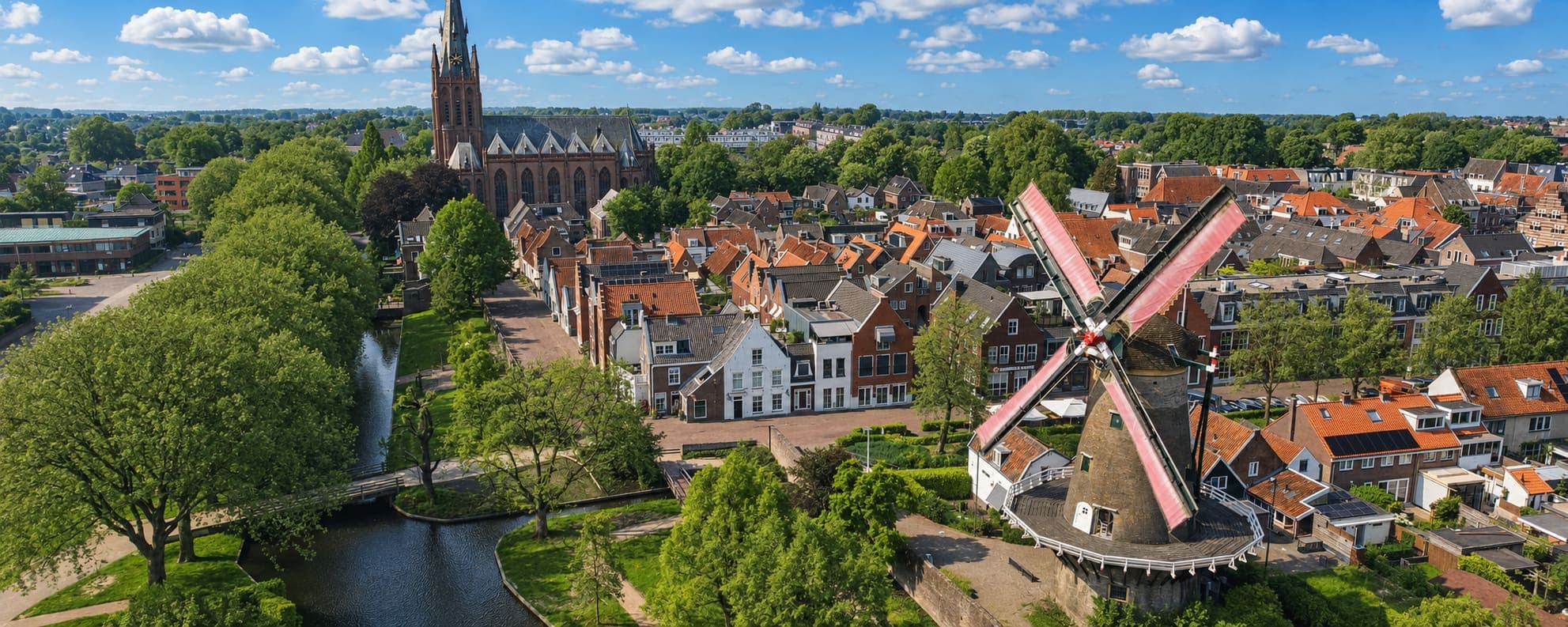
IJsselstein stands on the Hollandse IJssel on clay and peat, and that is ground that settles. You notice it in the facades: they move more than on sand, and a joint that cannot cope with that movement cracks open within a year. The medieval centre and the new build of Zenderpark stand on the same ground but react to it very differently.
Since 1959
Experience and craftsmanship from Utrecht
Clear communication
Short lines, clear agreements
100% satisfaction
We only leave once you are satisfied
Lasting quality
Top-quality materials for a long-lasting result
What matters in IJsselstein
An old centre on settling ground
A medieval centre with listed buildings, post-war expansions in terraced housing, and Zenderpark as a new-build district from the mid-nineties.
In the old centre around the Benschopperstraat and the Utrechtsestraat there are buildings with timber window frames, putty and glazing sealant, and there, for a listed building or a protected townscape, not just any product is allowed. The post-war expansions around it were built in rows and are well past the first round of replacement of their facade sealant. Zenderpark was built from about 1995 onwards and largely has plastic window frames; those are now thirty years old, and there the connection joint between window frame and masonry is by now due for replacement, even though the frame still looks new.
What makes IJsselstein different from a village on sand is that here you allow for settlement almost everywhere. The ground consists of clay and peat, and it settles unevenly: one part of a facade sinks faster than another. That means wider joints than you would lay on the Heuvelrug, and it means we first look at where the movement is before we decide how wide the joint will be. A narrow, neat joint that cracks open is no saving.
The old centre is narrow and partly car-free, with short parking bays and one-way traffic. There we park the van as close as we can and carry the gear some of the way, and sometimes an exemption is needed to be allowed to stop there briefly. We arrange that in advance and not on the spot. In the post-war districts and in Zenderpark it is a different matter: wide streets, free parking and usually right outside the door. Let us know when you send your request which part you live in.
Fifteen kilometres from our base, twenty minutes' drive. That is close enough to come for a single loose joint too, and the call-out charge is among the lowest we charge. For business work it means we can go there and back in one day without travel time weighing on the job, and that we do not get squeezed if the work runs over.
What we do in IJsselstein
- Bathroom, sanitary & kitchenSealing of sanitary ware, showers, baths, washbasins and kitchens.
- Window frames & glazingNeat, durable sealant work around window frames and glass.
- Facades & structural jointsFacade joints, connection joints and expansion joints in floors and walls.
- Swimming pool & wellnessSealant work in swimming pools, saunas, steam rooms and spas.
- Renovation & maintenanceSealant work during renovation, repairs and periodic maintenance.
- Specialist sealant workFor specific requirements and specialist applications.
You will hear from us within 15 minutes on working days, and the work comes with a 2-year guarantee.
The work here
What we do most often in IJsselstein
Joints sized for settlement
On clay and peat a building settles unevenly, and that comes out in the joints. At the site survey we measure how much movement is to be expected and derive the joint width from that. A wider joint can withstand more movement without cracking. What a sealant joint does not do is hold back the structure; it follows the movement, it does not stop it.
More about this serviceConnection joints in Zenderpark
The plastic window frames from the nineties often still look good, but the sealant between them and the masonry is thirty years old and therefore worn out. Plastic expands considerably in the sun, so that joint has stretched and shrunk for years on end. It has hardened, comes away on one side, and then water runs down behind the frame.
More about this serviceSealant work in the old centre
In the historic buildings the glass often sits in putty or old glazing sealant, and for a listed building or a protected townscape not just any product is allowed. We first look at what is there and what is permitted, and only then at what it will be. That takes a conversation beforehand and prevents something going in that has to come out again.
More about this serviceHow we approach it here
Which sealant on what, and what it costs
The substrate decides the sealant
The flank the sealant has to adhere to varies a great deal in IJsselstein by building period. In the old centre the masonry is soft and porous and sometimes still has lime mortar between the bricks; there the brick sucks the adhesion out of a sealant that goes on without a primer. In the post-war terraced housing it is painted timber, and then the sealant adheres to the paint layer: if that is loose, the sealant will later come away with it. With the plastic window frames in Zenderpark the flank is smooth and expands considerably in the sun, and an ordinary facade sealant simply does not adhere to it. Three substrates, three products, and we determine which one it will be at the site survey, not beforehand over the phone.
Costs and lead time
The price depends on the metres, on accessibility and on what has to come out first. Removing the old joint weighs more heavily in the price than the application itself. In the old centre accessibility counts: if we have to carry the gear the length of a street or an exemption is needed, that costs time and we say so in advance. An average bathroom is done in half a day; the connection joints around the window frames of a terraced house usually take a day. You hear the amount before we start and not afterwards, including the call-out charge. Curing is not working time but it is waiting time, and we tell you that too so that you can plan around the shower.
Two routes
Business or homeowner in IJsselstein
For contractors and property managers, the post-war housing stock in IJsselstein is predictable work: many identical homes a short distance apart, so little moving about and a fixed price per metre. In the complexes on the softer parts, the work is mainly in the expansion and connection joints. We come in as a subcontractor alongside a repainting cycle or do only the sealant work, and hand over with videos per address so that you can show what has been done.
For businesses
Contractors, painters, homeowners' associations, property managers and interior fit-out.
See what we do for businessesAlso near IJsselstein
As the crow flies from the centre. By road it is further.
- Nieuwegein 4 km
- Montfoort 7 km
- Lopik 6 km
- Houten 8 km
- Utrecht 10 km
Is your town or city not listed? See the whole service area.
Questions from IJsselstein
What people in IJsselstein ask most often
There is a crack in my facade joint. Is that bad?
It depends on where it is and how it runs. A joint that has come cleanly away from one flank along its whole length is usually an adhesion problem, and we solve that with a new joint on a well-prepared substrate. A joint that has cracked down the middle points more to movement beyond what the joint could cope with, and then it needs to be wider. On the soft ground of IJsselstein that second case is no exception. We look at it first before we say anything.
Can I just have sealant replaced in the old centre?
Usually yes, but not always with every product. If your building is listed or stands in a protected townscape, there are requirements on what you change on the outside, and a glazing sealant that looks different from what was there falls under those. We find that out in advance instead of discovering it once it is in. Ask when you send your request, and you will hear before anyone goes along your windows with a knife.
Why is my window frame still fine and the sealant not?
Because they are two different materials with different service lives. A plastic window frame from Zenderpark can still look perfectly fine after thirty years, while the sealant in between has had to stretch and shrink through that whole period with every warm day and every cold night. It loses its elasticity, hardens and comes away on one side. Replacing the frame is then not necessary; replacing the joint is.
Can you also come in the evening or at the weekend?
For homeowners we prefer not to, and there is a technical reason for that. Sealant cures at roughly two to three millimetres per day, and a sanitary joint is about six millimetres deep. That means that after the work, two days pass regardless before you can use the shower again. Starting on a weekday morning therefore gives you no less waiting time than on a Saturday, and we are easier to reach then.
What if the new joint cracks again anyway?
Then we come and look at it. There is a 2-year guarantee on our work, and it covers the workmanship: the adhesion, the finish and whether the right sealant is in the right place. What falls outside it is the movement of the structure itself; that is how it is set out in the terms and conditions too. On this ground that is no small detail, which is why we measure how much movement there is before the work and derive the joint width from that. What we never promise is that sealant will hold back a building that is sinking. No sealant does that, from any brand.

