
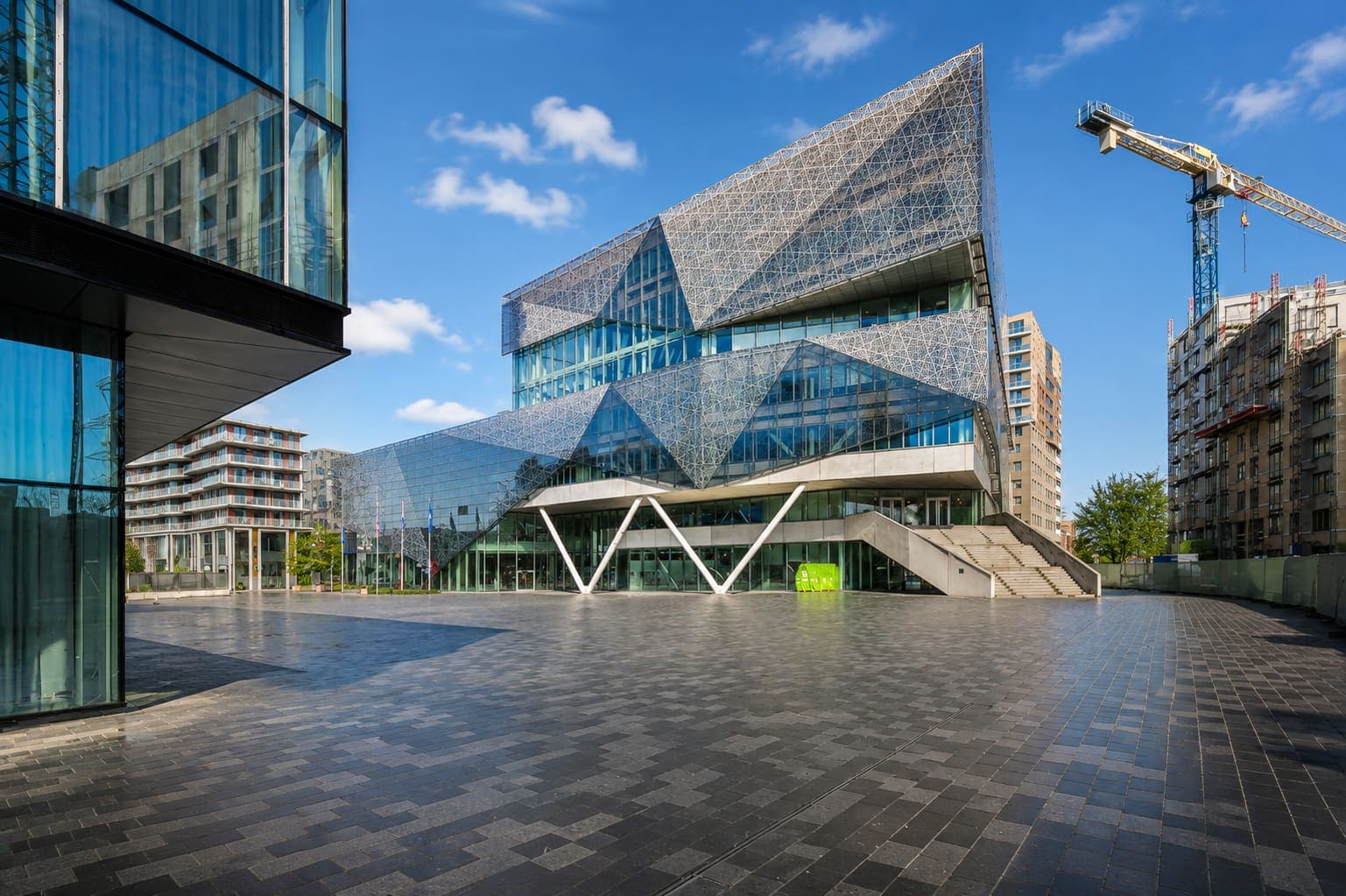
Utrecht · approx. 13 km from Utrecht
Sealant work in Nieuwegein
Between 1971 and 1985 most of the town was put up here in one go: from 12,000 to 55,000 inhabitants in fourteen years. As a result, the sealant work in those districts reaches the end of its life by the street and not by the house: the same bathroom size, the same window opening, the same joint that comes away at the same moment. That makes the work there predictable, and that saves you measuring.
Since 1959
Experience and craftsmanship from Utrecht
Clear communication
Short lines, clear agreements
100% satisfaction
We only leave once you are satisfied
Lasting quality
Top-quality materials for a long-lasting result
What matters in Nieuwegein
In the growth centre the sealant is all the same age
A growth centre from 1971: largely built up in fourteen years with terraced houses, home zones and deck-access flats, alongside the old village centres of Jutphaas and Vreeswijk and new build that was added after 1990 and is still being added.
Zandveld, Hoog-Zandveld and Doorslag are the earliest growth-centre districts from the 1970s: home zones, low-rise and stacked housing, where the work is in the bathrooms and on the access decks. Zuilenstein, Batau-Noord and Fokkesteeg followed around the 1980s, with terraced houses where the timber window frames have often already been replaced by plastic. Galecop is 1990s; there the connection joints on the facade are now due. Blokhoeve is younger: that district has been built from 2004 onwards and is still being extended, so there it is more about checking and touching up than about replacing. Vreeswijk is the old village centre around the Oude Sluis, a nationally protected village conservation area, with painted timber and glazing sealant.
Large parts of this town were built in series, in rows with the same floor plan. So you are not repairing a one-off problem but a series: what goes wrong at number 12 goes wrong at number 40 in the same way. If a plastic window frame goes into an existing wall opening, that frame moves many times as much as the brick around it. A single joint has to accommodate that movement, and we measure that joint against what actually moves.
In the residential districts the van can go outside the door or in the parking bay by the home zone. Two places are different. Around the town centre you pay for parking and much of the parking is underground, with a height restriction that a van cannot always get under. There we unload first and then drive the van away. And in Vreeswijk the streets narrow towards the Oude Sluis, with drawbridges in between.
Just under half an hour's drive from Utrecht city centre, and you notice that in the planning. Thirteen kilometres is short enough to start there in the early morning. If it turns out during cutting out that there are more metres than expected, we re-measure and you hear straight away what that means for the planning.
What we do in Nieuwegein
- Bathroom, sanitary & kitchenSealing of sanitary ware, showers, baths, washbasins and kitchens.
- Window frames & glazingNeat, durable sealant work around window frames and glass.
- Facades & structural jointsFacade joints, connection joints and expansion joints in floors and walls.
- Swimming pool & wellnessSealant work in swimming pools, saunas, steam rooms and spas.
- Renovation & maintenanceSealant work during renovation, repairs and periodic maintenance.
- Specialist sealant workFor specific requirements and specialist applications.
You will hear from us within 15 minutes on working days, and the work comes with a 2-year guarantee.
The work here
What we do most often in Nieuwegein
Bathrooms from the first building wave
Bathrooms from the 1970s and 1980s have usually been resealed once or twice already. That makes the work heavier, not lighter: sealant does not adhere to sealant, so the old edge has to come out completely. A sanitary joint is made at least 8 mm wide and 6 mm deep, otherwise it cannot keep up with the movement of a bath filling up.
More about this servicePlastic window frames in an existing opening
In many post-war rows the timber window frames have been replaced by plastic, in the existing opening. PVC expands by 70 to 80 millionths per degree, concrete by only 10 to 12. So brick and concrete move a fraction of what the frame does, and that connection joint has to accommodate the difference on its own. The width therefore follows from the movement and not from the eye, with 8 mm as the lower limit.
More about this serviceJoints in stacked housing
Many flats from the growth centre have concrete facade elements with expansion joints between them. Concrete is alkaline, so acetoxy silicone comes away there sooner or later; a neutral-cure product goes in. Outside, a closed-cell PE backing rod belongs behind it, otherwise the sealant adheres on three sides and cracks in the middle.
More about this serviceHow we approach it here
Which sealant on what, and what it costs
The substrate decides the sealant
Three substrates dominate here. In the bathrooms, glazed tiling with an acrylic bath or plastic shower tray below: smooth, no suction, wet for long periods. Acrylic disperses in water, so silicone or a hybrid with fungicide goes in there. On the facade, plastic window frames and, on the flats and the old offices, powder-coated aluminium. On that aluminium we do an adhesion test first. And concrete everywhere: access deck slabs, sills, expansion joints. Concrete is alkaline and does not tolerate acetoxy silicone. In Vreeswijk and old Jutphaas, painted timber is added, with the reverse rule: silicone is not overpaintable, so if paint has to go over it, it becomes acrylic or an overpaintable hybrid. Natural stone on a worktop calls for natural stone sealant; edge-zone staining never comes out again.
Costs and lead time
You see the sliding scale best here on the window frames. If your timber window frames were ever replaced by plastic, in these rows that rarely stopped at one house, and so the connection joints of the whole block are the same age. If you do only your own front facade, a handful of metres carries the travel, the cutting out and the clearing up. If the block joins in, the same metres continue and the price per linear metre falls. That is the sliding scale. What that metre costs is not here yet, because the rates have not been fixed. Beyond that, count on replacement here and not on new: that is the more expensive of the two, because the old sealant has to come out completely first. In a bathroom that has already been resealed before, most of the work is in that cutting out and not in the application. And curing belongs in your planning: roughly 2 to 3 mm per 24 hours, so after a sanitary joint there is no showering for two days. In a terraced house with one bathroom, those two days have to fit somewhere in the week. If it is a handover, keep at least two days between the sanitary joint and the handing over of the keys. Send the measurements of one bathroom or one window frame, and you have a reply within 15 minutes on working days. We give a 2-year guarantee on the work. What a guarantee cannot cover is movement of the structure itself: if the building settles or moves, that falls outside it. That is why we measure the joint against the movement that is there, and say so if a joint has been made too narrow for what it has to accommodate.
Two routes
Business or homeowner in Nieuwegein
The business work in this town is mainly in planned maintenance. Housing associations and property managers for homeowners' associations (VvE) have whole complexes here from the same year of construction, so sealant work is often an item in a long-term maintenance plan (MJOP) and goes block by block. We are also happy to work under painters and maintenance contractors who already have the scaffolding up. On Plettenburg, De Wiers and Het Klooster, and at the offices in Rijnhuizen that are becoming homes, it is about something else: curtain walls, concrete and new wet rooms. Send the work description, and you get a price per metre with a sliding scale on the total.
For businesses
Contractors, painters, homeowners' associations, property managers and interior fit-out.
See what we do for businessesAlso near Nieuwegein
As the crow flies from the centre. By road it is further.
Is your town or city not listed? See the whole service area.
Questions from Nieuwegein
What people in Nieuwegein ask most often
In our row everyone has the same bathroom. Is it smart to request it together with the neighbours?
Please do. In these districts there are whole rows with the same floor plan, so we survey one home and know what the rest have. For you the sliding scale counts most: all the addresses add up to one job, and that comes with a lower price per metre than one single bathroom. We schedule them one after the other, so the van only has to come once.
My 1970s house has plastic window frames. Why does the sealant there keep cracking?
Because PVC moves far more than the brick around it: many times as much per degree of temperature difference. If the crack is in the middle of the joint, the joint was designed too narrow for that movement and refilling solves nothing. If it is along the flank, the sealant came away from the substrate and it is about preparation. So we look first at where the crack is before we name a price.
My house in Vreeswijk still has the original timber window frames, with putty in them. Can you simply renew those joints?
Not just like that, and that is because of the year of construction. In the protected village conservation area around the Oude Sluis, original window frames often stay in place, so you really do still come across them there. If the building dates from before 1994, that sealant is suspected of containing asbestos, risk class 2. We then cut nothing out until it is established what is in it; if it turns out to contain asbestos, that work belongs with a licensed company. If paint goes over it afterwards, silicone cannot go in, because silicone is not overpaintable.
We are a homeowners' association (VvE) with a deck-access flat. What exactly do you seal?
The expansion joints between the concrete elements, the connections at the access deck and balcony, and the joints around the window frames. We prefer to come and look in the cold season: the building components are then contracted and the joints at their widest, so you see straight away what is really coming away. Send the item from the long-term maintenance plan (MJOP) or the work description, and you get a price per linear metre with a sliding scale on the total.
Our office building in Rijnhuizen is being converted into flats. What sealant work does that involve?
Outside, the curtain wall: powder-coated aluminium and concrete. No acetoxy silicone may go on concrete, because concrete is alkaline and the sealant loses its adhesion there. On a coated profile you only know after an adhesion test what will stay on, so we do that first. Inside, all the new wet rooms. Watch the ventilation there: a new build requires 14 dm³/s in a bathroom. If that falls short, the joint stays wet and mould grows on it. That is not a sealant problem but an air problem, and bleach only makes it worse.

