
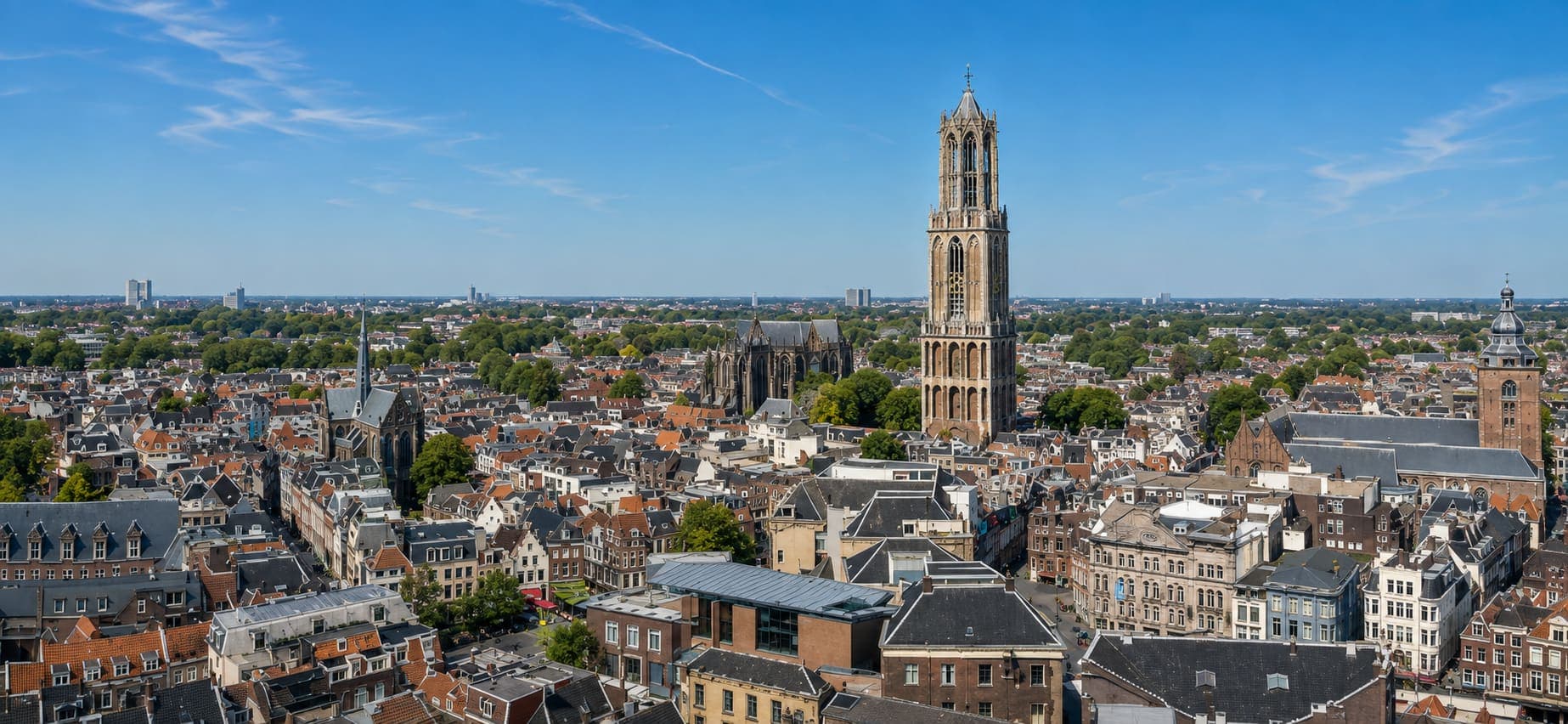
Utrecht · our base
Sealant work in Utrecht
The old city stands on a sandy natural levee of the Rhine. Overvecht and Kanaleneiland stand on softer ground with clay and peat, and that ground is settling. Leidsche Rijn lies on the stream ridges of the Oude Rijn: sandier, with basin clay in the lower parts. A facade on settling ground moves more than a facade on sand, and movement determines how wide a sealant joint needs to be. Our address is here too.
Since 1959
Experience and craftsmanship from Utrecht
Clear communication
Short lines, clear agreements
100% satisfaction
We only leave once you are satisfied
Lasting quality
Top-quality materials for a long-lasting result
What matters in Utrecht
The ground differs by district
A medieval city centre, a nineteenth-century belt, social housing from the interwar period, concrete flats from the sixties and Leidsche Rijn from 1998 onwards. Five layers, five kinds of joints.
Lombok was built between 1886 and 1920 and Wittevrouwen is nineteenth-century: timber window frames, putty and glazing sealant. Ondiep is early social housing, largely from the interwar period, with a lot of housing association stock; there, sealant work usually goes along with a planned repainting cycle. Kanaleneiland was put up from 1957 onwards in prefabricated construction, with the Intervam system used for the first time in the southern part: concrete elements from the factory, stacked into housing blocks on site. Overvecht got walk-up and deck-access flats of up to ten storeys; there the work is in the expansion joints and along the access decks. In Leidsche Rijn the first keys were handed over in 1998, and the oldest parts are now almost thirty years old.
In Utrecht the building periods sit close together. In a single day you come across bluestone in the city centre, painted timber in Lombok, alkaline concrete in Kanaleneiland and, in Leidsche Rijn, plastic and powder-coated aluminium alongside timber. Each of those substrates calls for a different type of sealant. Acetoxy silicone that works fine on tiling loses its adhesion on concrete and leaves a dark edge in natural stone that never comes out.
Since 1 January 2025 the city centre has been a zero-emission zone, within the same boundary as the low-emission zone. There is a transitional arrangement for vans: emission class 5 is still allowed in until 1 January 2027 and emission class 6 until 1 January 2028, possibly a year longer. After that, every van has to be zero-emission. Check the current dates with the municipality before you plan an appointment in the city centre. In a large part of the city there is paid parking and the loading and unloading bays are short-stay. Along the canals you are also standing one storey above the wharf. We agree in advance where the van goes, because time spent carrying is not time spent sealing.
Our base is in this city. So there is no drive between your message and our visit, and a second visit is quickly arranged too. That helps with replacement work: we cut out and refill, and check the joint once more after it has cured. Even for one single joint we do not have far to come.
What we do in Utrecht
- Bathroom, sanitary & kitchenSealing of sanitary ware, showers, baths, washbasins and kitchens.
- Window frames & glazingNeat, durable sealant work around window frames and glass.
- Facades & structural jointsFacade joints, connection joints and expansion joints in floors and walls.
- Swimming pool & wellnessSealant work in swimming pools, saunas, steam rooms and spas.
- Renovation & maintenanceSealant work during renovation, repairs and periodic maintenance.
- Specialist sealant workFor specific requirements and specialist applications.
You will hear from us within 15 minutes on working days, and the work comes with a 2-year guarantee.
The work here
What we do most often in Utrecht
Window frames in the old belt
In Lombok, Wittevrouwen and the Tweede Daalsebuurt there are still many timber window frames with putty and glazing sealant, often painted over a few times. If the building dates from before 1994, that sealant is suspected of containing asbestos and we cut nothing out until it is established what is in it. Have it tested first, and only then does the chisel go in.
More about this serviceExpansion joints in concrete construction
Kanaleneiland and Overvecht were built from prefabricated concrete elements. The facades of the offices at Papendorp and the Utrecht Science Park also have expansion joints. Concrete expands by 10 to 12 millionths per degree, so the width of the joint between two panels follows from that movement. Outside, a closed-cell PE backing rod goes in behind, so that the sealant adheres only to the two flanks.
More about this serviceShowers in subdivided buildings
Where a nineteenth-century building has been subdivided into flats or rooms, showers were put into spaces that were never built for it: little extraction, heavy use. Acrylic cannot cope with that, because it disperses under prolonged exposure to water. That calls for silicone or a hybrid with fungicide, and a joint at least 8 mm wide and 6 mm deep.
More about this serviceHow we approach it here
Which sealant on what, and what it costs
The substrate decides the sealant
The city centre gives you bluestone sills, natural stone and brick facades. Only natural stone sealant with chemically bound plasticisers may go on those. Ordinary silicone leaves a dark edge in the pores that cannot be polished out, and you only see it after weeks. In Kanaleneiland and Overvecht it is concrete, and concrete is alkaline: acetoxy silicone loses its adhesion there. In Leidsche Rijn you come across a lot of plastic and powder-coated aluminium: smooth material where the preparation determines whether it holds. And in the bathrooms, glazed tiling and acrylic baths everywhere. As standard we work with OTTOSEAL S 125, but we choose which type goes in based on the substrate.
Costs and lead time
The price is per linear metre, with a sliding scale based on the size of the job. In a city with so many blocks of flats that makes a difference: all the expansion joints of one deck-access block in Overvecht in a single round is a different price per metre from one single joint on one access deck. If the sealant work goes along with a housing association's planned repainting, we look at the size of the whole job and not at individual homes. There are no amounts here yet, because the rates have not been fixed. Cutting out and refilling costs more than a new joint: the old sealant has to come out completely first, and in the old belt it sits under layers of paint. Sealant cures at roughly 2 to 3 mm per day, so after a sanitary joint the shower stays closed for two days. For a family bathroom, plan that around the weekend. If a subdivided building shares one shower between several tenants, we fix those two days with the landlord in advance. You get a reply within 15 minutes on working days. Our sealant work comes with a 2-year guarantee. Settlement and movement of the structure are not covered by the guarantee. What we do: measure the joint against the movement that is there, and say in advance what a guarantee cannot cover. The conditions are set out in the terms and conditions.
Two routes
Business or homeowner in Utrecht
Business sealant work in Utrecht is mainly in blocks of flats and planned maintenance. If you outsource sealant work, this page is about you. Think of painters and contractors who outsource the sealant work, property managers for homeowners' associations (VvE) with blocks of flats in Kanaleneiland, Overvecht and Hoograven, housing associations that tender planned maintenance, and interior fit-out companies that have worktops and wall junctions sealed. And managers of offices and laboratories at Papendorp and the Utrecht Science Park, and of business premises on Lage Weide. If a main contractor places the sealant work with us, we apply the VAT reverse charge: it is not on our invoice but goes through your own VAT return. Send the work description or the item from the long-term maintenance plan (MJOP), and you get a price per metre with a sliding scale on the total.
For businesses
Contractors, painters, homeowners' associations, property managers and interior fit-out.
See what we do for businessesAlso near Utrecht
As the crow flies from the centre. By road it is further.
- Nieuwegein 6 km
- Zeist 11 km
- Woerden 15 km
- Hilversum 16 km
- Amersfoort 22 km
- Gouda 28 km
Is your town or city not listed? See the whole service area.
Questions from Utrecht
What people in Utrecht ask most often
The joint along my window frames keeps splitting down the middle. Why?
A crack down the middle of the joint is cohesive failure: the joint is too narrow for the movement it is exposed to. Refilling then solves nothing. The centre lies on a sandy natural levee. In the post-war districts on softer ground, such as Overvecht and Kanaleneiland, the ground is settling and a facade moves more. We look on site at what lies under your building. Elastic sealant starts at 8 mm wide; the depth is that width divided by three, plus 6 mm. If the building itself is settling, sealant will not solve that, and that movement is also not covered by the guarantee.
Leidsche Rijn is not yet thirty years old. Why sealant work already?
The oldest parts have stood since 1998, and that is the age at which the first sealant joints are due for replacement. Plastic expands by 70 to 80 millionths per degree, aluminium by 23 to 24 and concrete by 10 to 12. The connection joint between two of those materials is therefore subjected to the most movement and goes first. Have it looked at in the cold season: the building components are then contracted and the joint is at its widest.
I let rooms and the sealant in the shower keeps turning black. Does bleach help?
Bleach removes the black edge for a while and then makes it come back faster. Chlorine-based and aggressive cleaners wash the anti-mould agent out of the sealant and make the edge porous. In rooms that are let, people shower far more often than in a family bathroom and there is usually too little extraction; for a new bathroom the requirement is 14 dm³/s. Let the ventilation run on after showering and clean with a neutral cleaner.
Our flat in Kanaleneiland is made of concrete panels. Can ordinary silicone sealant go on that?
Not the acetoxy type. Concrete is alkaline and acetoxy silicone loses its adhesion on it. The same applies to bare aluminium, zinc, lead and natural stone. A neutral-cure sealant goes in, with a closed-cell PE backing rod behind it, so that the joint adheres only to the two flanks. If it also adheres to the base, the middle cannot stretch and it cracks anyway.
I have a building on the canal with bluestone sills. What do you look out for?
Edge-zone staining. Free plasticisers and silicone oil migrate into the pores of natural stone and leave a dark edge along the joint, often only visible after weeks. Polishing does not help and it is irreparable. That is why we use only natural stone sealant with chemically bound plasticisers, and we put in writing beforehand that we cannot guarantee against that edge. If in doubt, a test piece first, somewhere out of sight.

