
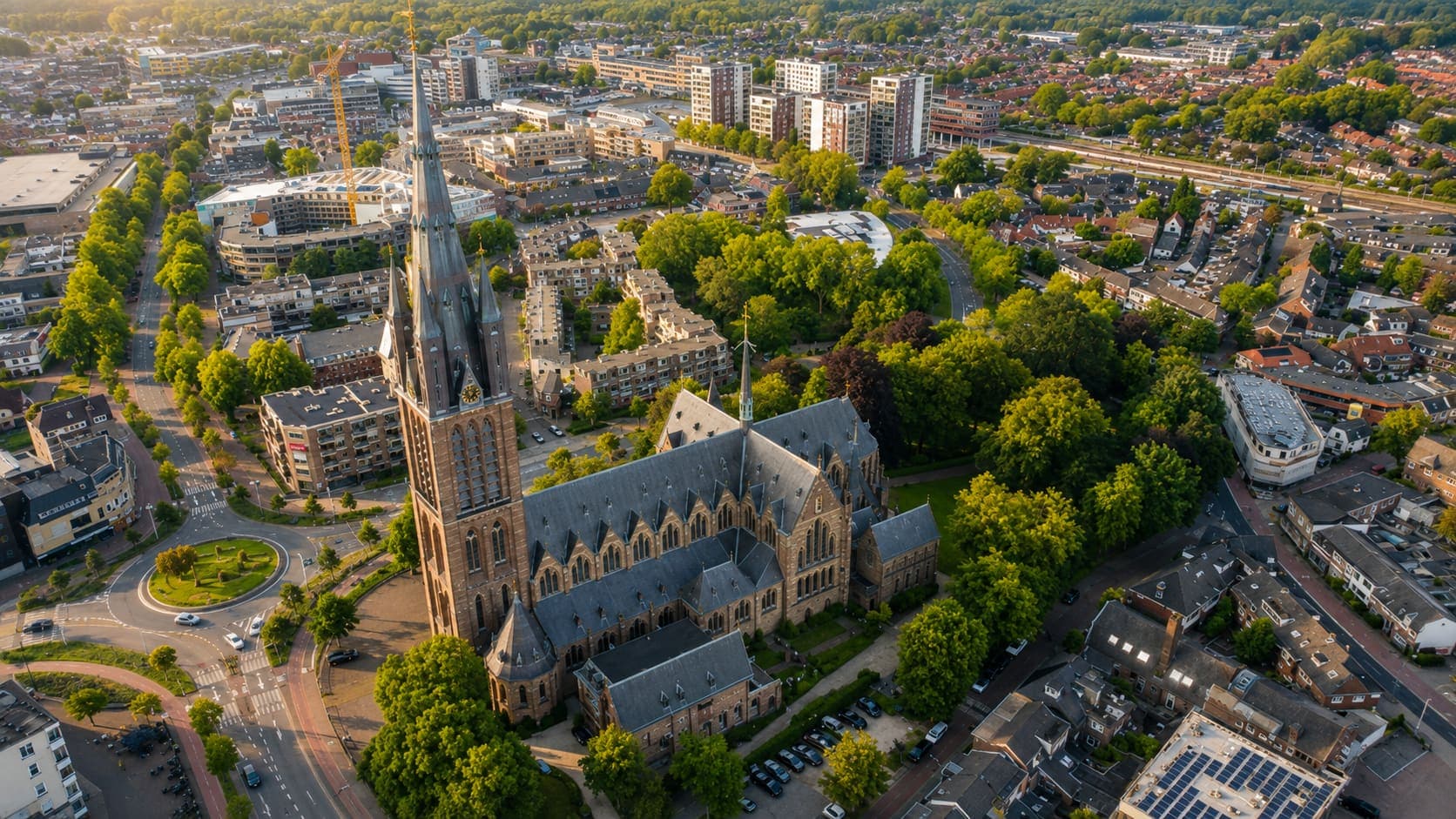
Noord-Holland · approx. 25 km from Utrecht
Sealant work in Hilversum
Most of Hilversum lies on the sand of the ice-pushed ridge of the Gooi. On that sand, settlement hardly plays a part, so there the movement in a joint comes not from the ground but from the building components themselves. Then the question is not how much the building settles, but how much the joint has to be able to stretch. In the lower-lying Hilversumse Meent, a drained polder with peat in the subsoil, we also look at the ground.
Since 1959
Experience and craftsmanship from Utrecht
Clear communication
Short lines, clear agreements
100% satisfaction
We only leave once you are satisfied
Lasting quality
Top-quality materials for a long-lasting result
What matters in Hilversum
Sand underfoot, movement in the facade
Villa parks from 1875, housing by Dudok from the interwar period, and post-war extensions such as Kerkelanden and the Hilversumse Meent. Around them, offices and studios on the Mediapark.
The villa parks Trompenberg and Boomberg date from around 1875 and are full of timber, conservatories and natural stone sills. Over 't Spoor was the industrial heart and got housing complexes by Dudok in the interwar period. If such a pre-war complex still has a steel window with the original glazing sealant, a separate approach applies there. Plan Oost goes back to a plan by Dudok from 1933; there the work is in window frame connections and sills. Kerkelanden dates from after 1966 and the Hilversumse Meent was built between 1974 and 1978: there it is about bathrooms, kitchens and concrete elements with expansion joints.
On the Gooi sand the buildings stand still, and then the movement comes from the building components themselves: brickwork that warms up, steel windows, aluminium against concrete. So the joint width follows from the expansion of the two parts that border that joint, not from what the eye says. In that polder it is different: on a layer of sand laid over peat a building can indeed settle, and then we measure the joint against the movement that is there. North-facing facades in the shelter of the Gooi woods dry more slowly, and on such a joint you see deposits more often.
Since May 2025, paid parking has applied throughout Hilversum up to and including the outer ring road, Monday to Saturday from 9:00 to 24:00. For a van that is parked there for a day, that adds up, so it should be counted into the price. Hilversum has three protected townscapes: the Noordwestelijk Villagebied, Plan Oost and Hilversum Zuid. If the building is in one of those, or is a listed building, its own rules apply. For ordinary maintenance where form, material and colour stay the same, usually no permit is needed. You only know for sure once it has been checked with the municipality. That is why we keep the colour that is already there. If the joint has to be wider to cope with the movement, we put that forward beforehand.
From Utrecht it is 25 kilometres by road: onto the A27, and off again at Hilversum. That is short enough to come and survey the site ourselves instead of estimating from a distance, and with natural stone or old glazing sealant you want that too. If there are several addresses in the Gooi, we schedule them back to back as far as possible.
What we do in Hilversum
- Bathroom, sanitary & kitchenSealing of sanitary ware, showers, baths, washbasins and kitchens.
- Window frames & glazingNeat, durable sealant work around window frames and glass.
- Facades & structural jointsFacade joints, connection joints and expansion joints in floors and walls.
- Swimming pool & wellnessSealant work in swimming pools, saunas, steam rooms and spas.
- Renovation & maintenanceSealant work during renovation, repairs and periodic maintenance.
- Specialist sealant workFor specific requirements and specialist applications.
You will hear from us within 15 minutes on working days, and the work comes with a 2-year guarantee.
The work here
What we do most often in Hilversum
Glazing sealant in steel windows
If you come across a steel window in a pre-war building that still has the original glazing sealant in it, it counts as suspected of containing asbestos as soon as it dates from before 1994: risk class 2 as standard. We do not put a knife in it until it is established what is in it. The joint between the frame and the brickwork is separate from that; we simply replace it.
More about this serviceNatural stone in the villa parks
Sills, plinths and window ledges of bluestone or marble are everywhere in Trompenberg and Boomberg. No ordinary silicone sealant may go against them: free plasticisers migrate into the pores and weeks later leave a dark edge that never comes out. We use natural stone sealant with chemically bound plasticisers, and acetoxy does not come anywhere near it.
More about this serviceBathrooms from the 1970s
Kerkelanden and the Hilversumse Meent were put up in a short period, so the bathrooms there are often the same age. Acrylic does not belong there: it disperses under prolonged exposure to water. For a sanitary joint that means at least 8 mm wide and 6 mm deep.
More about this serviceHow we approach it here
Which sealant on what, and what it costs
The substrate decides the sealant
Four substrates determine the choice here. Concrete and masonry mortar are alkaline, and on an alkaline substrate acetoxy silicone sealant loses its adhesion, so a neutral-cure sealant goes on. Natural stone is everywhere in the villa parks: sills, plinths, window ledges. Only natural stone sealant with chemically bound plasticisers belongs on it, because edge-zone staining cannot be polished out or repaired. Painted timber from the interwar period goes along with the next repainting cycle, and silicone cannot be painted over, so acrylic or an overpaintable hybrid goes in there. Powder-coated aluminium on the offices expands roughly twice as much as the concrete around it, so there the joint width is the first question. As standard we reach for OTTOSEAL S 125, but the substrate decides.
Costs and lead time
What it costs here depends mainly on how the work is bundled. The unit is the linear metre, and there is a sliding scale based on the size of the order. A villa in Trompenberg has sills, plinths and window ledges all the way round: all short runs, each with its own start, so there the metres add up slowly. If a property manager has a whole interwar housing block gone over in one go, or all the bathrooms in a complex in the Hilversumse Meent, you end up at the favourable end of that scale. So request something like that for the whole block and not per home. We are not putting amounts here yet, because the rates have not been fixed. Replacement comes out higher than new work: the old joint has to come out completely before anything can go in, and that cutting out takes more time than the application afterwards. If a steel window still has original glazing sealant in it, the investigation into what is in it comes before that. Curing goes at 2 to 3 mm per 24 hours. For a contractor on the Mediapark that is a line in the schedule; for a family with one bathroom in Kerkelanden it is two days without a shower, so you plan that for a time that suits. We answer an enquiry within 15 minutes on working days, whether it is about one sill or a whole block. The work carried out comes with a 2-year guarantee. Movement or working of the structure is not covered, and that is why we measure the joint in advance against the movement that is there. Exactly what is covered is set out in the terms and conditions.
Two routes
Business or homeowner in Hilversum
On the Mediapark and the Arenapark it is about aluminium facades, connections and expansion joints. The Mediapark is private property and guarded 24 hours a day. Work there is only possible with an access pass, and no work is done around recordings. Anyone working there needs such a pass, and that goes through the company the work is for. In the Havenkwartier and on the Kerkelanden business park there are halls with concrete floors that are walked and driven on; there the joint has to withstand wheels and not just water. If you are a painter, contractor or property manager for a homeowners' association (VvE) and you outsource the sealant work, we take on only that part and you keep the schedule in your own hands. If you engage us as a subcontractor, the VAT is shown as reverse-charged on the invoice.
For businesses
Contractors, painters, homeowners' associations, property managers and interior fit-out.
See what we do for businessesAlso near Hilversum
As the crow flies from the centre. By road it is further.
- Laren 4 km
- Bussum 5 km
- Loosdrecht 6 km
- Naarden 9 km
- Baarn 7 km
- Huizen 10 km
- Amersfoort 16 km
- Utrecht 16 km
Is your town or city not listed? See the whole service area.
Questions from Hilversum
What people in Hilversum ask most often
My house dates from 1932 and still has steel windows. Can you replace that sealant?
We leave the sealant around the glass alone until it is known what is in it. Glazing sealant and putty from before 1994 count as suspected of containing asbestos, risk class 2 as standard, and then cutting it out is work for a licensed company with the paperwork to go with it. The joint between the frame and the brickwork falls outside that; we replace that without any fuss. If the glass was fitted after 1994, the point no longer applies.
We have bluestone sills. Why can the same sealant as in the bathroom not go on them?
Because natural stone is porous. Ordinary silicone contains plasticisers that can move freely; they migrate into the stone and leave a dark edge along the joint, often only visible after weeks. Polishing does not help and neither does grinding, because it sits in the pores. So only natural stone sealant with chemically bound plasticisers, and never an acetoxy silicone sealant on stone or concrete.
We are converting a studio. Does a sealant joint keep sound out?
A joint stops what it seals: where air can get past, sound goes with it. So fill it fully, with a backing rod behind it, so that the sealant adheres on two sides and not three. If it also adheres to the base, the middle cannot stretch and it cracks open. Indoors, an open-cell PU backing rod goes behind it. What value the wall has to achieve is in the specification, and that determines the build-up, so send that along.
The facade joints are cracking, even though the ground here does not settle. How can that be?
Look at where such a joint cracks. If it comes away along the flank, it is the adhesion: the wrong sealant, or a dirty or damp substrate. If it cracks down the middle of the joint, it was designed too narrow for the movement acting on it, and then refilling solves nothing. Then it has to be wider. Elastic sealant works between 8 and 30 mm; above that a profile belongs in it and not sealant. For elastic sealant 8 mm is the minimum, and the depth is the width divided by three plus 6 mm.
Black keeps appearing on the sealant in the shower. Does bleach help?
Bleach takes the colour off for a while and leaves the sealant worse off. Chlorine washes the anti-mould agent out and makes the edge porous, so a few weeks later it is back. Look at the air in the room first. In homes from the 1960s and 1970s the bathroom is often small, with one grille and a door that stays shut. For a new bathroom the requirement is 14 dm³/s (Bbl). An old grille in a closed bathroom usually does not achieve that, so first measure what comes out. If the black is in the sealant and not on it, replacement is the only solution.

