
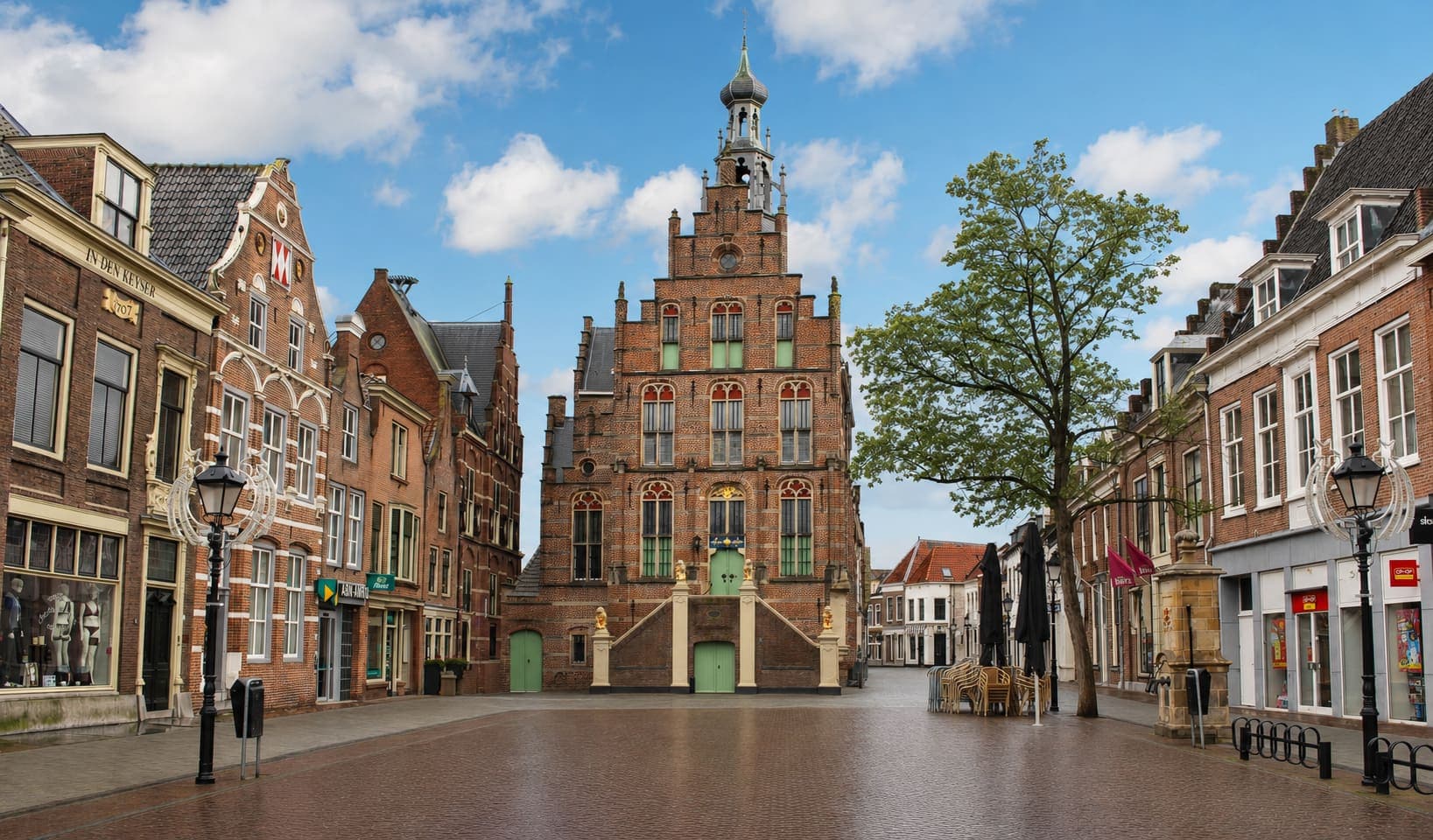
Gelderland · approx. 30 km from Utrecht
Sealant work in Culemborg
Besides a historic town centre, Culemborg has something you rarely find in such concentration: a district where a great deal of timber was deliberately used, inside and out. Timber moves with moisture and temperature, more than brick or concrete, and every joint in between has to follow. That makes maintenance here more predictable, and needed more often.
Since 1959
Experience and craftsmanship from Utrecht
Clear communication
Short lines, clear agreements
100% satisfaction
We only leave once you are satisfied
Lasting quality
Top-quality materials for a long-lasting result
What matters in Culemborg
A town with a striking amount of timber
A medieval town centre on the Lek, post-war expansion districts, an ecologically planned district with a lot of timber construction, and new build on the south side.
The town centre has buildings with timber window frames, putty and old glazing, partly within a conservation area; there, what is permitted comes first and what goes in comes second. The post-war districts to the north were built in terraces and are past the first replacement cycle of their facade sealant. EVA-Lanxmeer was built from the mid-nineties with a lot of timber in the facades and in the detailing, and that is exactly where most of the work per home sits: timber moves and every connection around it moves with it. The new build on the south side is younger, but there too the sealant applied at handover is by now due for its second life.
What sets Culemborg apart is the amount of timber facade work per home. Timber absorbs moisture and gives it off again, so it swells and shrinks with the seasons. A joint between two timber parts therefore makes a larger movement than the same joint between two bricks. Here that more often means a permanently elastic product and rarely anything hard, and it means the substrate has to be dry at the moment we arrive.
The town centre is narrow and partly low-traffic; there the van stays outside the centre and we carry the tools some distance. In EVA-Lanxmeer cars largely do not drive up to the homes, which is how the district was designed, so there we park on the edge and walk the last stretch. That takes time and we include it honestly in the quote instead of reporting it afterwards. In the post-war districts and the new build we park right outside the door.
Thirty kilometres by road, about half an hour. For a bathroom or a set of window frames that is perfectly doable; for a single joint we charge a minimum amount, and we tell you that in advance. We like to combine Culemborg with Vianen or Leerdam on one day, because the three lie in a line and then the trip is needed once instead of three times.
What we do in Culemborg
- Bathroom, sanitary & kitchenSealing of sanitary ware, showers, baths, washbasins and kitchens.
- Window frames & glazingNeat, durable sealant work around window frames and glass.
- Facades & structural jointsFacade joints, connection joints and expansion joints in floors and walls.
- Swimming pool & wellnessSealant work in swimming pools, saunas, steam rooms and spas.
- Renovation & maintenanceSealant work during renovation, repairs and periodic maintenance.
- Specialist sealant workFor specific requirements and specialist applications.
You will hear from us within 15 minutes on working days, and the work comes with a 2-year guarantee.
The work here
What we do most often in Culemborg
Joints in timber facades
Where timber meets timber or brick, there is a joint that has to swell and shrink with the seasons. A sealant that has gone hard cracks there first. We remove it, check that the timber beneath is dry and sound, and put back a permanently elastic product that can follow that yearly movement.
More about this serviceHistoric glazing
In the town centre the glass is often still set in putty or old glazing sealant that lasts for decades and then suddenly comes loose everywhere at once. Water then runs along the pane into the rebate and attacks the timber from the inside. We remove the old bead without damaging the glass, and first check what is permitted on a protected building.
More about this serviceBathrooms in the new build
The homes from the mid-nineties are now at the first or second replacement cycle of their bathroom sealant. Mould in the corners sits in the material and not on it, so cleaning only moves the problem. The joint comes out, the corner is dried and cleaned, and a sanitary sealant goes in that can take daily use.
More about this serviceHow we approach it here
Which sealant on what, and what it costs
The substrate decides the sealant
Timber is the most common joint face here, and that sets two requirements that matter less elsewhere. The first is moisture: sealant does not adhere to wet timber, and facade timber that has just had rain is dry on the outside and not a millimetre deeper. So we measure the moisture content or wait a day, instead of carrying on because the schedule says so. The second is the finish: on painted or stained timber the sealant adheres to that layer and not to the timber beneath. If that layer is loose, the sealant will come loose with it. In the town centre you also find porous brickwork and sometimes lime mortar; that draws the adhesion out of a sealant applied without primer. What preparation is needed becomes clear at the site survey, not on the phone.
Costs and lead time
What you pay depends on the metres, the access and whether the old joint has to come out. With timber construction there is something extra: there are more connections per facade than with brickwork, so the number of metres comes out higher than people expect. We measure that at the site survey and put it in the quote, so you do not get an adjustment halfway through. If the van cannot get to the home, we include that walking time in the quote, openly and in advance. A bathroom is usually done within half a day. Curing does not count as working time, but you cannot use the room during that period; we mention that so you can plan for it.
Two routes
Business or homeowner in Culemborg
Property managers and contractors running planned maintenance here deal with more linear metres per home than the average terraced house yields. That is easy to budget as long as you measure it in advance instead of estimating it per address. We can do that site survey and then join the repainting cycle as a subcontractor, or take on just the sealant part. For each address we supply videos, so the client sees what was done without having to go there.
For businesses
Contractors, painters, homeowners' associations, property managers and interior fit-out.
See what we do for businessesAlso near Culemborg
As the crow flies from the centre. By road it is further.
- Vianen 8 km
- Houten 12 km
- Leerdam 13 km
- Wijk bij Duurstede 12 km
- Nieuwegein 14 km
Is your town or city not listed? See the whole service area.
Questions from Culemborg
What people in Culemborg ask most often
Why does timber construction need sealant work more often?
Because timber moves and brick hardly does. Timber absorbs moisture when it is wet and gives it off again when it dries, so it swells and shrinks every season. A joint between two timber parts therefore makes a much larger movement than the same joint between two bricks, and that movement costs the sealant elasticity. That is not a quality problem with the material but a consequence of the construction. You do get something in return: timber shows damage sooner.
Can you work when it has just rained?
On timber, preferably not, and that is not excessive caution. Sealant does not adhere to wet timber, and facade timber that has had rain feels dry on the outside while it still holds moisture a millimetre deeper. If you put a joint in there anyway, it comes loose within a season and you have paid for the work twice. We measure the moisture content or we move it back a day. We tell you as soon as we see it, not afterwards.
In the town centre, can new sealant simply go in?
Not with every product. If your building is listed or stands in a conservation area, there are rules on what you change on the outside, and the sealing around the glass is part of that. We find that out before anyone turns up with tools, because a wrong choice has to come out again and then you pay double. Tell us in your request what kind of building it is, and you will know in advance.
The van cannot get to my home, what then?
Then we walk the last stretch, and in parts of Culemborg that is simply how it is. In the town centre and in the low-traffic districts we park on the edge and carry materials and tools in. That takes time, and we include that time honestly in the amount you are quoted in advance. What we do not do is add it afterwards as an extra item. Tell us in your request how far the walk is, and the quote is right first time.
How do I know whether my sealant needs replacing?
Press your fingernail into it. A healthy joint springs back; a worn joint feels hard and keeps a dent or crumbles. Then look at the edges: does the sealant sit against both joint faces along its full length, or has it come away on one side? The latter is the start of water ingress, even if there is nothing else to see. And with timber: a dark discolouration right next to the joint usually means there is already moisture behind it.

