
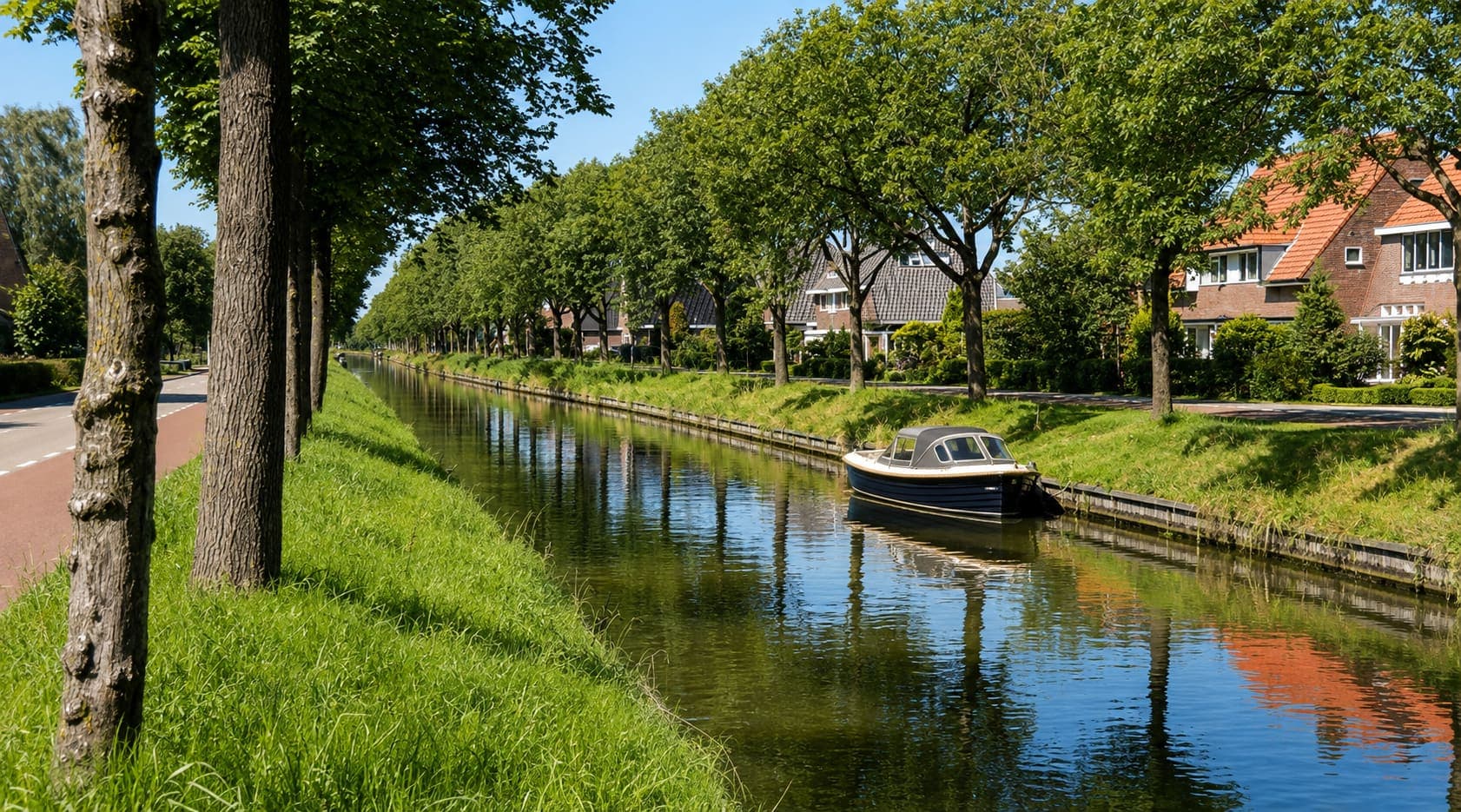
Utrecht · approx. 10 km from Utrecht
Sealant work in De Meern
De Meern grew along the water, with a ribbon of older buildings around which large-scale new build was later laid. For sealant work that produces two very different tasks that often begin in the same street: maintenance of ageing glazing on the one hand, and the first replacement of the sealant applied at handover on the other.
Since 1959
Experience and craftsmanship from Utrecht
Clear communication
Short lines, clear agreements
100% satisfaction
We only leave once you are satisfied
Lasting quality
Top-quality materials for a long-lasting result
What matters in De Meern
A ribbon with new build around it
Ribbon development along the water with buildings of varying ages, and around it new build from the period from about 1998 onwards.
Along the old ribbon stand homes and farmhouse-like buildings with timber window frames and glazing that has often been in for decades; anything in there from before 1994 counts as suspected of containing asbestos until testing shows otherwise. The new build around it was put up in construction runs, with the same window frames and the same sealing in each phase. Those homes are now approaching or passing twenty-five years, and that is the age at which the connection joint between window frame and brickwork loses its stretch. On the edges there are also office and business locations where the work is on a completely different scale.
Where De Meern stands out is the age profile of the sealant work. In many places the stock is spread across decades; here a large part falls into two sharply defined periods. That makes the work predictable: we usually know before the visit which type of window frame and which sealing we will come across, and so we can quote more precisely than in a village where every street is different again.
Along the ribbon the road is narrow and sometimes one-way; there we park the van as close as possible and carry the gear part of the way. In the new build parking is plentiful and free. What we ask about in advance is access to the rear facade: many new-build homes have a rear path that cannot be reached with the van, and that makes a difference to the time we have to allow for the work.
Ten kilometres from our base, a quarter of an hour's drive. That makes this one of the places where we also come for one single joint and where the call-out fee is lowest. For business work in the new build or at the business locations on the edge we can run several consecutive days without travel time weighing on the budget.
What we do in De Meern
- Bathroom, sanitary & kitchenSealing of sanitary ware, showers, baths, washbasins and kitchens.
- Window frames & glazingNeat, durable sealant work around window frames and glass.
- Facades & structural jointsFacade joints, connection joints and expansion joints in floors and walls.
- Swimming pool & wellnessSealant work in swimming pools, saunas, steam rooms and spas.
- Renovation & maintenanceSealant work during renovation, repairs and periodic maintenance.
- Specialist sealant workFor specific requirements and specialist applications.
You will hear from us within 15 minutes on working days, and the work comes with a 2-year guarantee.
The work here
What we do most often in De Meern
Window frame connections, new build
In new build from around the turn of the century, the joint between window frame and brickwork is the first thing to give up. The window frame itself lasts longer, but the sealing has a quarter of a century of daily expansion behind it. We take it out, assess the flanks and put in a product that adheres to plastic or aluminium.
More about this serviceGlazing in the ribbon
Older buildings along the water have glazing sealant that has hardened and is coming away at the edges. You usually see the result not in the sealant but in the timber: dark discolouration in the bottom rail, and, in time, rot. We replace the sealing and say so honestly if the timber has to be repaired first before sealant work makes sense.
More about this serviceOffices and business premises
At the locations on the edge it is about curtain walls, facade cladding and expansion joints over great lengths. There what counts is adhesion to smooth, coated surfaces and the stretch that large surfaces in the sun demand. We fit the work around opening hours, so that no work is done while the building is full.
More about this serviceHow we approach it here
Which sealant on what, and what it costs
The substrate decides the sealant
In the new build the flanks are mainly plastic, aluminium and modern brickwork. The first two are smooth and expand considerably in the sun: a standard facade sealant does not adhere to them for long, and a product is needed that is intended specifically for those materials. Modern brickwork is hard and absorbs little, so a primer is usually not needed there, although the cut face has to be clean and free of dust. In the ribbon the picture changes: there it is painted timber, on which the sealant adheres to the paint layer rather than to the timber, and sometimes brickwork that is porous enough to need pre-treatment. At business locations, coated steel and concrete elements are added, each with their own requirements. Which preparation is needed, we decide per facade.
Costs and lead time
What you pay depends on the metres, the accessibility and taking out what is there. In the new build that can be budgeted tightly because the homes are identical; with several addresses in the same street the price per home falls because the fixed part is only needed once. In the ribbon there is more variation and we give a range until we have seen the work. If the sealant dates from before 1994, asbestos testing comes before the quote. For a bathroom we usually allow half a working day; the curing time after that is in the schedule you receive.
Two routes
Business or homeowner in De Meern
On the edges of De Meern there are office and business locations where it is about curtain walls, cladding and long expansion joints. That is work that can be budgeted per metre and that we can carry out outside office hours if the building is in use. In the residential districts we work for property managers and contractors on complexes of identical homes, where one site survey per house type is enough. In both cases we hand over with the work recorded in images, per address or per facade.
For businesses
Contractors, painters, homeowners' associations, property managers and interior fit-out.
See what we do for businessesQuestions from De Meern
What people in De Meern ask most often
My home dates from 2001. Is that already due for replacement?
For the sealant, usually yes. Depending on orientation and load, a connection joint lasts roughly fifteen to twenty years, and a home from 2001 is well past that. That the window frames still look good says little: they are made of a different material with a different lifespan. Look at the joint itself. If it feels hard and does not spring back when you press into it, it has done its job.
There is rot in the timber by my window. Can you seal that?
No, and that is an honest answer you would rather hear now. Sealant does not adhere for long to decayed timber; whatever you put in comes loose again within a season, and meanwhile the moisture is trapped and the rot carries on. First the bad timber has to come out and be repaired, and only after that does sealing make sense. We say so at the site survey, even if that means a carpenter has to come round first.
Do you also work on business premises outside office hours?
Yes, and for buildings that are in use during the day that is often the best solution. Sealant work on curtain walls and facades produces noise, dust and sometimes odour, and you do not want that while people are sitting there working or customers are coming in. We coordinate the schedule with the manager or the business owner. The work itself takes no longer per metre; only the scheduling needs more coordination, and we arrange that in advance.
How long does a new connection joint last?
That differs per facade, and so we do not name a figure for the whole house. A joint facing south gets the most sun and therefore the greatest daily stretch; the same joint facing north stands almost still and lasts noticeably longer. At the site survey we say what we expect for each building component. What we can say: well prepared and with the right product, you get considerably more years than with a joint that was applied in a hurry.
Do I have to be at home when you come?
For outdoor work not necessarily, as long as we can get to the facade and know where we need to be. For indoor work such as a bathroom, yes, if only to be able to get in and out of the room. What helps: let us know whether there is a gate or a back entrance and whether it is locked. We check in on arrival and on departure, and you get videos of the finished work, so that you can also see afterwards what has been done.

