
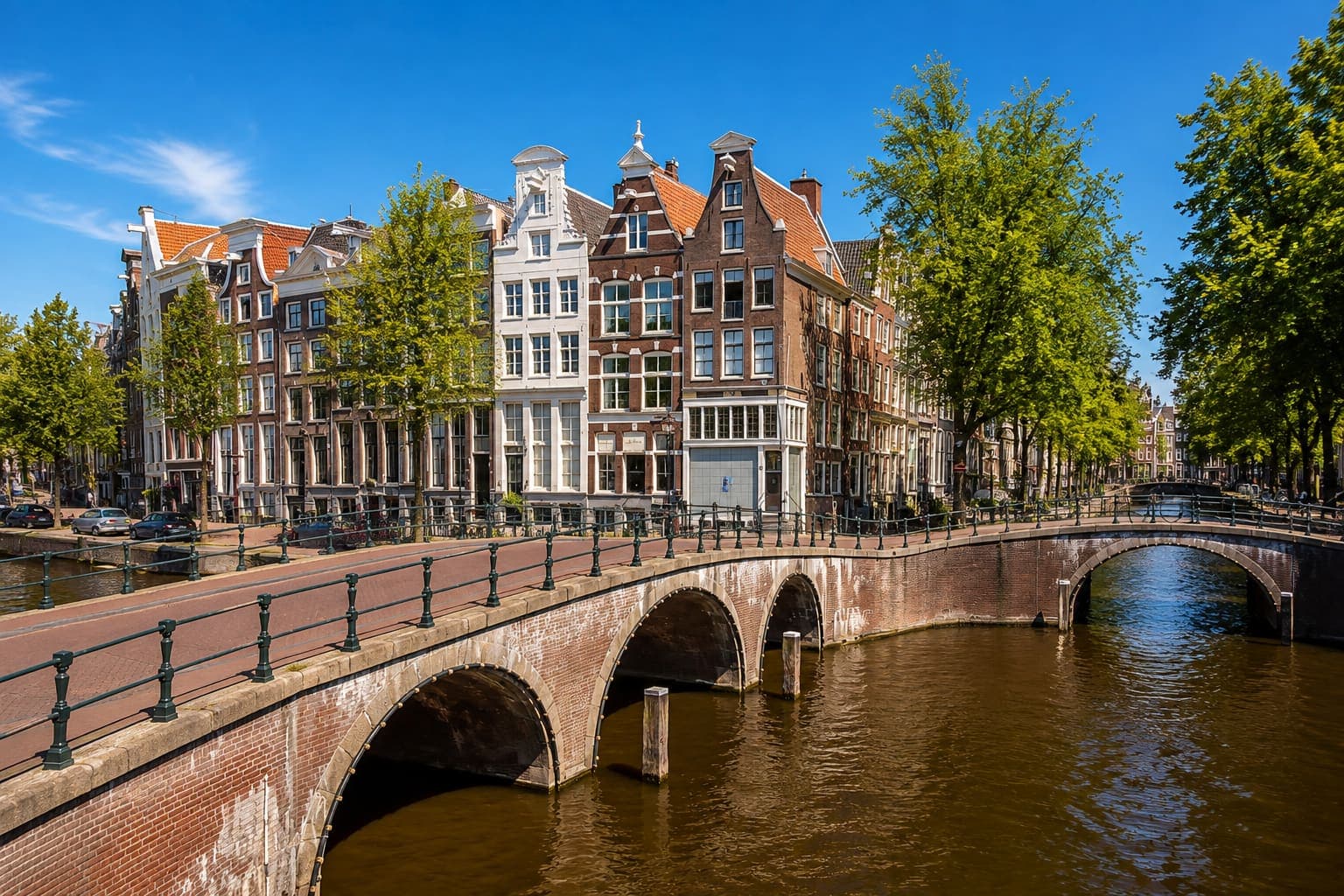
Noord-Holland · approx. 45 km from Utrecht
Sealant work in Amsterdam
Amsterdam lives stacked. More than half of the homes belong to a homeowners' association (VvE), well over twenty thousand associations in total. The facade then belongs to the association and the bathroom to the resident. Between those two sits the joint, and who commissions the work determines how it runs.
Since 1959
Experience and craftsmanship from Utrecht
Clear communication
Short lines, clear agreements
100% satisfaction
We only leave once you are satisfied
Lasting quality
Top-quality materials for a long-lasting result
What matters in Amsterdam
The facade belongs to the association
A seventeenth-century canal belt within the Singelgracht, nineteenth-century belt districts, Plan Zuid from the 1920s, post-war garden cities and new build on IJburg and along the IJ.
In the centre and the canal belt stand buildings from the seventeenth and eighteenth centuries: bluestone steps and sills, timber window frames, single glazing. De Pijp and the Dapperbuurt come from the nineteenth-century belt: De Pijp from 1870, the Dapperbuurt a decade later, both until around 1900. Plan Zuid is 1920s and 1930s, in Amsterdam School brickwork. The Westelijke Tuinsteden and the Bijlmermeer date from the 1950s to the 1970s: walk-up and deck-access flats with concrete, expansion joints and bathrooms that have since been renewed once or twice. IJburg and the Houthavens are post-2000, with aluminium glazed facades.
Almost everything here is shared ownership. The facade, the stairwell and the roof belong to the homeowners' association (VvE), the bathroom belongs to the resident, and the joint between window frame and brickwork goes with the first. That changes the order: first a decision of the general meeting, then the site survey, then the work per block. And you are working above someone else's home, so what is opened up is closed again the same day.
Since 1 January 2025 the city centre within the S100 has been a zero-emission zone for vans. For older diesel vans there is a national transitional arrangement that has been pushed back several times in recent years; check milieuzones.nl for today's position. We arrange our own access. Within the ring road the low-emission zone has been tightened. In the low-traffic part there are bollards and time windows apply for loading and unloading, and the quay repairs open up streets there every year. So everything goes upstairs in one go, and the van is rarely parked at the door.
From Utrecht it is 45 kilometres along the A2, three quarters of an hour outside the rush hour and considerably more in it. So we schedule Amsterdam at the edges of the day, or as whole days: one address where there is enough to do, or a few addresses in the same neighbourhood one after another. We prefer to do the site survey on the same trip.
What we do in Amsterdam
- Bathroom, sanitary & kitchenSealing of sanitary ware, showers, baths, washbasins and kitchens.
- Window frames & glazingNeat, durable sealant work around window frames and glass.
- Facades & structural jointsFacade joints, connection joints and expansion joints in floors and walls.
- Swimming pool & wellnessSealant work in swimming pools, saunas, steam rooms and spas.
- Renovation & maintenanceSealant work during renovation, repairs and periodic maintenance.
- Specialist sealant workFor specific requirements and specialist applications.
You will hear from us within 15 minutes on working days, and the work comes with a 2-year guarantee.
The work here
What we do most often in Amsterdam
Facade sealing per block
A homeowners' association (VvE) has the facade done in a single round, and then the site survey counts for more than applying the sealant. We survey the joints in the cold season, because then the building components are contracted and the joint is at its widest. We size to that measurement: at least 8 millimetres wide, depth is width divided by three plus 6 millimetres.
More about this serviceNatural stone on the canals
Along the canals there are bluestone steps, sills and string courses. No sealant with free plasticisers may go on those: they migrate into the pores and leave a dark edge that never comes out. Polishing does not help. Natural stone sealant with chemically bound plasticisers goes in, and certainly no acetoxy silicone.
More about this serviceBathrooms in walk-up and deck-access flats
In a walk-up flat you work above the neighbours, and the shower room has to be closed up again the same day. So we schedule per home and take the old layer out completely in one go; new sealant does not adhere to old. In a room that gets wet daily, silicone or a hybrid with fungicide belongs, not acrylic: that disperses.
More about this serviceHow we approach it here
Which sealant on what, and what it costs
The substrate decides the sealant
Five substrates come up most often here. Bluestone at steps, sills and string courses in the old city: natural stone sealant only, because edge-zone staining cannot be undone. Painted timber in window frames, where the painter goes over it: silicone is not paintable, so acrylic or a paintable hybrid. Zinc and lead in gutters, flashings and dormers: acetoxy silicone does not belong on those, any more than on copper. Concrete and powder-coated aluminium in the garden cities and the new build: on alkaline concrete acetoxy loses its adhesion. And glazed tiling in the bathrooms. OTTOSEAL S 125 is in the van as standard, but what goes upstairs we choose based on the substrate, and we decide that at the site survey: here the van is rarely parked at the door and you do not just pop back for another cartridge.
Costs and lead time
The same metres twice can produce a different price per metre here, and that is down to the sliding scale. We charge per linear metre, and that price drops as more metres go into one job. If the association has the window frame connections of a whole block done in a single round, that is one job. If you have one window frame resealed on your own floor while the rest of the block waits, it falls at the bottom of the scale. For a homeowners' association (VvE) that is the argument for doing it in one decision and not per home. You will not read an amount here yet, because the rates have not been fixed. What is fixed is that replacement costs more than new. In the garden cities and the Bijlmermeer most bathrooms already have a layer from before, sometimes two. That has to come out completely first, because new sealant does not adhere to an old layer. That is where most of the work is, not in applying the sealant. A sanitary joint also comes with a sum in days. Sealant cures at roughly 2 to 3 millimetres per day, so after sealing there is no showering for two days. In a walk-up flat there is rarely a second bathroom to fall back on. So count on two days in which the shower cannot be used, and put in your request which days those may be. If you are a contractor working on a block and want to hand over on Friday, the sanitary sealant goes in on Tuesday and not Thursday. Put in your request roughly how many metres it is, what the substrate is, at what height it is and whether a decision of the general meeting still has to underpin it. A request that comes in on a working day between 09:00 and 22:00 we answer within 15 minutes; if there is still a meeting in between, you will make the agenda comfortably. The work comes with a 2-year guarantee, in the name of whoever commissions it: for the facade that is the association, for your own bathroom that is you. Conditions come with it and they are in our terms and conditions. Two of them concern what is found in Amsterdam: with natural stone we exclude edge-zone staining in writing beforehand, and with a wet room the maintenance instructions are signed off at handover. And if the structure itself moves, through settlement or deflection, no guarantee covers that. If the joint moves more than the sealant can handle, the same applies. That is why we measure the joint against the movement that is there, and not by eye.
Two routes
Business or homeowner in Amsterdam
Four kinds of clients outsource sealant work in Amsterdam. Property managers for homeowners' associations (VvE) who tender per complex, often tied to painting or facade maintenance. Housing associations and contractors renovating the post-war flats. Painters in the old city and in Plan Zuid, both conservation areas, where the appearance of the facade is fixed and the joint has to be paintable. And contractors on the Zuidas, in Westpoort and on IJburg: expansion joints and connection joints in concrete and aluminium. An association awards a complex in one go and to one party, so such work usually runs through a main contractor or a painting contractor. We take it on as a subcontractor. The VAT on our invoice is then reverse charged and you settle it in your own return.
For businesses
Contractors, painters, homeowners' associations, property managers and interior fit-out.
See what we do for businessesAlso near Amsterdam
As the crow flies from the centre. By road it is further.
- Diemen 7 km
- Duivendrecht 5 km
- Landsmeer 8 km
- Ouderkerk aan de Amstel 10 km
- Amstelveen 10 km
- Halfweg 12 km
- Badhoevedorp 10 km
- Zaandam 10 km
Is your town or city not listed? See the whole service area.
Questions from Amsterdam
What people in Amsterdam ask most often
Who commissions the sealant on the facade: me or the VvE?
In almost every deed of division the facade is a communal part, so facade sealing runs through the association. Inside your own home you decide for yourself. That makes a difference to the planning: facade work goes per block in a single round, with scaffolding or an aerial work platform, and there the sliding scale works out favourably. We survey the joints in the cold season, because then the building components are contracted and the joint is at its widest.
Our building is in the canal belt. Can that old sealant just come out?
Not just like that, and for two reasons. Glazing sealant and putty from before 1994 count as suspected of containing asbestos, risk class 2 as standard; we cut nothing out of those until it is established what is in them. And the whole city centre within the Singelgracht is a conservation area, with many national and municipal listed buildings. On a listed building, alterations require a permit: putty that becomes a sealant joint is an alteration. Maintenance in the same form usually is not. Check with the municipality.
Our zinc gutter and the lead flashings are fixed to the facade with sealant. Does that matter?
Yes. Acetoxy silicone does not belong on zinc, lead, copper or bare aluminium; it attacks the metal and the adhesion is not up to it. A neutral-cure sealant goes in there. More important still is the build-up: behind the joint belongs a closed-cell PE backing rod, because outside and under exposure to water no moisture may get in. Without a backing rod the sealant adheres on three sides and cracks.
Our new build on IJburg has aluminium glazed facades. Where in such a facade is the fault you only see years later?
At the bottom sill. There are drainage slots there that keep the rebate pressure-equalised, and those quite often get sealed shut. Then water stands in the rebate and wrecks the edge seal of the insulating glass. At least one opening for a sill up to 600 millimetres, two for longer ones, 8 millimetres round or 5 by 25. Aluminium expands well over twice as much as concrete, so the connection joint has to be sized for that.
The sealant in our shower room keeps turning black. What are we doing wrong?
Usually it is moisture that cannot get away. In a walk-up or deck-access flat the shower room is often an internal room without a window, so the extraction has to do it all on its own. If the wall stays wet after showering, the anti-mould agent in the sealant becomes exhausted and the black comes back, however often you replace the joint. Do not go over it with bleach then. That washes away precisely the agent that is supposed to hold back the mould, and leaves a porous edge in which it settles again. We replace the joint in silicone with fungicide and check straight away whether air is being extracted. For a new-build bathroom that requirement in the Bbl is 14 dm³/s. If the extraction duct is in the communal part, its maintenance runs through the association and not through you.

