
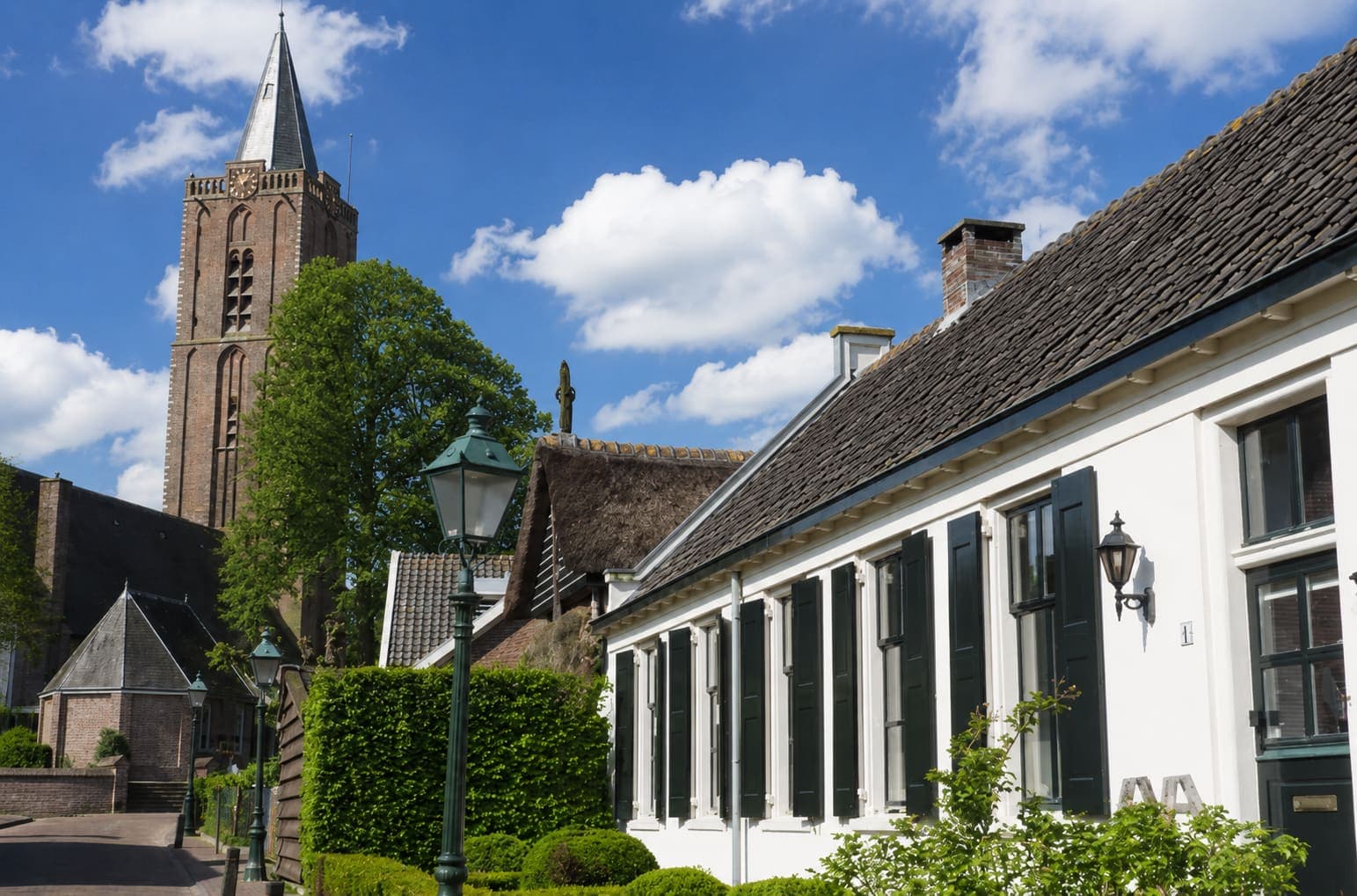
Utrecht · approx. 25 km from Utrecht
Sealant work in Soest
Soest sits against the Utrechtse Heuvelrug on the east side and slopes down to the Eempolder on the west side. Within a single village, that is the difference between firm sand and soft ground that settles. A facade on sand hardly moves at all, a facade towards the polder moves with the ground, and movement determines how wide a sealant joint needs to be.
Since 1959
Experience and craftsmanship from Utrecht
Clear communication
Short lines, clear agreements
100% satisfaction
We only leave once you are satisfied
Lasting quality
Top-quality materials for a long-lasting result
What matters in Soest
On the edge of sand and polder
Pre-war villas and 1930s houses on the high side, post-war extensions on the low side, and a lot of detached housing with plenty of glass.
Around Soestdijk and Soest-Zuid there are villas and 1930s houses with timber window frames, putty and glazing sealant around single glazing. There, the sealing around the glass is often the oldest part of the whole facade. The post-war extensions to the north and west of that were built in terraces and are now well past the first replacement round of their sealant work. Soesterberg belongs to the same municipality but is a different story: there is a lot of much younger building on the former airfield site, with plastic window frames and sealant that is not yet due for replacement.
What makes Soest different from a village further along is that here you have two kinds of substrate under your hands in a single day. On the Heuvelrug the ground is sandy and a facade stays put; towards the Eem there is clay and peat and it slowly sinks. The same house with the same window frames needs a narrower joint on one side of the village than on the other. We measure that at the site survey and do not guess at it.
Soest is spaciously laid out and that works in our favour: wide streets, plenty of driveways and free parking almost everywhere. At the villas we usually just park on the property itself. What we do watch is the height. Many detached houses here have tall facades with large windows, and then a ladder is not enough. That means a mobile scaffold tower or a cherry picker, and we say so in advance so that it does not turn up as a surprise on the bill.
Twenty-five kilometres by road, half an hour's drive. That is far enough that we cannot leave out the call-out charge, and close enough that we will come for a single bathroom. For business work we like to schedule Soest on the same day as Baarn or Soesterberg, because then we make that trip once for three addresses instead of three times.
What we do in Soest
- Bathroom, sanitary & kitchenSealing of sanitary ware, showers, baths, washbasins and kitchens.
- Window frames & glazingNeat, durable sealant work around window frames and glass.
- Facades & structural jointsFacade joints, connection joints and expansion joints in floors and walls.
- Swimming pool & wellnessSealant work in swimming pools, saunas, steam rooms and spas.
- Renovation & maintenanceSealant work during renovation, repairs and periodic maintenance.
- Specialist sealant workFor specific requirements and specialist applications.
You will hear from us within 15 minutes on working days, and the work comes with a 2-year guarantee.
The work here
What we do most often in Soest
Glazing sealant in old window frames
In the villas and 1930s houses the glass is often still set in putty or in a glazing sealant that has been in for decades. It goes hard, shrinks and comes away at the edges, and then water runs down the glass into the frame. Timber rots from that. We take the old sealing out and put in one that can move with the timber.
More about this serviceExpansion joints on the polder side
On the low side of Soest there is clay and peat, and it does not settle at the same rate everywhere. A facade that moves along with it needs a joint that can accommodate that movement without cracking. So the joint width there follows from the movement we measure, and not from whatever happened to be there already. Too narrow and it cracks open within a year.
More about this serviceBathrooms in the post-war districts
The terraced houses from the fifties to the seventies are now on their second or third bathroom, and the sealant in it is usually the oldest thing still in there. Black edges along the bath or in the shower corner come from mould in the sealant, not on it. Scrubbing does not help; the joint has to come out and a sanitary sealant has to go back in its place.
More about this serviceHow we approach it here
Which sealant on what, and what it costs
The substrate decides the sealant
The substrate in Soest differs from street to street, and that determines the choice of sealant more than the age of the house. Painted timber is the most common flank here, and then the sealant adheres to the paint layer and not to the timber. If that paint is loose, the sealant will come away with it later, however neatly the joint was run. That is why, when in doubt, we first take the paint off down to sound timber. Interwar brickwork is softer and more porous than modern brickwork; a primer goes on there, otherwise the brick draws the adhesion out of the sealant. Around glass it is different again: a glazing sealant has to tolerate glass and timber expanding differently in the sun, and an ordinary facade sealant does not. Which of the three it will be, we decide on the spot.
Costs and lead time
The price depends on the number of metres, whether the old sealant has to come out and how easy it is to get at. Cutting out is the real work; running the new joint is quick after that. At the villas the height counts too: if a mobile scaffold tower or cherry picker is needed, that is in the amount and you hear about it in advance. An average bathroom is done in half a day. The glazing of a house with many old window frames takes two days rather than one, because cutting out hard glazing sealant is slow work and you want to keep the glass intact. You hear the amount before we start, including the call-out charge, and curing is waiting time, not working time.
Two routes
Business or homeowner in Soest
For painting contractors running planned maintenance here, Soest is attractive work: a lot of detached property with plenty of linear metres per address. We come in as part of a repainting cycle, or do only the sealant work while you do the rest. The same goes for managers of the post-war stock towards the Eem: there the work is in the facade joints and the connections, and that is easy to schedule per complex. We hand over with videos per address.
For businesses
Contractors, painters, homeowners' associations, property managers and interior fit-out.
See what we do for businessesAlso near Soest
As the crow flies from the centre. By road it is further.
- Soesterberg 5 km
- Baarn 4 km
- Amersfoort 7 km
- Den Dolder 6 km
- Bilthoven 11 km
Is your town or city not listed? See the whole service area.
Questions from Soest
What people in Soest ask most often
Why is my neighbour's joint wider than mine?
Because the ground under your houses can differ. Soest lies on the edge of the Heuvelrug and the Eempolder: on the sand a facade hardly moves at all, towards the polder it slowly sinks along with the ground. A facade that moves needs a wider joint, because the sealant has to be able to accommodate that movement without cracking. That is not carelessness but arithmetic, and we measure it at the site survey instead of copying what was there.
My house dates from before 1994. Does that matter?
Yes, and it is the first question we ask. Until 1994 asbestos was used in certain types of sealant, especially in glazing sealant around windows. With the 1930s houses and villas in Soest that is certainly no theory. We then cut nothing out until it is established what is in it: having a sample tested costs little and takes little time, and only after that do you hear what the work costs. That is the order the rules require, not a hedge.
Will my facade need scaffolding?
That depends on the height, and we say so in advance. Many detached houses in Soest have tall facades with large windows, and above about four metres a ladder is no longer safe and no longer accurate either: you cannot run a clean joint from one. Then a mobile scaffold tower or cherry picker comes in. That costs money, and it is in the price you get in advance, so it is not an item that gets added afterwards.
Can you do Soest and Soesterberg on the same day?
Yes, and it saves you money. The set-up is the fixed part of the price: driving out, unpacking, masking off, clearing up. If we do two addresses on the same day in the same area, that set-up counts once. Soest, Soesterberg and Baarn are close enough together to make that work. Mention it when you make your request, then we schedule it that way straight away instead of having to change something afterwards.
Can the new sealant be painted over?
That depends on the type of sealant, and it is a question to ask before the work, not after. Most sealants that stay permanently elastic cannot be painted over: paint adheres poorly to them and cracks open as soon as the joint moves. Paintable sealant does exist, but it is less stretchable. If you want to paint the facade later, say so when you make your request, then we choose the product with that in mind instead of afterwards.

