
Zuid-Holland · approx. 70 km from Utrecht
Sealant work in Delft
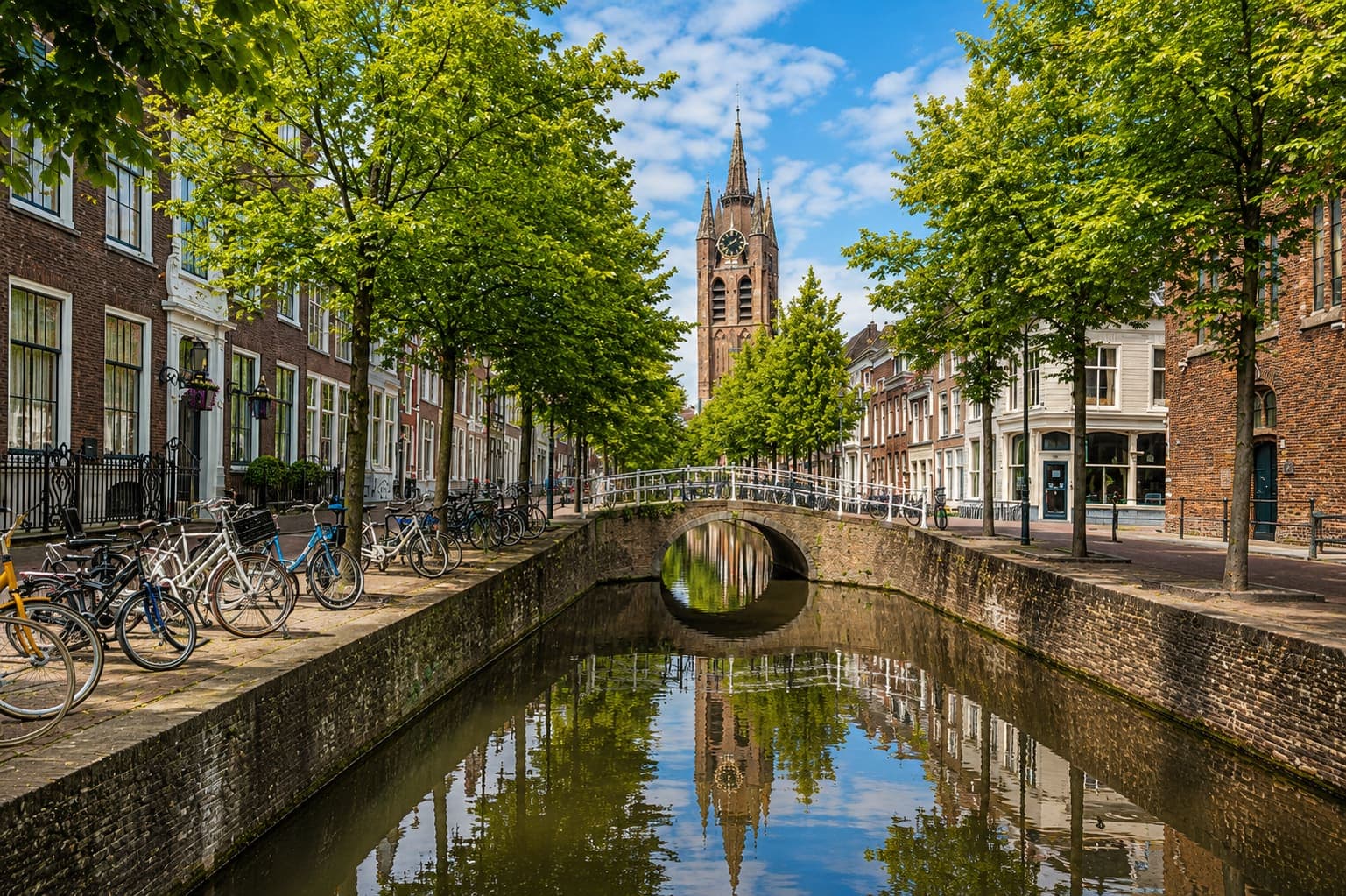
Delft is an old town on soft ground: a protected canal centre full of listed buildings, a campus with laboratories, and thousands of students in rented rooms behind those old facades. Three kinds of sealant work that have little to do with each other, close together.
Since 1959
Experience and craftsmanship from Utrecht
Clear communication
Short lines, clear agreements
100% satisfaction
We only leave once you are satisfied
Lasting quality
Top-quality materials for a long-lasting result
What matters in Delft
Delft is sinking, and that determines the joint size
A protected canal centre with almost fifteen hundred listed buildings, pre-war districts around it, sixties high-rise in the south, low-rise from the eighties and new build on the old railway alignment.
The city centre has been a conservation area since 1978: painted timber window frames, bluestone sills and glazing sealant that is often still the original. Hof van Delft, right up against the centre, is largely pre-war. Voorhof and Buitenhof are from the sixties, with concrete deck-access flats where the facade and expansion joints are due for their second round; in the Poptahof the renewal has been under way since 2005. Tanthof began in the late seventies, with a lot of timberwork on the facade. And Nieuw Delft, on the old railway zone, is new build where you no longer come across painted timber.
The old town stands on timber piles in the peat, and that does not stand still. If an extension on a shallow foundation sinks with the ground while the main house stays put on its piles, that difference ends up in the joint between them. We therefore size the width of such a joint against that difference in height, and not against what looks neat next to an old facade. If the sealant cracks down the middle, the joint was designed too narrow and refilling does nothing.
In the city centre a zero-emission zone for vans has applied since 1 January 2025; under the transitional arrangement a Euro 6 van can still get in until 2028. On top of that lies the autoluwplus low-traffic area: loading and unloading is allowed there within the time windows, Sunday to Friday from 07:00 to 12:00 and Saturday until 10:00. Outside that, an exemption is needed. Outside those hours an exemption is needed. That means starting early.
From Utrecht it is 70 kilometres by road, usually via the A12 and the A4. Our service area is the whole of the Netherlands. Delft is just under an hour's drive, so when scheduling we look at whether there is more to do in the same building or the same street.
What we do in Delft
- Bathroom, sanitary & kitchenSealing of sanitary ware, showers, baths, washbasins and kitchens.
- Window frames & glazingNeat, durable sealant work around window frames and glass.
- Facades & structural jointsFacade joints, connection joints and expansion joints in floors and walls.
- Swimming pool & wellnessSealant work in swimming pools, saunas, steam rooms and spas.
- Renovation & maintenanceSealant work during renovation, repairs and periodic maintenance.
- Specialist sealant workFor specific requirements and specialist applications.
You will hear from us within 15 minutes on working days, and the work comes with a 2-year guarantee.
The work here
What we do most often in Delft
Joints sized to the subsidence
An extension or terrace on a shallow foundation sinks faster here than the house behind it. That difference ends up in the joint between them, so we size it to the movement. At least 8 mm wide, the depth is the width divided by three plus 6 mm, and a backing rod goes in behind so that the sealant adheres on two sides and not three.
More about this serviceShowers in houses let as rooms
Small wet rooms where five people shower one after the other. Acrylic cannot cope with that: it disperses under prolonged exposure to water. Silicone or a hybrid with an anti-mould agent goes in there, and no tighter than 8 mm wide by 6 mm deep: a thin bead of sealant does not last a season at that showering rate. And we tell you what needs to be done about the extraction, because that is usually where the cause lies.
More about this serviceWindow frames in the old centre
Painted timber calls for a joint the painter can paint over. Paint does not stay on silicone, so in such a window frame acrylic goes in, or a hybrid the painter can simply paint over. If original glazing sealant from before 1994 is still in it, it counts as suspected of containing asbestos and we cut nothing out until it is established what is in it.
More about this serviceHow we approach it here
Which sealant on what, and what it costs
The substrate decides the sealant
In the old centre you come across bluestone: sills, kerbstones, plinths. That takes natural stone sealant with chemically bound plasticisers. Free plasticisers migrate into the pores and leave a dark edge along the joint, often only visible after weeks, and you never get it out again. In the flats on the south side the substrate is concrete, and concrete is alkaline: acetoxy silicone loses its adhesion there. In the new build and on the campus you come across powder-coated aluminium and plastic: smooth, so clean and prime first, and plastic expands seven times as much as concrete, so the joint gets wider there. In a student shower it is glazed tiling. S 125 is our standard, but the substrate decides.
Costs and lead time
It goes per linear metre, and the price per metre drops as more metres lie at one address. At the deck-access flats in Voorhof and Buitenhof you notice that most: the facade and expansion joints of a whole block in one go is something quite different from one home in between. So when you make a request, let us know what else is outstanding in the complex. You will not find amounts here, because the rates have not yet been fixed. One difference we can name: in the new build of Nieuw Delft the joint lies clean and open, in a pre-war building the old sealant has to come out completely first. That cutting out is most of the work, so replacing costs more than applying new. After that, curing goes at roughly 2 to 3 mm per day. At home with one bathroom that means two days without showering; in a house let as rooms we can do the wet rooms in turn, so that not everything is closed at once. The work comes with a 2-year guarantee. The movement of the building itself falls outside that: if the building sinks, that is not a fault in the joint. What we do is measure the joint beforehand against the movement that is there, so that it is not laid too narrow, and we say that in advance and not afterwards. We answer a request within 15 minutes on working days. For an address in the city centre we look at the time windows straight away.
Two routes
Business or homeowner in Delft
Between the campus and the Schie lies over a hundred hectares of business park: Schieoevers, Delftechpark and Technopolis, with hundreds of companies in engineering and manufacturing. There it is about technical rooms and labs, where a joint has to withstand cleaning agents and no moisture may get behind it. The other sealant work in Delft is with homeowners' associations (VvE) and managers of the flats in the south, with painters and contractors renovating in the city centre, and with landlords with many wet rooms at one address. If a main contractor hires us for their own job, the VAT is reverse-charged on our invoice.
For businesses
Contractors, painters, homeowners' associations, property managers and interior fit-out.
See what we do for businessesAlso near Delft
As the crow flies from the centre. By road it is further.
- Rijswijk 5 km
- Pijnacker 5 km
- Den Hoorn 3 km
- The Hague 9 km
- Schiedam 8 km
- Rotterdam 12 km
- Naaldwijk 11 km
- Zoetermeer 11 km
Is your town or city not listed? See the whole service area.
Questions from Delft
What people in Delft ask most often
The joint between my house and the extension keeps cracking again. How come?
It is probably too narrow. If the sealant cracks down the middle, that is called cohesive failure and it means the joint cannot cope with the movement. Refilling at the same width then solves nothing. On this ground an extension simply sinks differently from the main house, so a wider joint belongs there. Above 30 mm it is no longer sealant work but an expansion joint profile; we say that in advance. If the sealant comes away along the flank instead, it is adhesion and we look at the substrate and the preparation.
Our building in the city centre is pre-war. Can the glazing sealant just come out?
No. In a building of that age the pane often still sits in its original putty, and everything from before 1994 counts as suspected of containing asbestos: risk class 2 is then the starting point. There has to be clarity about what is in it before a knife goes in; removal is done by a licensed company following the protocol. We do not start on that with a knife. If the glazing has already been replaced, that is usually quick to see and we can simply get to work.
We let rooms and the shower sealant is black within six months. What helps?
As long as the wall does not dry out between two showers, no sealant will keep it free of mould. In a house let as rooms, ventilation is the real problem: for a new bathroom the building regulations (Bbl) require 14 dm³/s. Bleach makes it worse rather than better, because it washes the anti-mould agent out of the sealant and makes the edge porous. We replace the joint and tell you what needs to be done about the extraction.
Our new build in Nieuw Delft has just been handed over. When should we have the joints checked?
First inspection within a year of handover, then every two years. Do that in the cold season: the building components have then contracted and the joint is at its widest, so you see exactly what is no longer keeping up. At the window frames, look straight away at the drainage slots in the bottom sill. If there is sealant in those, the rebate can no longer equalise the pressure and in time that wrecks the insulating glass.
Can you actually get into the low-traffic city centre with the van?
Yes, but not just like that. Since January 2025 the city centre has been a zero-emission zone for vans, and on top of that you may only load and unload within the time windows: Sunday to Friday until 12:00, Saturday until 10:00. Outside those hours an exemption is needed. So we bring the material in early and then carry on working. We cut out and fill in one go, because you do not leave a cut-out joint standing open.

