
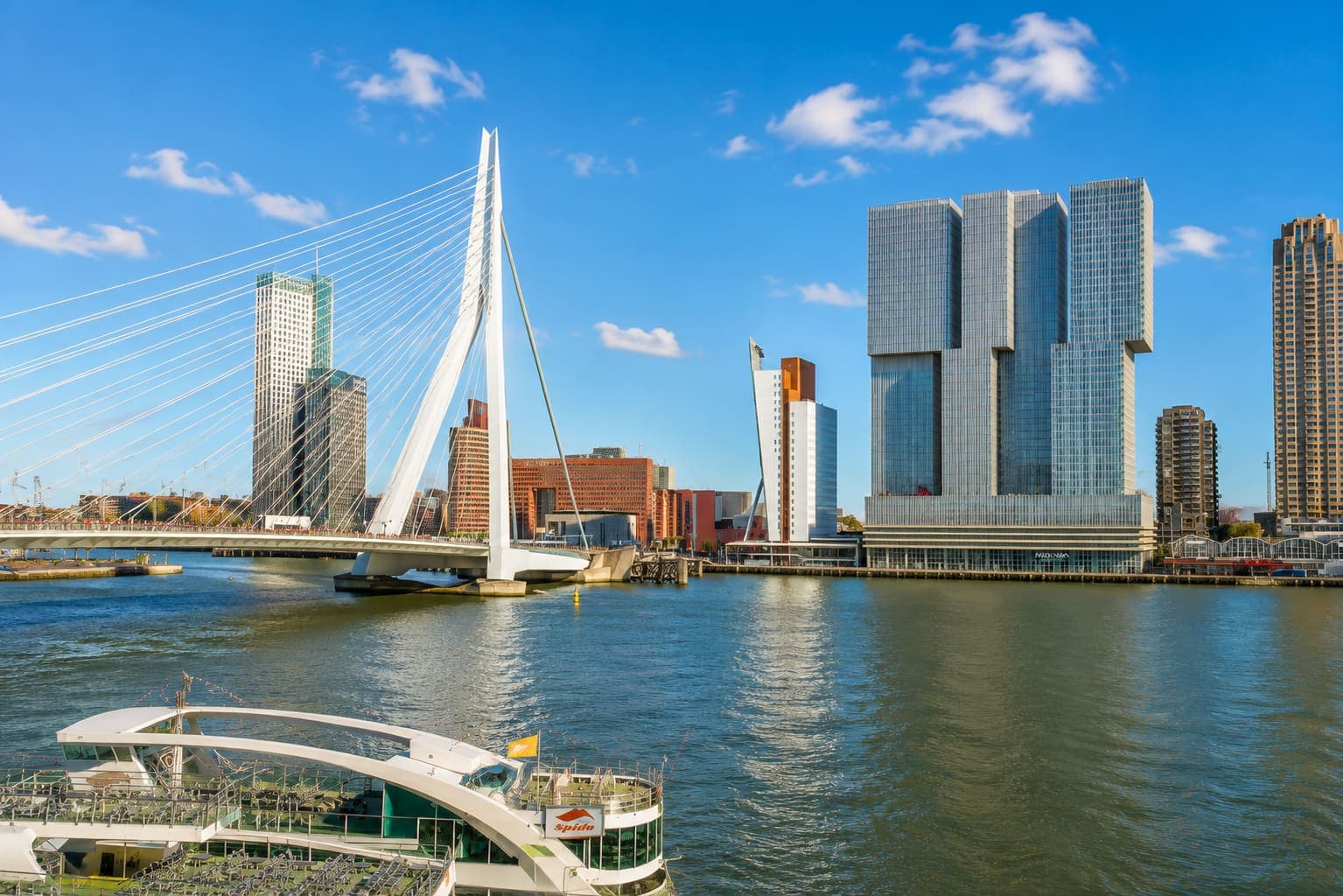
Zuid-Holland · approx. 60 km from Utrecht
Sealant work in Rotterdam
Clay and peat below ground, and tall, heavy buildings standing on it. Above, facades of concrete, aluminium and glass work against each other; below, everything that is not on piles is sinking. Both end up at the same joint, and here it is wider than at a building on firm sandy ground: the width follows from the movement in it.
Since 1959
Experience and craftsmanship from Utrecht
Clear communication
Short lines, clear agreements
100% satisfaction
We only leave once you are satisfied
Lasting quality
Top-quality materials for a long-lasting result
What matters in Rotterdam
Built high on sinking ground
A lot of multi-storey housing: post-war reconstruction in the centre, deck-access and walk-up flats in the post-war polder districts, towers in Rotterdam-Zuid, and pre-war streets in Kralingen, Delfshaven and Vreewijk.
In the centre stands the reconstruction of the fifties: large glazed frontages with steel and aluminium frames, in which the glazing sealant is sometimes still original. From before 1994 it is suspected of containing asbestos. Ommoord was built industrially between 1967 and 1975: angled deck-access flats of concrete elements, so expansion joint after expansion joint. Pendrecht and Zuidwijk are fifties walk-up flats, where sealant work goes along with a maintenance round. Vreewijk is a garden village from 1916 onwards, painted timber, so no silicone. On the Kop van Zuid stand towers with curtain walls of powder-coated aluminium, and neutral-cure sealant goes in there.
The ground is clay and peat, and in places it is sinking by more than a centimetre a year. The house stands on piles, but the garden, the patio and an extension without foundations do not. Every year they grow further apart. So the joint between them is a movement joint and not a bit of edge trim: the width follows from the movement, and 8 mm is the lower limit for elastic sealant.
Inside the ring road there is paid parking almost everywhere, and if the van has to stand at the door where that is normally not allowed, that needs an exemption. We arrange that in advance. In that same area the zero-emission zone for vans and lorries has applied since 2025, with a transitional arrangement for existing vans. In the narrow streets of Delfshaven and the Oude Westen we unload outside rush hour.
Sixty kilometres by road, via the A12 and the A20. Outside rush hour that is just under an hour; in rush hour, half an hour easily gets added. That is why we start early here and drive back before the evening rush hour. Rotterdam lies within the area where we also come for a single address, not only for a whole complex.
What we do in Rotterdam
- Bathroom, sanitary & kitchenSealing of sanitary ware, showers, baths, washbasins and kitchens.
- Window frames & glazingNeat, durable sealant work around window frames and glass.
- Facades & structural jointsFacade joints, connection joints and expansion joints in floors and walls.
- Swimming pool & wellnessSealant work in swimming pools, saunas, steam rooms and spas.
- Renovation & maintenanceSealant work during renovation, repairs and periodic maintenance.
- Specialist sealant workFor specific requirements and specialist applications.
You will hear from us within 15 minutes on working days, and the work comes with a 2-year guarantee.
The work here
What we do most often in Rotterdam
Curtain walls and aluminium frontages
On the Kop van Zuid and in the office towers there is powder-coated aluminium against concrete. Aluminium expands well over twice as much per degree as concrete, so it is precisely that connection joint that sees the most movement. Acetoxy silicone cannot go in there: on aluminium and on alkaline concrete it loses its adhesion.
More about this serviceExpansion joints in precast concrete
The deck-access flats in Ommoord are built up from concrete elements with a joint between them. In Pendrecht and Zuidwijk stands the post-war walk-up housing, with a different kind of junction. Such a joint may adhere on two sides only, not on three: if it also adheres to the base, the middle cannot stretch and it cracks open. That is why a closed-cell PE backing rod goes in behind, because rain gets onto it here.
More about this serviceCold stores and commercial kitchens
Around the port there is food processing, refrigeration and hospitality. There, cleaning is done daily with aggressive agents, and that is exactly what wrecks a joint: chlorine washes the anti-mould agent out of the sealant and makes the edge porous. Acrylic does not belong in there in any case, as it disperses under prolonged exposure to water. We choose the sealant based on the cleaning that will go over it.
More about this serviceHow we approach it here
Which sealant on what, and what it costs
The substrate decides the sealant
Rotterdam is a city of concrete and aluminium. In the flats and the towers you work on precast concrete, cast concrete and powder-coated aluminium, and that calls for a neutral-cure sealant: acetoxy silicone loses its adhesion on alkaline concrete and does not belong on bare aluminium either. In entrances and facade plinths there is natural stone, and then only natural stone sealant with chemically bound plasticisers, because free plasticisers migrate into the pores and you never get that dark edge out again. In Kralingen, Delfshaven and Vreewijk there is painted timber: silicone is not overpaintable, so acrylic or an overpaintable hybrid goes in there. On glazed tiling, silicone with fungicide. The standard is OTTOSEAL S 125, but we choose the product based on the substrate.
Costs and lead time
Take a deck-access block in Ommoord: the same expansion joint recurs there on every floor, and every home has the same junction. If the housing association puts that whole block out as one job, the price per linear metre goes down. If you register one home, it stays one address and there is little to scale. You will not read an amount here; we work that out per request. Two things weigh more here than the metres. Replacement costs more than new, because the old sealant has to come out completely first, and in the post-war flats there is usually already a layer from an earlier round. And access: a cherry picker, scaffolding or facade access equipment is a separate item, so joining a repainting cycle for which the scaffolding is already up saves the most. Curing at 2 to 3 mm per day means something different for everyone. If you live there yourself, after a sanitary joint it is two days without showering. If the home is empty between two tenants, nobody showers and it only determines when the keys can go out again. The work comes with a 2-year guarantee. That covers the joint we apply. Movement and working of the structure fall outside it, and on this ground that is not small print. That is why we first measure how much movement there is in the joint, and say in advance what a guarantee cannot cover.
Two routes
Business or homeowner in Rotterdam
Rotterdam is a city of multi-storey housing, and that determines how sealant work is tendered here. The work sits with contractors, painting contractors, property managers for homeowners' associations (VvE), housing associations and property managers with whole complexes in their portfolio. At such complexes sealant work goes along with planned maintenance and with change of tenancy: many identical homes, one work description, one handover file. In addition there is interior fit-out for offices, and there are companies on the port sites. We work as a subcontractor, with a fixed crew of skilled tradespeople that we manage ourselves. As a subcontractor we apply the VAT reverse charge.
For businesses
Contractors, painters, homeowners' associations, property managers and interior fit-out.
See what we do for businessesAlso near Rotterdam
As the crow flies from the centre. By road it is further.
- Schiedam 7 km
- Capelle aan den IJssel 7 km
- Barendrecht 8 km
- Vlaardingen 11 km
- Ridderkerk 10 km
- Delft 12 km
- Spijkenisse 13 km
Is your town or city not listed? See the whole service area.
Questions from Rotterdam
What people in Rotterdam ask most often
The joints between the concrete elements of our deck-access block are cracking in the middle. Can you refill them?
A crack in the middle of the joint is cohesive failure, and that usually means the joint is too narrow for the movement in it. Refilling does not solve that; in a year you are back there again. We first measure the joint width and look at how long the elements are. Often the joint has to be made wider. And we prefer to look in the cold season, because then the joint is open at its widest.
We are on the twelfth floor. Can you do the window frames on the outside?
That depends on access and not on the metres. If it can be done from a balcony or via the building's facade access equipment, it is ordinary work. If a cherry picker or scaffolding has to come, that is a separate item and you want to combine it with other maintenance on that same facade. The inside junction of the window frame we can do separately; nothing is needed for that.
The patio is sinking away from the rear facade and the joint gets wider every year. Can that be sealed?
Yes, but as a movement joint and not as a bit of edge trim. The house stands on piles and the patio does not, so that difference keeps growing. We make the joint wide enough, put a backing rod in so that the sealant adheres only to the two flanks and not to the base, and choose a sealant that can cope with that stretch. If the tiled floor itself is also sinking at an angle, sealing is a postponement and not a solution. We tell you that then.
Our building from the fifties still has the original sealant around the glass. Do you take that out?
Not just like that. Glazing sealant and putty from before 1994 are suspected of containing asbestos, risk class 2 as standard. So it first has to be established what is in it, and taking it out is a job for a licensed asbestos removal company with the proper paperwork. Once the rebate is clean and has been cleared, we do the new sealing. In the reconstruction-era buildings in the centre that sealant may still be original, so with buildings from before 1994 we ask about it straight away.
In our walk-up flat the sealant in the shower is black again within a year, and at the neighbours above us just the same. Is it the sealant or the building?
Usually the air. In a walk-up flat the extraction is often connected to a shared duct, and if that duct does not draw, your wall stays wet and mould grows on every joint, even a fresh one. For new builds the requirement is 14 dm³/s in a bathroom. If that is nowhere near being met, we say beforehand that it will come back. And never clean with chlorine: that washes the anti-mould agent out of the sealant.

