
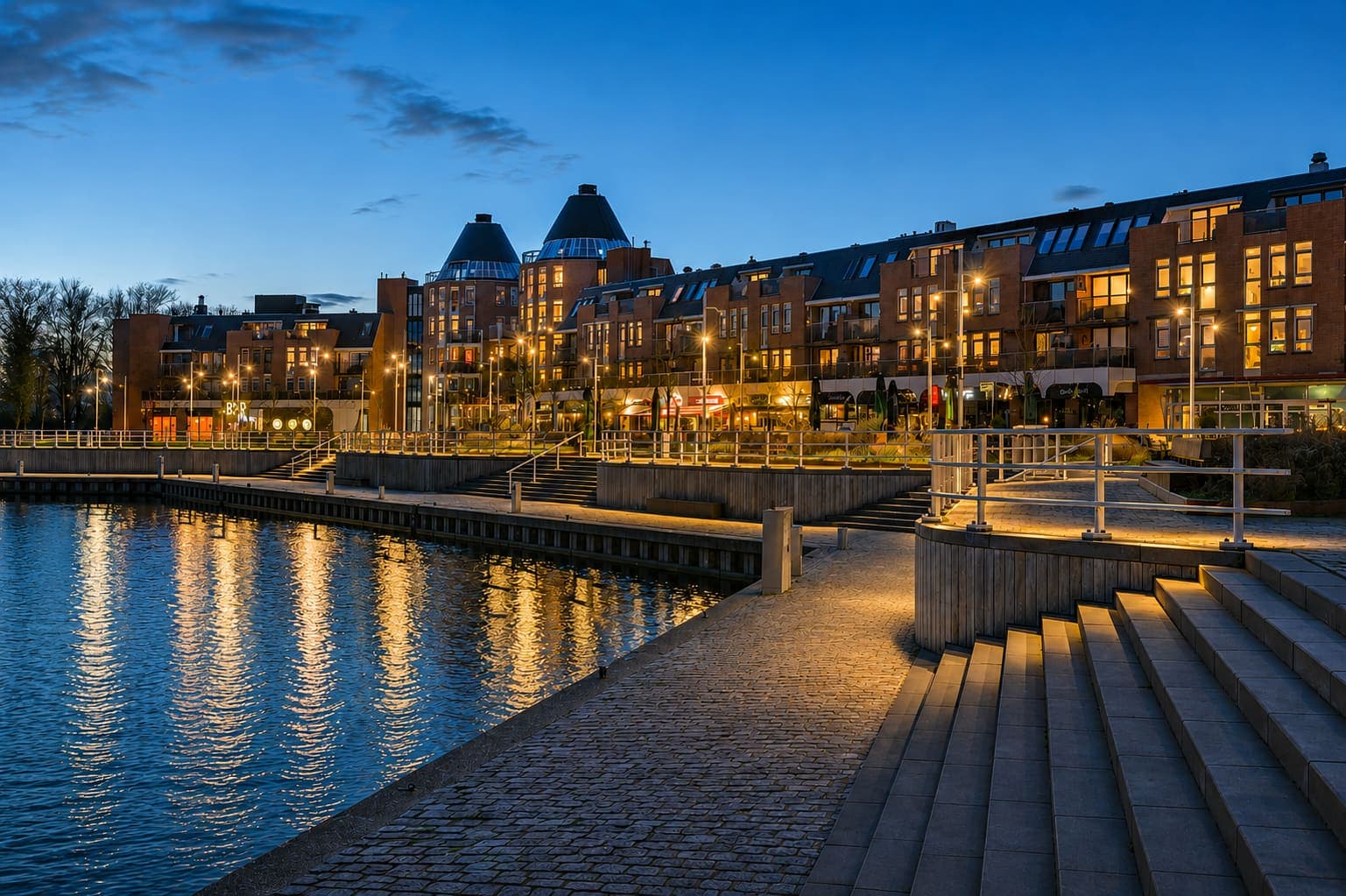
Flevoland · approx. 50 km from Utrecht
Sealant work in Almere
Almere stands on the bed of a lake that was drained in 1968. The house stands on piles down into the sand, the garden and the extension do not. Those two are sinking apart, and the joint between them is the one that most often needs replacing here.
Since 1959
Experience and craftsmanship from Utrecht
Clear communication
Short lines, clear agreements
100% satisfaction
We only leave once you are satisfied
Lasting quality
Top-quality materials for a long-lasting result
What matters in Almere
A city that is still sinking
Almost everything was built after 1976: low-rise housing and social housing from the 1980s and 1990s, new build from after 2000 on the edges. One age, so one wave of maintenance.
Almere Haven got its first residents in the 1970s: low-rise housing around communal courtyards. Almere Stad grew from 1979 onwards. The Muziekwijk (1990) and the Filmwijk (1992) come from the BouwRAI: experimental homes, so rarely two identical window frame connections in one street. Almere Buiten followed from 1984 onwards; the Regenboogbuurt within it dates from 1994 to 1998 and is entirely in colour, so paintable sealant goes there and not silicone. Poort and Duin date from after 2000: aluminium facade frames on their first round of joints.
Elsewhere the age of the building determines what is due. Here the ground counts too. The house stands on piles down into the sand; the garden, the garage and the extension stand on clay that is still compacting. That difference keeps growing. A connection joint that is 10 mm now may be wider in ten years. So the size follows from the movement and not from the eye.
Paid parking applies in the Stadshart and in a few districts around it, such as the Filmwijk and the Stedenwijk; elsewhere you simply park the van outside the door. In the Stadshart all deliveries go underneath the raised shopping deck. And in the home zones in Haven the car stands at the edge of the courtyard, so there we carry cases and backing rod the last stretch.
From Utrecht it is one road: the A27 northwards and over the Stichtse Brug. Fifty kilometres, and that bridge is the busiest stretch in the rush hour. That is why we schedule Almere early in the day. If you have a small job, look at your neighbours: in a street that was built in one go, the sealant is the same age everywhere.
What we do in Almere
- Bathroom, sanitary & kitchenSealing of sanitary ware, showers, baths, washbasins and kitchens.
- Window frames & glazingNeat, durable sealant work around window frames and glass.
- Facades & structural jointsFacade joints, connection joints and expansion joints in floors and walls.
- Swimming pool & wellnessSealant work in swimming pools, saunas, steam rooms and spas.
- Renovation & maintenanceSealant work during renovation, repairs and periodic maintenance.
- Specialist sealant workFor specific requirements and specialist applications.
You will hear from us within 15 minutes on working days, and the work comes with a 2-year guarantee.
The work here
What we do most often in Almere
The joint between house and extension
The main building stands on piles, the extension or shed usually on a shallow foundation. Those two do not sink at the same rate, so the joint between them has to accommodate the difference. A closed-cell PE backing rod goes in behind it: then the sealant adheres to the two flanks and not to the base, and the middle can stretch.
More about this serviceBathrooms from the first building wave
The bathrooms from the 1980s and 1990s here are due for their second or third round. Acrylic does not belong in them: it disperses under prolonged exposure to water. What does go in is a silicone sealant for wet rooms or a hybrid, in both cases with an anti-mould agent in it. A plastic shower tray also flexes under your weight, so that joint has to be able to follow that.
More about this serviceWindow frame connections in plastic
The building wave of the 1980s and 1990s contains a lot of plastic window frames. PVC expands five to eight times as much as concrete, so the connection joint between those two takes almost all the movement and is the first to come loose. That joint is at least 8 mm wide. And the drainage slot in the sill stays open, because sealing it shut wrecks the insulating glass.
More about this serviceHow we approach it here
Which sealant on what, and what it costs
The substrate decides the sealant
What you get under your sealant gun here is young and factory-made. In the bathrooms, glazed tiling, plastic shower trays and acrylic baths: smooth and non-porous, so it stands or falls with degreasing and the right primer. On the facade, plastic window frames, precast concrete, render and powder-coated aluminium facade frames in Poort and the Stadshart. Painted timber is found in the older districts and in the Regenboogbuurt, and silicone cannot go there: you cannot get paint over it. You rarely see natural stone in the facade here, but you do indoors on kitchen worktops. No acetoxy sealant goes on natural stone and concrete. The standard is OTTOSEAL S 125, but the substrate chooses the product.
Costs and lead time
The price is per linear metre, with a sliding scale based on the size of the job. You notice that most strongly here with one single joint. The joint between your house and the extension is only a few metres, and driving out for that alone falls in the most expensive band. In a house from the same building wave, the window frame connections and the bathroom joints are usually the same age; if you include those in the same round, the price per metre drops. Replacing costs more than new, and that difference is almost entirely in the cutting out. With that joint between house and extension in particular it adds up: it has grown with the sinking, so old sealant comes out wide and deep and then the flanks have to be clean before anything new can go in. The aluminium facade frames in Poort and Duin are due for their first round, so that work is not part of it there. There are no amounts here, because the rates have not been fixed yet. Send us your metres and you have a reply within 15 minutes on working days. Sealant cures at roughly 2 to 3 mm per 24 hours: after a sanitary joint, two days without showering is realistic, and with one bathroom in the house you would rather choose those two days yourself. The work comes with a 2-year guarantee. That is about our work and not about the ground: movement and settlement of the structure are expressly excluded, and so is a joint that is too narrow for the movement beneath it. That is why here we first measure how much that joint moves and size it accordingly. That is the part that is in our hands.
Two routes
Business or homeowner in Almere
Social housing here sits with three housing associations, and their districts were built in the same years. That makes the work planned: whole blocks at once, window frame connections along with the repainting cycle, bathrooms at change of tenancy. In addition there are the homeowners' associations (VvE) of the flats in Poort and the Stadshart. Along the A6 lie the business parks Gooisekant, Veluwsekant and Sallandsekant, with floor and wall joints in industrial units. For a painter or interior fit-out company, the sealant work is the last leg of the journey, after the painting and before handover. That is the slot in the schedule where we put ourselves in. If we work under a main contractor, the VAT is reverse charged and you put it in your own VAT return.
For businesses
Contractors, painters, homeowners' associations, property managers and interior fit-out.
See what we do for businessesAlso near Almere
As the crow flies from the centre. By road it is further.
- Huizen 12 km
- Weesp 15 km
- Blaricum 14 km
- Naarden 11 km
- Zeewolde 18 km
- Lelystad 19 km
- Amsterdam 21 km
- Hilversum 20 km
Is your town or city not listed? See the whole service area.
Questions from Almere
What people in Almere ask most often
My extension is cracking away from the house. Can that be solved with sealant?
Often, yes, but not with a narrow joint. The house stands on piles and the extension usually does not, so those two keep drifting apart. The joint has to be able to cope with that movement: at least 8 mm wide, with a backing rod behind it so that the sealant adheres on two sides and not on three. If the crack is in the middle of the old sealant, the joint was designed too narrow and refilling will not help.
Our house dates from 1980. Could there be asbestos in the glazing sealant?
Yes, it could. Almere is a young city, but glazing sealant and putty from before 1994 are suspected of containing asbestos, and Haven, Stad and Buiten all fall within that window. As standard that is risk class 2. So we cut nothing out until it is on paper what is in it. If your window frames still have the original glass, mention that in your request.
We are self-building on a plot in Poort. When does the sealant applicator come?
After the tiler and the plasterer, and before handover. More important is that you think about the joints in advance. An elastic joint wants to be at least 8 mm wide, and the depth is the width divided by three plus 6 mm. If the rebate turns out to be 4 mm afterwards, there is no sealant that makes up for that. In a self-build street every house is different, so we measure and do not guess.
The sealant in my bathroom keeps turning black again. What am I doing wrong?
Probably cleaning with bleach. That washes the anti-mould agent out of the sealant and makes the edge porous, so the mould comes back faster. Also look at the extraction: for a bathroom in a new build the requirement is 14 dm³/s, and a grille clogged with dust does not achieve that. If the mould is in the sealant and not on it, replacing is the only solution.
The joint along my plastic window frames is coming loose. Why there in particular?
Because that is where the most movement is. Plastic expands five to eight times as much as concrete, so that connection joint takes the whole difference. If the sealant comes away along the flank, it is adhesion: dirt, moisture or no primer. If the crack is in the middle, the joint is too narrow. You do not solve the second one with a new cartridge. We prefer to look at it in winter: then the joint is at its widest.

