
Noord-Brabant · approx. 80 km from Utrecht
Sealant work in Tilburg
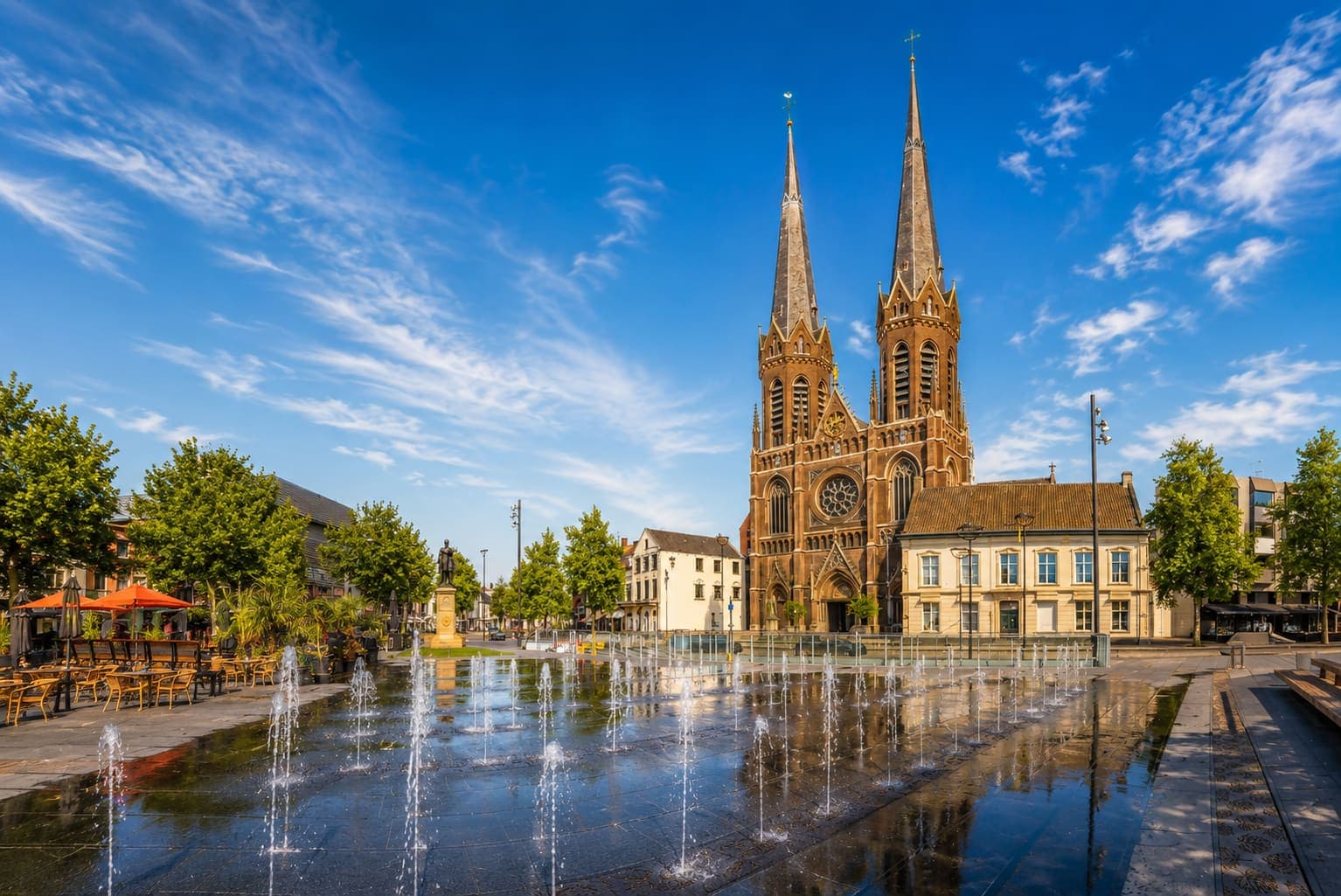
Tilburg grew big on wool and on railways. The halls of that time are now library, museum and offices, with steel windows in them. Around them lie districts that were put up in series in a short time. Two kinds of building, and so two kinds of joints.
Since 1959
Experience and craftsmanship from Utrecht
Clear communication
Short lines, clear agreements
100% satisfaction
We only leave once you are satisfied
Lasting quality
Top-quality materials for a long-lasting result
What matters in Tilburg
What a factory city leaves behind in joints
Terraced houses in series, large extensions in the north and the west, workers' housing around the old factories, and factory halls that are now homes, offices or a museum.
Oud-Noord, with Goirke-Hasselt, Theresia and Groeseind-Hoefstraat, is the old factory quarter: narrow homes with painted timber window frames, where the joint has to go along with the paintwork. Across the Wilhelminakanaal lies Tilburg-Noord. Stokhasselt got its first homes in 1966, with a lot of high-rise in between; deck-access flats from that time often have concrete panels with expansion joints running the full height. Quirijnstok followed in the 1970s, with the same deck-access flats and the same joints. The Reeshof was built from 1980 onwards, most of it in the 1990s: thousands of almost identical terraced houses, so here one site survey says a lot about the rest of the series.
Tilburg lies on the sandy soils of Brabant. Sand bears evenly, and that changes the diagnosis: if a joint cracks, settlement is usually not the first suspect here, but the size. A crack in the middle of the sealant is called cohesive failure: the joint was designed too narrow. Refilling does not solve that. In the stream valleys and on raised ground it can be different, so we look on site.
The old city lies within the four ring roads, Noord, Oost, Zuid and West. Within the ring roads a zero-emission zone applies for vans and lorries, with a transitional arrangement until 2030. If the building is within the ring roads, put that in your request. Then we know in advance what needs arranging for getting materials in and out. There we schedule the cutting out early in the day, because getting the old sealant out takes the most time and the most space. In the Reeshof and Tilburg-Noord there is usually room to load right by the door, so there this does not come into play.
From Utrecht it is about 80 kilometres by road, via the A2 and the A65. How much work there is determines how we plan that trip, so put the size in your request. If you have something small, put it in the same request together with the rest of the building. Then you see in one price what it comes to together.
What we do in Tilburg
- Bathroom, sanitary & kitchenSealing of sanitary ware, showers, baths, washbasins and kitchens.
- Window frames & glazingNeat, durable sealant work around window frames and glass.
- Facades & structural jointsFacade joints, connection joints and expansion joints in floors and walls.
- Swimming pool & wellnessSealant work in swimming pools, saunas, steam rooms and spas.
- Renovation & maintenanceSealant work during renovation, repairs and periodic maintenance.
- Specialist sealant workFor specific requirements and specialist applications.
You will hear from us within 15 minutes on working days, and the work comes with a 2-year guarantee.
The work here
What we do most often in Tilburg
Steel windows in old factory halls
The weaving mills and the railway workshop have become homes, offices and a museum. Such halls have steel windows with large panes and glazing sealant that is often still original. From before 1994 it is suspected of containing asbestos, risk class 2, and then we cut nothing out until it is established what is in it.
More about this serviceShowers in subdivided buildings
Tilburg is a student city, and in the old neighbourhoods around the centre whole houses have been subdivided into rooms. A shower that runs six times a day, behind a window that stays shut. Acrylic disperses under that exposure to water, so that calls for silicone or a hybrid with fungicide. And after sealing, the tray stays dry for two days.
More about this serviceFloor and facade joints on Vossenberg
On Vossenberg and Kraaiven there are halls with concrete floors and concrete facade panels. Concrete expands by 10 to 12 millionths per degree, so the joint width follows from the length of the surface and not from the eye. We calculate that movement first; only then do we fix width and depth.
More about this serviceHow we approach it here
Which sealant on what, and what it costs
The substrate decides the sealant
Four substrates come up most often here. Glazed tiling in the bathrooms of the post-war districts: smooth, so the adhesion has to come from a clean, dry and degreased flank. Concrete in the deck-access flats of Tilburg-Noord and in the halls on the business parks: it is alkaline, and acetoxy silicone loses its adhesion on it. Painted timber in Oud-Noord, where the joint has to go along with the paint; silicone is not paintable, so that calls for acrylic or a paintable hybrid. And natural stone on window boards and kitchen worktops: only natural stone sealant, because edge-zone staining migrates into the pores and never comes out again. OTTOSEAL S 125 is our standard, but the substrate decides.
Costs and lead time
A deck-access flat in Tilburg-Noord shows you fastest what a sliding scale does. The expansion joints between the concrete panels run the full height, so one facade is already a considerable length. We charge per linear metre and the sliding scale moves with the size of the job: the whole block in one job is more favourable per metre than each facade separately. Such a joint is almost never new here. The old sealant and the backing rod have to come out completely first, and that cutting out takes more time than the filling; replacing is therefore more expensive than new work. You will not read an amount here, because the rates have not been fixed yet. If you ask for a price on a working day, you have a reply within 15 minutes. The work we carry out comes with a 2-year guarantee. The movement of the building itself is not covered: if the structure moves or bends more than the sealant can cope with, that is not a guarantee case. That is why we measure the joint beforehand for the movement it is exposed to, and say so in advance if a joint is too tight for that. Then allow for curing: roughly 2 to 3 mm per day. In a subdivided building with one shower for the whole house, that is two days without a shower, and that is something you would rather agree with the residents beforehand. A floor joint in a hall on Vossenberg is deeper and so needs more days before it can take load again. Say when the space needs to be back in use, and we schedule the cutting around that.
Two routes
Business or homeowner in Tilburg
If you are a painter, contractor, housing manager or property manager for a homeowners' association (VvE), you can place the sealant work with us as a separate part. In the post-war blocks that work is mainly in planned maintenance: all the bathrooms in one stairwell, or the expansion joints of one access deck in a single round. If it is a series of identical homes, one site survey is enough for dozens of addresses. On the business parks it is about expansion and floor joints rather than bathrooms. If we work under a main contractor, we invoice with the VAT reverse charge. We prefer to do the site survey in the cold season, because then the building components are contracted and the joints are at their widest.
For businesses
Contractors, painters, homeowners' associations, property managers and interior fit-out.
See what we do for businessesAlso near Tilburg
As the crow flies from the centre. By road it is further.
- Goirle 7 km
- Oisterwijk 12 km
- Loon op Zand 6 km
- Hilvarenbeek 9 km
- Rijen 8 km
- Dongen 9 km
- Waalwijk 14 km
- Breda 20 km
Is your town or city not listed? See the whole service area.
Questions from Tilburg
What people in Tilburg ask most often
I let rooms in an old building. Why does the mould keep coming back?
Usually not because of the sealant. A shower that runs all day in a room where the air cannot get out keeps the joint wet, and then mould grows on it. Bleach makes it worse: it washes the anti-mould agent out of the sealant and makes the edge porous. So look at the air extraction first. For a new-build bathroom the requirement is 14 dm3 per second.
Our building in the Spoorzone still has original steel windows. Can that sealant come out?
Only once it is on paper what is in it. In a hall that has been converted, the windows are often the only thing that has stayed original, and it is precisely in the sealant and the putty around those panes that asbestos can sit once they date from before 1994. That falls into risk class 2 by default: first an asbestos survey, then a notification, and the removal is work for a licensed company. Ask the owner or manager for the survey report. If it says the windows were already dealt with during the conversion, we can get to work. Without that report we do not put a knife in.
We manage a hundred identical homes in the Reeshof. What does that get us?
Time and price per metre. With a hundred identical floor plans we measure one and know the rest too. The fixed part of a job, travel, setting up, masking and clearing up, you pay once and not per home, and all the metres together fall into a more favourable sliding scale. Supply the addresses in one request, and a price per home comes out.
My joint is cracking down the middle, while nothing has subsided anywhere.
That fits the ground here. On sand a foundation rarely settles unevenly, so settlement is usually not the cause. A crack in the middle of the sealant is called cohesive failure: the joint is too narrow for the movement it is exposed to. Refilling then does not last a year. It has to be wider: between 8 and 30 mm, with a depth of the width divided by three plus 6 mm.
The sealant on our plastic window frames is coming away along the edge. How come?
Plastic moves far more than the brickwork around it: some 70 to 80 millionths per degree, against 10 to 12 for concrete. So in the sun such a frame grows, and at night it shrinks again. Coming away along the flank is called adhesive failure. We make the joint wider, put a closed-cell PE backing rod behind it and choose a sealant that can cope with that stretch.

