
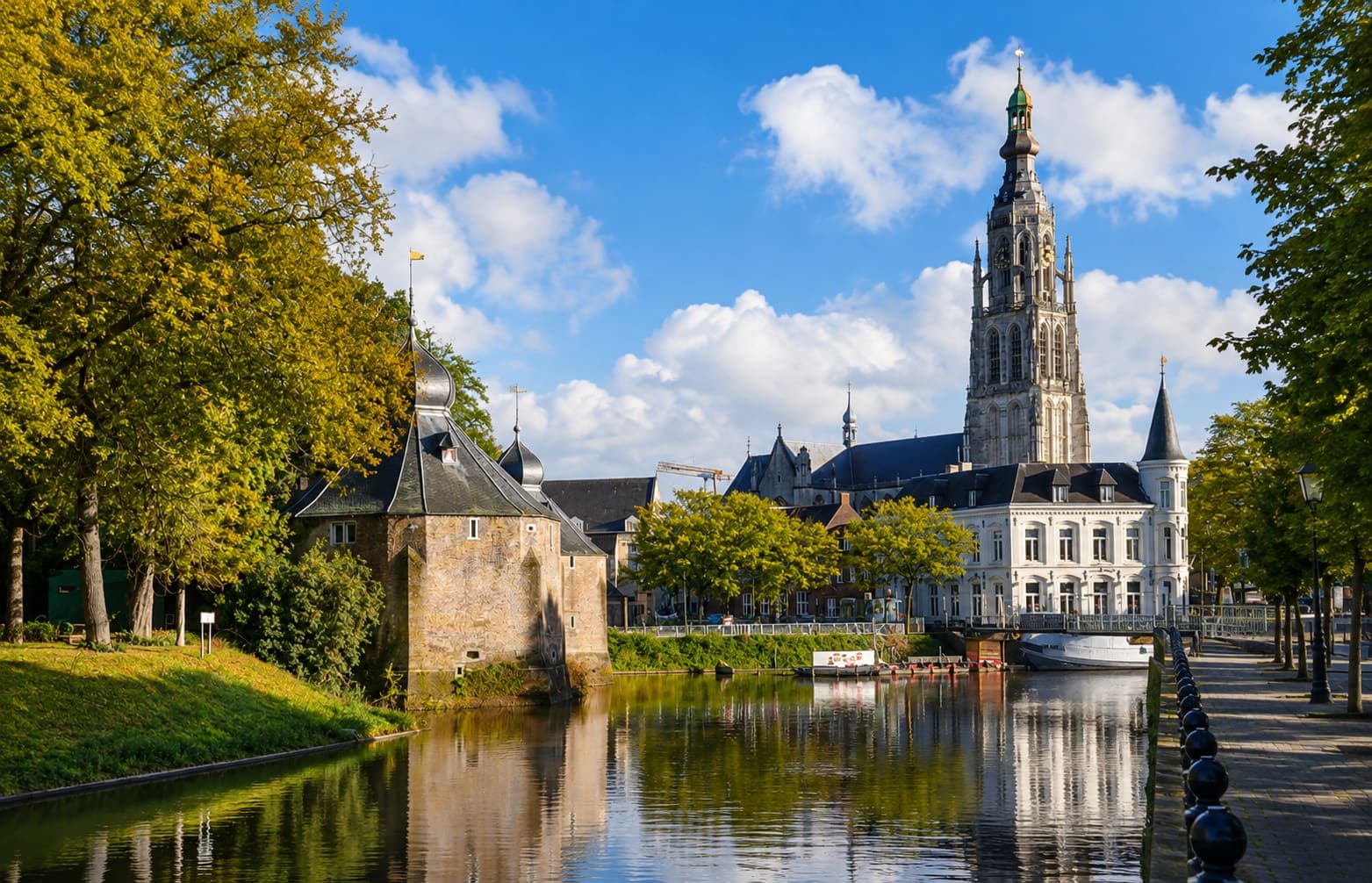
Noord-Brabant · approx. 75 km from Utrecht
Sealant work in Breda
Breda lies on the seam between two types of ground. South of the city there is cover sand, to the north lies wet marine clay with peat beneath it along the Mark. What lies under a building determines how much it moves, and movement determines how wide a sealant joint has to be.
Since 1959
Experience and craftsmanship from Utrecht
Clear communication
Short lines, clear agreements
100% satisfaction
We only leave once you are satisfied
Lasting quality
Top-quality materials for a long-lasting result
What matters in Breda
Two soils, two kinds of joint work
A fortified centre with listed buildings, districts from the thirties around Ginneken and Zandberg, post-war reconstruction flats in the Hoge Vucht, expansion housing from the late seventies onwards in the Haagse Beemden and new build with a lot of glass and aluminium around the station.
The Haagse Beemden was built from 1978 onwards in the water meadows along the Mark: wet grassland on clay, with peat beneath. Of all soil types peat sinks the most, and clay sinks more than sand: if an extension sinks differently from the house, that difference ends up in that one joint. The Hoge Vucht is post-war reconstruction from the sixties, with walk-up and deck-access flats of concrete panels and small tiled bathrooms. Zandberg and Ginneken are from the thirties and older: timber window frames with putty and glazing sealant. Around the station stands new build from after 2012, with powder-coated aluminium.
The conservation area here runs from the medieval centre through the singel area into Ginneken, and it takes in streets from 1850 to 1940. On such a facade the colour and finish of a joint are not a free choice. And if original glazing sealant from before 1994 is still in the window timber, it is suspected of containing asbestos and we cut nothing out until it is established what is in it.
The low-emission zone lies within the singels and applies to lorries: they must be at least emission class 6. With a van you simply drive in. What does chafe is the pedestrian area: loading and unloading is allowed at set times, outside those you need an exemption. From 1 January 2029 that zone becomes zero-emission and also applies to vans, so for maintenance that runs on for years that already counts now. Outside the singels the van simply stands at the door.
From Utrecht it is about 75 kilometres by road, usually via the A27. That is about an hour's drive. If it is one joint in one bathroom, say straight away what other maintenance there is, and we look at whether it fits in one trip.
What we do in Breda
- Bathroom, sanitary & kitchenSealing of sanitary ware, showers, baths, washbasins and kitchens.
- Window frames & glazingNeat, durable sealant work around window frames and glass.
- Facades & structural jointsFacade joints, connection joints and expansion joints in floors and walls.
- Swimming pool & wellnessSealant work in swimming pools, saunas, steam rooms and spas.
- Renovation & maintenanceSealant work during renovation, repairs and periodic maintenance.
- Specialist sealant workFor specific requirements and specialist applications.
You will hear from us within 15 minutes on working days, and the work comes with a 2-year guarantee.
The work here
What we do most often in Breda
Aluminium facade bands at the station
Building has been going on in the Stationskwartier since 2012, with a lot of powder-coated aluminium against concrete. Aluminium expands roughly twice as much as concrete, so that difference ends up in the connection joint: the width follows from the movement and not from the eye. A neutral-cure sealant goes in, never an acetoxy one.
More about this serviceBathrooms in the Hoge Vucht
The walk-up and deck-access flats from the sixties have small bathrooms with glazed tiling. Acrylic does not belong there: under prolonged exposure to water it disperses. Silicone or a hybrid with fungicide goes in, at least 8 mm wide and 6 mm deep, and we cut the old joint out completely first.
More about this serviceExpansion joints on the business parks
On Hazeldonk and Steenakker along the A16 and on De Krogten in Breda-Noord stand large halls of concrete elements. A facade of tens of metres like that moves with the temperature, and all of that ends up in the expansion joint. A closed-cell backing rod belongs behind it: then the sealant adheres to two flanks and the middle can stretch. If it also adheres to the base, it cracks.
More about this serviceHow we approach it here
Which sealant on what, and what it costs
The substrate decides the sealant
Drive here from the singels to the station and you come across four substrates that each call for a different sealant. Bluestone sills and natural stone in the centre and along the singels: only natural stone sealant with chemically bound plasticisers may go on those. Ordinary plasticisers migrate into the pores and leave a dark edge weeks later. You cannot get that out again; polishing does not help. Glazed tiling in the post-war bathrooms, where it comes down to a clean, dry flank. Powder-coated aluminium at the new build around the station, which calls for a neutral-cure sealant and not an acetoxy one. And painted timber in Zandberg and Ginneken: if paint has to go over it, it becomes acrylic or a paintable hybrid, because paint does not go over silicone.
Costs and lead time
What it costs here depends above all on how much you have done in one go. The work goes per linear metre, and the sliding scale follows the size of the job. In the Hoge Vucht you see what that does: for one bathroom in a walk-up flat we drive out, set up and clear away again for that one joint. If it is all the bathrooms in the block, or an access deck that is in the planned maintenance, that is setting up once and then the same operation over and over. You see that in the price per metre, just as with an expansion joint that runs along the full facade of a hall on Steenakker. There are no amounts here yet, because the rates are not fixed; you get them in the quote and not as an estimate that later turns out different. It also makes a difference whether there is already sealant in place. At the new build around the station the joint goes into a clean rebate, in the tiled bathrooms of Breda-Noord the old sealant has to come out completely first. That cutting out takes more time than the sealing itself, so replacing is dearer than new. With sanitary work, allow for the curing time: sealant cures at roughly 2 to 3 mm per day. If you have one bathroom at home, that is two days without showering. Say so if that is inconvenient, and we choose another day for it. If you are working towards a handover, the last sanitary joint cannot go in on the handover day. Put in your request what there is and where it is, and you have an answer within 15 minutes on working days between 09:00 and 22:00 and know whether it fits in one trip. The work comes with a 2-year guarantee. Movement of the building itself falls outside that: if an extension sinks or the structure moves, that is not a guarantee case. That is why we measure the joint beforehand against the movement that is there, so that it is not laid too narrow, and we say so in advance if a joint is too tight for that.
Two routes
Business or homeowner in Breda
If you are a painter, contractor or property manager for a homeowners' association (VvE), you can place the sealant work with us as a separate part. In the flats in Breda-Noord and the Haagse Beemden that work is mainly in planned maintenance: all the bathrooms in a block, or the facade joints of an access deck in one round. In interior fit-out it is about worktops and wall panels. On business parks such as Hazeldonk, Steenakker and De Krogten it is about expansion joints in concrete facades and the sealing of facade elements in warehouses. We work as a subcontractor, with the VAT reverse charge. Put in your request how many metres it is and what the joint has to adhere to, and you quickly know where you stand.
For businesses
Contractors, painters, homeowners' associations, property managers and interior fit-out.
See what we do for businessesAlso near Breda
As the crow flies from the centre. By road it is further.
- Etten-Leur 8 km
- Oosterhout 10 km
- Rijen 12 km
- Zundert 14 km
- Zevenbergen 13 km
- Dongen 15 km
- Tilburg 20 km
- Roosendaal 21 km
Is your town or city not listed? See the whole service area.
Questions from Breda
What people in Breda ask most often
The joint between my extension and the house keeps cracking open. Why?
Usually because it is too narrow for the movement it takes. On the peat and clay ground north of the city an extension often sinks differently from the main house, and that difference ends up in that one joint. If the sealant cracks in the middle of the joint, that is called cohesive failure and refilling is pointless. Then the joint has to be wider: at least 8 mm, and the depth is the width divided by three plus 6 mm.
Our building stands within the singels. Can sealant just go in there?
Not just like that on the outside: in the conservation area the municipality has a say in what you change on the facade, so discuss that before a colour is chosen. Technically the main rule is simple. On bluestone and other natural stone only natural stone sealant with chemically bound plasticisers goes; anything else leaves a dark edge that never comes out. And glazing sealant from before 1994 is suspected of containing asbestos. Nobody cuts into that until it is established what is in it.
Can you get the van right up to the door in the centre?
Within the singels there is a low-emission zone, but it applies to lorries; with a van you simply drive in. From 1 January 2029 it becomes a zero-emission zone and also applies to vans. The pedestrian area is the point: there you may load and unload at set times and outside those only with an exemption from the municipality. Let us know in your request whether there is a loading bay or an exemption, and we plan the day around it.
In our walk-up flat in the Hoge Vucht the sealant in the shower keeps turning black again, even after a new joint. Is that the wrong sealant?
Usually not. Mould grows on the joint and not in it, and that growth comes from moisture that lingers. Bleach seems to help, but washes the anti-mould agent out of the sealant and makes the edge porous. After that the mould actually comes back faster. So look at the ventilation first; for a new bathroom the requirement is 14 dm³/s. We put in silicone or a hybrid with fungicide and give you the maintenance instructions.
We are building at the station with aluminium facade elements. Which sealant goes in there?
A neutral-cure sealant, never an acetoxy silicone. That attacks bare aluminium and loses its adhesion on alkaline concrete. Beyond that, two things often go wrong. You calculate the joint width from the movement between aluminium and concrete and not from what looks good. And the drainage slots in the bottom sill stay open: if you seal those shut, the water stands in the rebate and the insulating glass is done for.

