
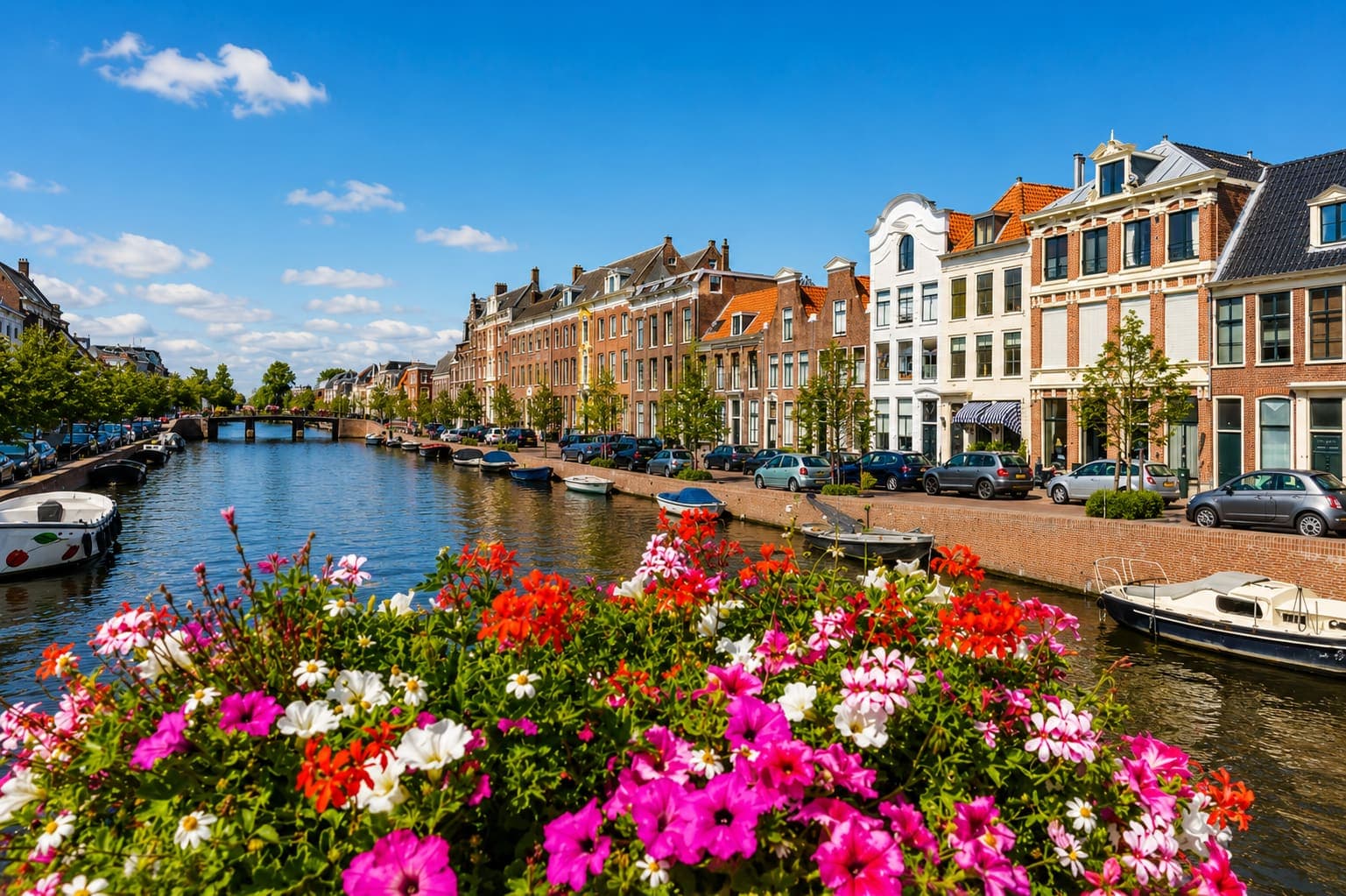
Noord-Holland · approx. 55 km from Utrecht
Sealant work in Haarlem
The old city lies on a beach ridge of sand, but the ground there varies from street to street: some of the buildings stand on that sand, some on timber piles in softer layers. Schalkwijk lies on clay and peat and was put on driven piles. So what a facade does depends on the foundation and not only on the ground, and that movement determines how wide a joint has to be.
Since 1959
Experience and craftsmanship from Utrecht
Clear communication
Short lines, clear agreements
100% satisfaction
We only leave once you are satisfied
Lasting quality
Top-quality materials for a long-lasting result
What matters in Haarlem
Sand, peat and timber piles, sometimes in one street
A dense historic city centre along the Spaarne, a belt of pre-war residential districts around it, and on the south-east side Schalkwijk: blocks of flats from the 1960s and 1970s.
In the Vijfhoek and around the Grote Markt stand buildings centuries old: timber window frames, glazing in putty, bluestone steps and plinths. The belt around it, with Kleverpark, Bomenbuurt, Frans Halsbuurt and Rozenprieel, was built up between 1880 and 1940; there the work is in facade connections after window frame replacement. Schalkwijk came in four parts: Europawijk and Boerhaavewijk in the 1960s, Meerwijk and Molenwijk after that. Deck-access flats, concrete expansion joints and bathrooms that are identical per block.
It is not the ground that determines how much a facade moves, but the foundation beneath it. Schalkwijk stands on clay and peat, but was put on driven piles in the 1960s, and then the movement is mainly in temperature and in the difference between two materials. In the old city some stand on the sand ridge and some on timber piles, and there settlement can indeed play a part. So we look per address at what the building stands on. If the crack is in the middle of the joint, the joint was designed too narrow and topping up does not help; it has to be wider, and above 30 mm elastic sealant no longer holds either. The beach is six kilometres away, and you notice that on the west facade: it makes the biggest temperature jump, so that is where the joint width is most critical.
Mind the van. Since 1 June 2025 the centre of Haarlem has had a zero-emission zone for vans and lorries, and since 1 March 2026 fines have been issued. Exactly where the boundary runs is on the municipality's map. That determines where the van ends up and how much we carry. In the city centre parking is paid and scarce; at a hofje the road ends at a gate. In Schalkwijk you simply park in front of the flats.
From Utrecht it is 55 kilometres by road, past Schiphol and the ring road. In the rush hour that drive gets considerably longer, so we prefer to schedule Haarlem early in the day. If you have several addresses or several rooms, put them in one request: the more metres there are in one job, the lower the price per metre.
What we do in Haarlem
- Bathroom, sanitary & kitchenSealing of sanitary ware, showers, baths, washbasins and kitchens.
- Window frames & glazingNeat, durable sealant work around window frames and glass.
- Facades & structural jointsFacade joints, connection joints and expansion joints in floors and walls.
- Swimming pool & wellnessSealant work in swimming pools, saunas, steam rooms and spas.
- Renovation & maintenanceSealant work during renovation, repairs and periodic maintenance.
- Specialist sealant workFor specific requirements and specialist applications.
You will hear from us within 15 minutes on working days, and the work comes with a 2-year guarantee.
The work here
What we do most often in Haarlem
Connection joints on the seaward side
The west facade here catches sun and salty air both. We prefer to inspect those joints in the cold season: then the building components are contracted and the joint is at its widest, so you see how much movement the sealant really has to accommodate. No silicone goes on painted timber: paint does not adhere to it.
More about this serviceBathrooms in a subdivided building
Many buildings in and around the centre have been subdivided into flats, with a shower in a place where a bathroom was never intended. Acrylic does not hold up to that: under prolonged exposure to water it disperses. Silicone or a hybrid with fungicide belongs in there, in a joint at least 8 mm wide and 6 mm deep.
More about this serviceExpansion joints measured against the movement
Deck-access flats and industrial units here stand on raised ground with clay and peat beneath it. Concrete components expand and contract, and the ground does not sink at the same rate everywhere. An expansion joint has to be able to cope with that sum: the width follows from the movement and not from what looks nice. Concrete is also alkaline, and acetoxy silicone comes loose on it.
More about this serviceHow we approach it here
Which sealant on what, and what it costs
The substrate decides the sealant
Painted timber predominates in the city centre and the pre-war belt. Silicone cannot go on that, because it is not paintable; it becomes acrylic or a paintable hybrid. Bluestone is in steps, sills and plinths: only natural stone sealant with chemically bound plasticisers, otherwise you get edge-zone staining and that is irreparable. Polishing does not help. Concrete in the flats of Schalkwijk and the units in the Waarderpolder is alkaline, so no acetoxy silicone goes on it. After a renovation there are plastic or powder-coated aluminium window frames in, and plastic expands far more per degree than concrete. So the connection joint around such a frame becomes wider. Our standard is OTTOSEAL S 125, but what goes in depends on what it has to adhere to.
Costs and lead time
The price is per linear metre, and the more metres there are in one job, the lower that price per metre. In Schalkwijk that pays off most: the bathrooms in a deck-access flat are the same per block, so whoever has a whole row done at once comes out lower per metre than the resident who only has their own shower replaced. We do not put an amount with it, because the rates have not been fixed yet. Replacing costs more than new: in those flats the old sealant is already in and has to come out completely first, whereas a facade joint after window frame replacement starts empty. In a bathroom the curing counts too, roughly 2 to 3 mm per 24 hours, so two days without showering. If there is only one shower in a subdivided building, we lay that joint at the end of the week; in a walk-up block we go home by home, so that the whole block is not without a shower at the same time. Put in your request roughly how many metres it is and where the van can stand; you have a reply within 15 minutes on working days. The work comes with a 2-year guarantee. That covers our work, not the movement of the building around it: settlement and movement of the structure fall outside it, on the clay of Schalkwijk just as much as on the sand of the old city. What we do about it is measure the joint against the movement that is there, and determine the width from that.
Two routes
Business or homeowner in Haarlem
The Waarderpolder holds Haarlem's commercial property: units, offices, facade elements and expansion joints that have to be redone every so many years. In the city centre the business work is in subdivided buildings: many homeowners' associations (VvE), small bathrooms in places where one was never intended, and a repainting cycle that the sealant joint belongs with. In Schalkwijk and in the post-war flat neighbourhoods of Haarlem-Noord it is about series: the same flat, the same bathroom, the same joint. What you see in one home is the same throughout the block. If you outsource the sealant joint as a painter, maintenance company or contractor, we work as a subcontractor and the invoice goes to you with the VAT reverse charged.
For businesses
Contractors, painters, homeowners' associations, property managers and interior fit-out.
See what we do for businessesAlso near Haarlem
As the crow flies from the centre. By road it is further.
- Bloemendaal 4 km
- Heemstede 5 km
- Zandvoort 8 km
- Hoofddorp 9 km
- IJmuiden 9 km
- Beverwijk 11 km
- Amsterdam 18 km
Is your town or city not listed? See the whole service area.
Questions from Haarlem
What people in Haarlem ask most often
Our building is in a conservation area. Can the sealant work simply be replaced?
Usually, yes, but check. Haarlem does not only have a conservation area in the centre; parts of Noord, Zuid and Zuid-West fall under it too, and separate rules apply to a national monument. Does anything change in the appearance, that is the colour, the width or the material in the facade? Then check with the municipality. We first lay a test piece on an unobtrusive stretch of facade, so you see what you get.
There is old glazing sealant in our window frames. Can you take it out?
We cut nothing out until it is known what is in it, and with Haarlem window frames that is no formality. Glazing sealant and putty from before 1994 are suspected of containing asbestos, risk class 2 as standard, and in the city centre and the pre-war belt that is simply the year of construction. Survey first, then notification, then removal by a licensed asbestos removal company. After that we seal the rebate again, with the drainage openings in the sill open, because a slot sealed shut does not let the water out and wrecks the insulating glass.
In our flat in Schalkwijk the facade sealant keeps cracking in the same place. How is that possible?
Look at where it cracks. If the sealant comes away along the flank, it is the adhesion: wrongly prepared, or the wrong product on this substrate. If it cracks in the middle of the joint, the joint is too narrow for the movement. On the clay and peat under Schalkwijk that movement is greater than on the sand of the old city. Refilling does not solve that: the joint has to be wider, with a backing rod behind it so that it adheres on only two sides.
We live in a hofje in the city centre. Can you actually work there?
Yes, it just takes planning. The road stops at the gate, so everything goes in by hand: sealant sausages, cutting-out tools, rubbish bag. Parking there is paid and scarce, and with the zero-emission zone around it we do not simply put the van outside the door. Tell us in advance whether there is a loading bay or a driveway and how many metres the walk is. Then the right approach is in the quote from the start and not in the costing afterwards.
Our shower in the city centre is in what used to be a cupboard, and the sealant keeps turning black again. Does it need a different sealant?
Rarely. First look at the extraction: a shower built later into a room or a cupboard often has no decent extraction. For new build the rule is 14 dm³/s in a bathroom; if you fall far short of that, the steam lingers and mould grows on the joint, however well it is fitted. Do not attack it with bleach: chlorine-based cleaners wash the anti-mould agent out of the sealant and make the edge porous. Then it comes back faster than before.

