
Noord-Brabant · approx. 55 km from Utrecht
Sealant work in Den Bosch
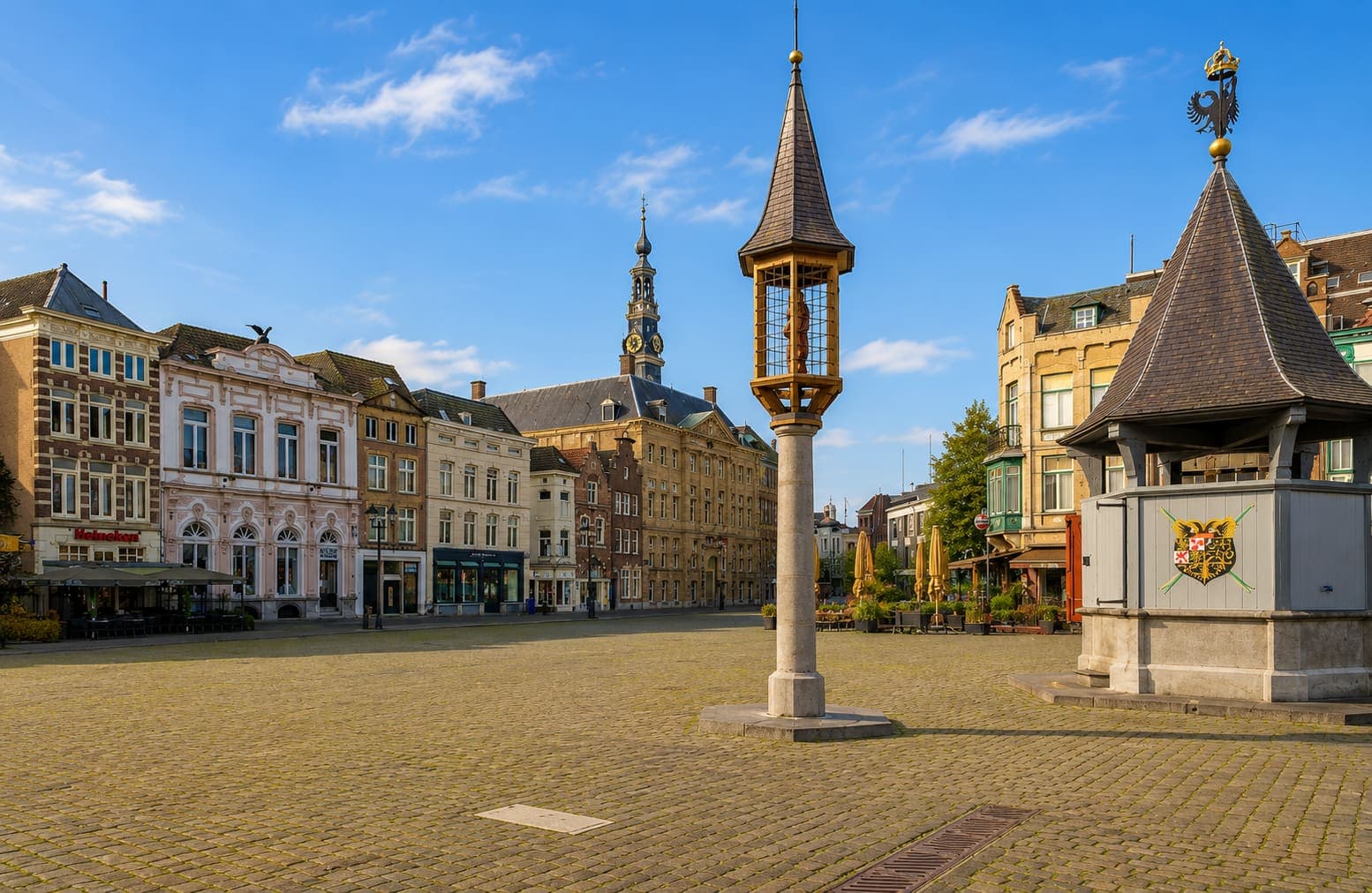
Den Bosch lies where the Dommel and the Aa meet and flow on to the Maas as the Dieze. The groundwater is high here and the ground around it is soft. Movement in the structure eventually ends up in the joints, and that is where our work begins.
Since 1959
Experience and craftsmanship from Utrecht
Clear communication
Short lines, clear agreements
100% satisfaction
We only leave once you are satisfied
Lasting quality
Top-quality materials for a long-lasting result
What matters in Den Bosch
What sinking ground does to joints
A protected city centre with bluestone and render, pre-war neighbourhoods in brick, post-war expansion areas on polder ground and new build in concrete and aluminium by the station.
The city centre has been a protected townscape since 1972: bluestone and render on show, so natural stone sealant and a colour test beforehand. De Muntel and Hinthamerpoort date from the 1920s and 1930s, with timber window frames in which the glazing sealant may still be original. Maaspoort was built in the polder from 1977 and De Groote Wielen from 2005; there the work is in connection joints where the settlement ends up. The Paleiskwartier dates from after 1995: concrete against powder-coated aluminium.
The Dommel and the Aa break through the sand ridge here, and beyond it lie clay and peat that hold the water. Parts of a building on their own foundations therefore sink differently from the house next to them, and that difference ends up in the connection joint. How wide that joint needs to be therefore depends on where you are standing: on the sand ridge under the walled town there is less movement than in the polder outside it, and the same joint needs more room there. We do not go below 8 mm: that is the minimum joint width the VMRG applies for elastic sealant. Above 30 mm we agree it beforehand.
Since 1 March 2025 the city centre has been a zero-emission zone for vans and lorries. Euro 5 vans are still allowed in until 1 January 2027 and Euro 6 until 1 January 2029; for lorries the transition runs until 2030. For a single day there is a one-day exemption. The walled town is otherwise largely car-free, with time windows: we unload at the door and park the van further away. Some buildings stand over the Binnendieze, and you cannot reach that rear facade from the street.
The A2 runs in one straight line from Utrecht to Den Bosch, 55 kilometres. In the walled town, unloading at the door is only possible within the time windows, so we agree beforehand what time we will be there. We leave early. In the walled town that saves working time, because unloading at the door is only possible within the time windows. If a larger project is running, we fit in with the contractor's schedule.
What we do in Den Bosch
- Bathroom, sanitary & kitchenSealing of sanitary ware, showers, baths, washbasins and kitchens.
- Window frames & glazingNeat, durable sealant work around window frames and glass.
- Facades & structural jointsFacade joints, connection joints and expansion joints in floors and walls.
- Swimming pool & wellnessSealant work in swimming pools, saunas, steam rooms and spas.
- Renovation & maintenanceSealant work during renovation, repairs and periodic maintenance.
- Specialist sealant workFor specific requirements and specialist applications.
You will hear from us within 15 minutes on working days, and the work comes with a 2-year guarantee.
The work here
What we do most often in Den Bosch
Window frames in the pre-war neighbourhoods
In 't Zand, De Muntel and Hinthamerpoort there are timber window frames with glazing sealant that is sometimes still original. De Muntel and Hinthamerpoort date from the 1920s and 1930s, so that sealant is from well before the 1994 cut-off: suspected of containing asbestos, risk class 2. We then cut nothing out until it is established what is in it. If it is clean, the rebate is opened up and we reseal it.
More about this serviceSettlement joints at extensions and patios
On the polder ground in Maaspoort, Empel and De Groote Wielen an extension or paving sinks differently from the house itself. That connection joint has to be wide enough for that difference, so a backing rod goes behind it: closed-cell PE outdoors. That way the sealant adheres on two sides and not to the base, and the middle can stretch. What we do is measure the joint for the movement that is there, so that it is wide enough for it. The settlement itself falls outside the guarantee: no sealant will stop a building from sinking.
More about this serviceBathrooms in the new build
In De Groote Wielen, Willemspoort and Empel there is crisp tiling in small, well-sealed bathrooms. Those need silicone or a hybrid with fungicide, not acrylic: that breaks down under prolonged exposure to water. A new bathroom must be able to extract 14 dm³/s; if the ventilation does not manage that, the joint is not your problem.
More about this serviceHow we approach it here
Which sealant on what, and what it costs
The substrate decides the sealant
Between the walled town and the Paleiskwartier, four substrates sit side by side, and each calls for a different sealant. Bluestone in the city centre, in sills, plinths and string courses: only natural stone sealant with chemically bound plasticisers, because free plasticisers are drawn into the pores and leave a dark edge that never comes out. Concrete and powder-coated aluminium in the Paleiskwartier: no acetoxy silicone, which loses its adhesion on alkaline concrete. Painted timber in the pre-war neighbourhoods: if it is going to be painted over, then acrylic or a paintable hybrid, because paint will not adhere to silicone. Glazed tiling in the new build: silicone with fungicide. That is why we ask beforehand what the sealant has to adhere to, and not what colour it should be.
Costs and lead time
The price is per linear metre, with a sliding scale based on the size of the job. In the walled town you notice that most. Getting in takes time here: the zone, the time windows, and a van parked further away. If we do all the sills and window frames of the building in one go, you pay for that set-up once instead of again for every separate joint. The same applies to a block in De Muntel or Hinthamerpoort: the same window frames from the same years, so the work repeats itself window by window. The rates are not yet fixed, so we do not put a figure here that would turn out differently later anyway. What is certain: replacement costs more than new work. The old sealant has to come out completely first, and against bluestone that is slow going, because the stone must not come to harm. A bathroom or a set of window frames is not finished once the sealant is applied: sealant cures at roughly 2 to 3 mm per day, so no showering for two days after a sanitary joint. If you have one bathroom, plan for that. Send us the measurements and you will have an answer within 15 minutes on working days.
Two routes
Business or homeowner in Den Bosch
De Rietvelden is the largest business park in the city, with De Brand on the south-east side by the A2 and the Bruistensingel in the north, and offices at Pettelaarpark and in the Paleiskwartier. That is different work from a residential area: long facades in concrete and powder-coated aluminium, where the connection joint between two different materials sees the most movement. You can place this work with us as a contractor, painting contractor, homeowners' association (VvE) manager or housing association, and as an interior fit-out company that wants its worktops and wall connections sealed. If we work under your main contract, the VAT is reverse-charged on our invoice. If there is a handover date attached, tell us straight away: a sanitary joint has to cure, so it cannot go in on the morning of the handover. All the bathrooms in one complex or all the window frames in a block go into one work specification, with one sliding scale across the total metres.
For businesses
Contractors, painters, homeowners' associations, property managers and interior fit-out.
See what we do for businessesAlso near Den Bosch
As the crow flies from the centre. By road it is further.
- Vught 7 km
- Rosmalen 6 km
- Sint-Michielsgestel 8 km
- Vlijmen 6 km
- Boxtel 14 km
- Zaltbommel 11 km
- Oss 17 km
- Tilburg 23 km
Is your town or city not listed? See the whole service area.
Questions from Den Bosch
What people in Den Bosch ask most often
My house dates from 1930 and the sealant around the panes has gone rock hard. Can it just come out?
Not just like that. A house from 1930 with the original putty is well before the 1994 cut-off, and then glazing sealant is suspected of containing asbestos: risk class 2 as standard. First it has to be established what is in it. If it is clean, we take it out and reseal the rebate. If it does contain asbestos, we keep our hands off and that part goes to a licensed asbestos removal company. Cutting it out and seeing what happens is not an option here.
We have a building in the walled town with bluestone sills. A dark edge has appeared along the sealant. Can we still get it out?
No. That is edge staining: plasticisers from the sealant have been drawn into the pores of the stone, often only visible weeks later. It is in the stone and not on it, so cleaning will not get it out, and a harsh cleaner is more likely to damage the bluestone than to shift the stain. It can only be prevented beforehand, with natural stone sealant in which the plasticisers are chemically bound. With bluestone in the city centre we therefore first ask exactly what the stone is.
The joint between my extension and the house cracks open again every year.
Then the joint has probably been designed too narrow. If it cracks in the middle of the sealant, that is called cohesive failure and refilling will not help: the joint needs to be wider. If it comes away along the flank, the problem is in the adhesion or the preparation. On the soft ground here an extension on its own foundation sinks differently from the house, so that joint really has to be able to move. Do bear in mind that a guarantee does not cover the settlement itself. What we take on is the sizing and the application: the joint wide enough for the movement we measure, with a backing rod behind it.
Our bathroom in De Groote Wielen is small and only has mechanical extraction. The sealant in the shower turns black within a year. Is the wrong sealant in there?
Usually not. Anti-mould sealant works, but the agent in it is used up if the room stays permanently wet. Chlorine-based cleaners actually wash that agent out faster and make the edge porous, so with those it goes faster rather than slower. For a new bathroom the ventilation requirement is 14 dm³/s. We replace the joint, and we tell you if the extraction is the cause.
We are in the city centre. Do you still come there now that there is a zero-emission zone?
Yes. For a single day there is a one-day exemption, and it can even be arranged on the day itself. We do plan the centre tightly: one trip in, and then the job has to be done. That is why we measure the joint width beforehand and ask what substrate is underneath, so that the right sealant and the right backing rod are in the van from the start. PE backing rod outside, PU backing rod inside.

