
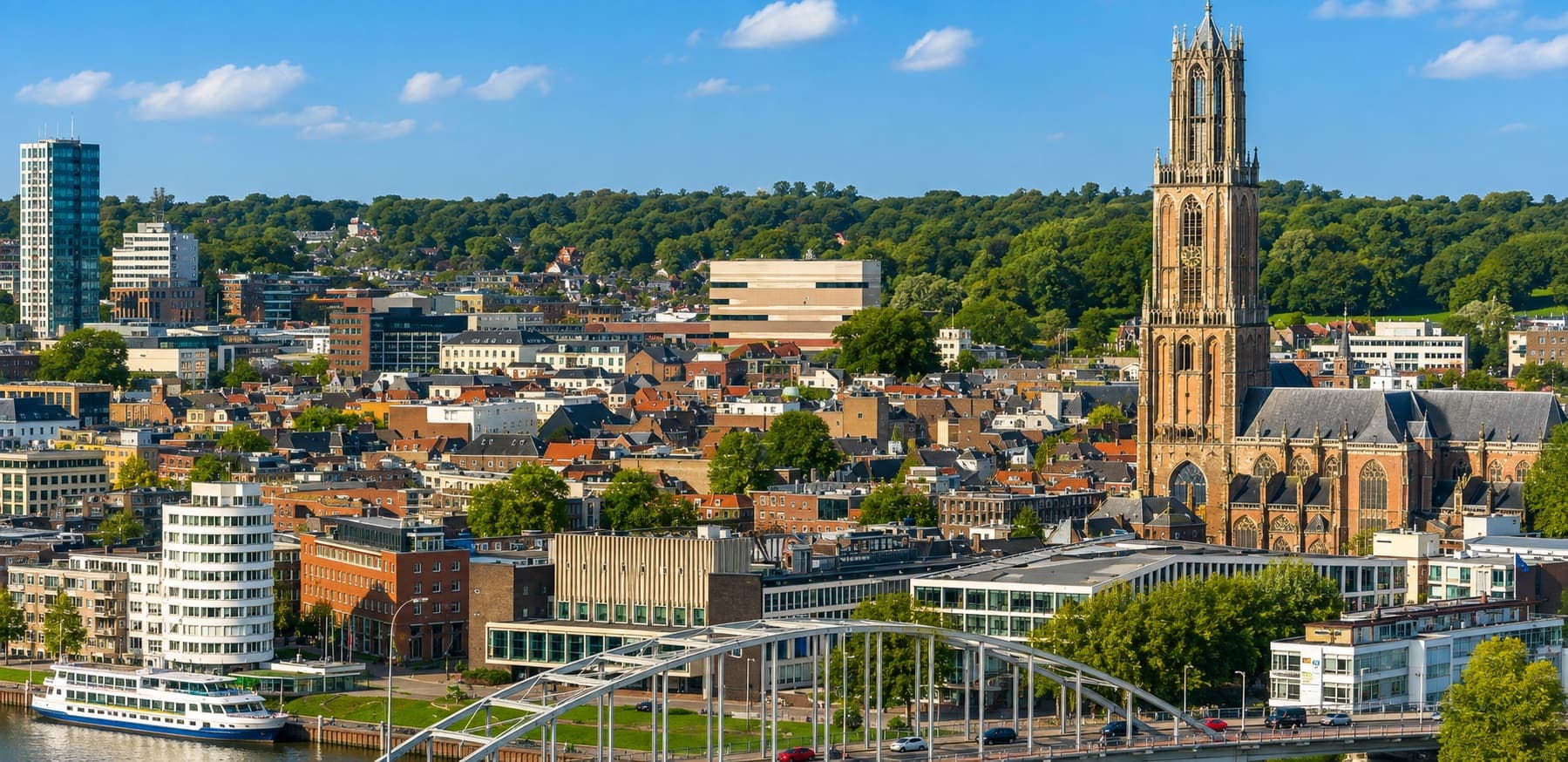
Gelderland · approx. 65 km from Utrecht
Sealant work in Arnhem
Between Onderlangs and Bovenover there is twenty metres of height difference, and with the height the ground changes: sand on the glacial ridge, river clay by the Rhine. That determines what moves, what cracks and how you get to a facade. Look at the spot first, then choose the sealant.
Since 1959
Experience and craftsmanship from Utrecht
Clear communication
Short lines, clear agreements
100% satisfaction
We only leave once you are satisfied
Lasting quality
Top-quality materials for a long-lasting result
What matters in Arnhem
Sand above, clay below, different sealant work
Villas and nineteenth-century districts on the glacial ridge, post-war reconstruction in the centre, post-war flats in Presikhaaf and new build in Schuytgraaf. Four layers of time, four kinds of joints.
Klarendal and the Spijkerkwartier date from the nineteenth century: painted timber and tall windows, and the Spijkerkwartier is a nationally protected townscape. There the sealant has to be paintable. The centre was rebuilt after the war: concrete in the structure, and in the frontages often aluminium window frames with a powder coating. Presikhaaf was built between 1948 and 1970: walk-up and deck-access flats with long expansion joints. Malburgen began in the thirties and has been largely rebuilt since the end of 2001, so there two building methods stand in one street. Schuytgraaf got its first homes in 2004.
Within one city you work here on two kinds of ground. On the glacial ridge there is sand and little moves. Down below, in Malburgen, Elderveld and Schuytgraaf, there is river clay, and there an extension settles just differently from the house next to it. That movement ends up in the connection joint. There the width follows from the movement and not from the eye: below 8 mm, elastic sealant has no room to stretch.
With houses against the slope, the rear facade often starts a storey higher than the front facade: a ladder job at the front, a mobile scaffold tower or aerial work platform at the back. Above the through roads hang the overhead lines of the trolleybus, and those are live; working with a ladder underneath them is done in consultation. In the centre a zero-emission zone applies to vans: the ring roads, the Nieuwe Plein and the Hoge Rijnkade are part of it, and everything that lies within. Tell us if your address falls within it, because the zone determines where the van will be parked and how far the materials have to go. North and South are connected only by the bridges, so with more than one address we first look at which side of the Rhine they are on.
The A12 runs from Utrecht straight here: 65 kilometres, and before the rush hour you do that in just under an hour. After that it goes up, so we leave early when we head this way. One bathroom is reason enough to come: Arnhem lies within the 75 kilometres within which we travel for work at people's homes. We would rather fill a day here with metres than with kilometres.
What we do in Arnhem
- Bathroom, sanitary & kitchenSealing of sanitary ware, showers, baths, washbasins and kitchens.
- Window frames & glazingNeat, durable sealant work around window frames and glass.
- Facades & structural jointsFacade joints, connection joints and expansion joints in floors and walls.
- Swimming pool & wellnessSealant work in swimming pools, saunas, steam rooms and spas.
- Renovation & maintenanceSealant work during renovation, repairs and periodic maintenance.
- Specialist sealant workFor specific requirements and specialist applications.
You will hear from us within 15 minutes on working days, and the work comes with a 2-year guarantee.
The work here
What we do most often in Arnhem
Window frames in the nineteenth-century districts
In Klarendal and the Spijkerkwartier there are timber window frames with paint over them. The painter goes over those, and paint does not adhere to silicone. So acrylic goes in, or a hybrid that you can paint over. And the drainage slot in the bottom rail stays open: that rebate has to remain pressure-equalised, otherwise moisture sits against the insulating glass.
More about this serviceExpansion joints in the flats of Presikhaaf
Walk-up and deck-access flats from 1948 to 1970 are full of concrete elements that expand and contract with the temperature. Concrete does that differently from the aluminium or plastic against it, and it is precisely at that transition that the most movement occurs. Outside, a closed-cell PE backing rod goes in behind, so that the joint adheres on two sides and not on three.
More about this serviceBathrooms in Arnhem-Zuid
In Schuytgraaf, De Laar and the rebuilt Malburgen there are bathrooms with glazed tiling and a plastic bath. Acrylic does not belong there: it disperses under prolonged exposure to water. Silicone or a hybrid with fungicide goes in, at least 8 mm wide and 6 mm deep, because any narrower and you cannot get a decent backing rod in.
More about this serviceHow we approach it here
Which sealant on what, and what it costs
The substrate decides the sealant
In the new build of Zuid, glazed tiling with plastic baths predominates; a neutral-cure silicone adheres to that perfectly well. In the villas on the glacial ridge and in the old facades of the centre there is natural stone in thresholds, skirting boards and window sills, and that is the expensive pitfall: sealant with free plasticisers gives a dark edge that only appears after weeks and never comes out again. Natural stone sealant with chemically bound plasticisers belongs there. Acetoxy silicone stays away from natural stone, concrete and bare aluminium, so also from the concrete frontages in the centre. Paintable sealant goes on painted timber. OTTOSEAL S 125 is the standard, but the substrate chooses the product.
Costs and lead time
We charge per linear metre, with a sliding scale based on the size of the job. What that means is best seen from an example: all the entrances of the same block in Presikhaaf in one work description, one set-up, the same expansion joint over and over again. The price per metre there is lower than when we come for one connection joint behind a house in Elderveld. There are no amounts here yet, because the rates have not been fixed. Replacing costs more than new, because the old sealant has to come out completely first: in Klarendal it sits under a layer of paint in a timber rebate, and cutting it out takes longer than the sealing itself. In the new build of Schuytgraaf that work falls away. Also allow for curing, roughly 2 to 3 mm per day. If you have one bathroom, that is two days without a shower and we choose the day in consultation; if it is a building on the Kleefse Waard, those two days are scheduled before the handover and not after it. Send your work description or a few photos, and say which side of the Rhine the address is on. You get a reply within 15 minutes on working days. Our work comes with a 2-year guarantee. Movement of the building itself falls outside it: if an extension settles on the clay in Zuid, that is the structure and not the sealant. That is why we measure the joint in advance against the movement that is there, so that it is not laid too narrow. If a rebate or a substrate is not sound, you hear that before we start and not afterwards.
Two routes
Business or homeowner in Arnhem
In Presikhaaf and Malburgen there is a lot of multi-storey housing, and there the sealant work is mainly in planned maintenance: large series of identical homes, one work description. If you are a painter, contractor, property manager for a homeowners' association (VvE) or maintenance provider for a housing association, you can place that part with us separately. Along the Westervoortsedijk and on the Kleefse Waard it is about business premises and offices: expansion joints in the facade, joints in sanitary rooms, sealing around penetrations. We come as subcontractor and manage our own regular crew ourselves. If we do not trust a substrate, that goes on the job sheet before we seal. If you take us along in such a planned round, we apply the VAT reverse charge: there is no VAT amount on our invoice and you include it in your own VAT return.
For businesses
Contractors, painters, homeowners' associations, property managers and interior fit-out.
See what we do for businessesAlso near Arnhem
As the crow flies from the centre. By road it is further.
- Velp 6 km
- Oosterbeek 4 km
- Westervoort 7 km
- Huissen 8 km
- Duiven 10 km
- Elst 10 km
- Zevenaar 15 km
- Nijmegen 19 km
Is your town or city not listed? See the whole service area.
Questions from Arnhem
What people in Arnhem ask most often
Our house stands against the slope. Can you get to the rear facade?
Usually yes, but not with the same equipment as at the front. On the street side it is often a ladder or mobile scaffold tower, while the rear facade starts a storey higher and then calls for an aerial work platform. That is a separate item and you want to know about it in advance. Send a photo of both sides with your request, and the right working method is included in the price straight away.
In Arnhem-Zuid the joint between our extension and the house keeps cracking again and again. Why?
The position of the crack says the most. If the crack is in the middle of the sealant, the joint was designed too narrow and refilling solves nothing. On river clay an extension settles just differently from the main building, so that joint has to be measured for more movement than you would think. We saw it open to at least 8 mm. For facade and connection joints the rule then is: the depth is the width divided by three, plus 6 mm.
Our window frames date from before 1994, with hard sealant around the glass. Can it come out?
Not as long as it is unknown what is in it. Glazing sealant and putty applied before 1994 are suspected of containing asbestos, risk class 2 as standard. In the nineteenth-century districts here that is still often in the rebate. A sample is then taken first. If there is asbestos in it, a licensed company removes it according to the applicable protocol, and not our cutting knife. If the rebate is clean, we seal it.
We manage a deck-access flat in Presikhaaf. In summer those long concrete joints look intact. Is that the moment to have them checked?
In the cold season. Then the concrete elements have contracted and the joint is open at its widest, so you can see how much stretch is left in it and whether it is coming away along the flank. In summer everything is closed up and the same joint looks healthy. For facade elements, an inspection once every two years is customary, the first time within a year of handover.
Our bathroom in Schuytgraaf is new and the sealant is already black. How can that be?
Then the room stays wet too long. For a new bathroom the ventilation requirement is 14 dm³/s; if the extraction is set lower or a grille is closed, the joint no longer dries out between two showers. Do not scrub bleach over it: that washes the anti-mould agent out of the sealant and makes the edge porous, after which it comes back faster and faster.

