
Gelderland · approx. 80 km from Utrecht
Sealant work in Nijmegen
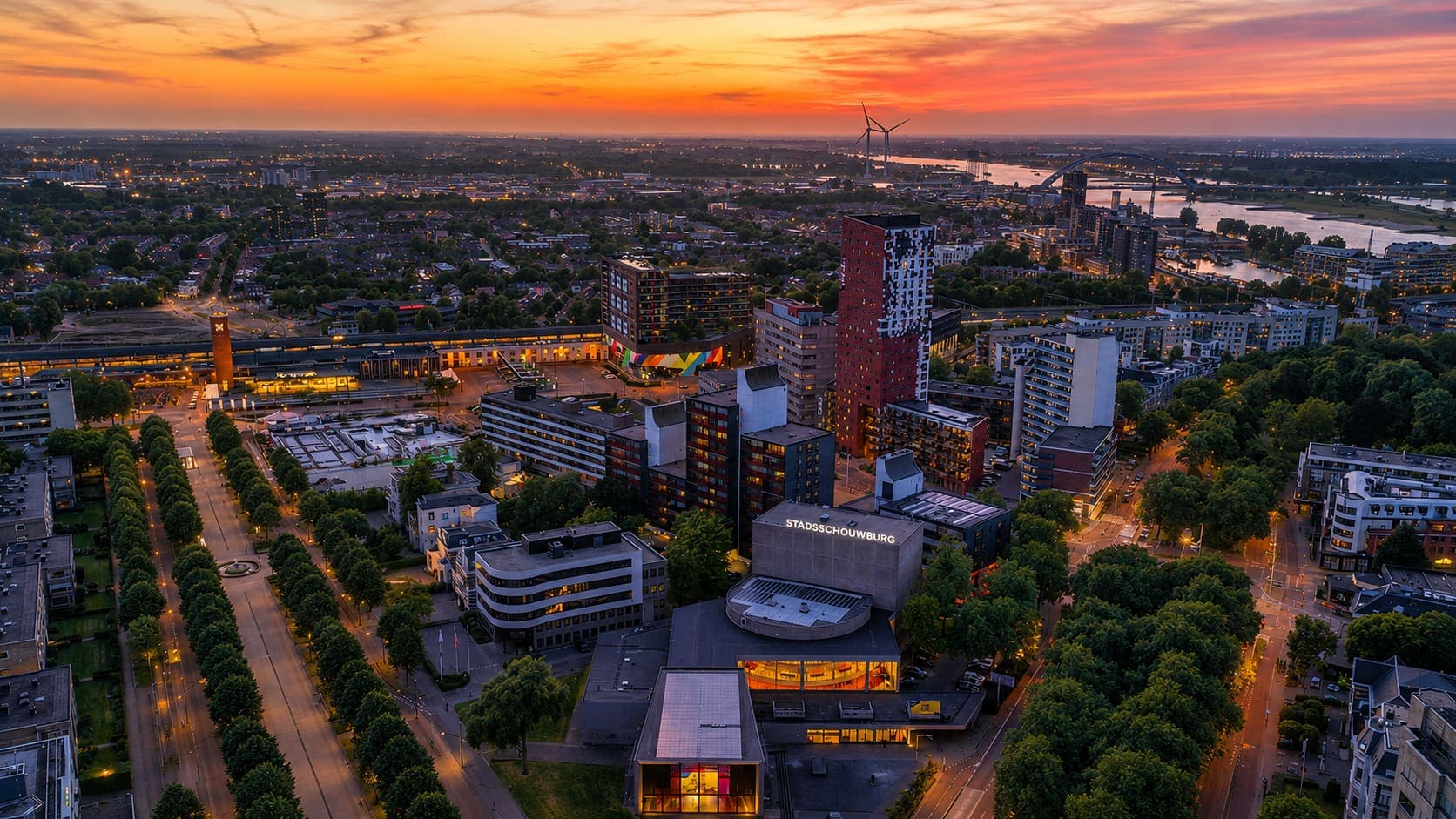
Old Nijmegen stands on the ice-pushed ridge: sand, and there a house hardly settles. Dukenburg and Lindenholt in the west lie right beside that ridge, on clay and river deposits. North of the Waal, in the Waalsprong, there is river clay as well. Sand hardly settles and clay does, and that difference determines whether a joint cracks through movement of the building or through temperature.
Since 1959
Experience and craftsmanship from Utrecht
Clear communication
Short lines, clear agreements
100% satisfaction
We only leave once you are satisfied
Lasting quality
Top-quality materials for a long-lasting result
What matters in Nijmegen
Two kinds of ground, and the joint notices
Post-war reconstruction in the centre, working-class districts from around 1900 to 1925 south of the centre, districts of flats from 1966 and later in the west, and new build across the Waal.
The centre was rebuilt after February 1944: reconstruction-era buildings with steel window frames and glazing sealant that is sometimes still original. Bottendaal dates from around 1900 and the Willemskwartier from 1917 to 1925; in both districts and in Galgenveld many buildings have been subdivided into rooms. Dukenburg was built from 1966 onwards and Lindenholt from 1977, with concrete deck-access flats full of expansion joints. In the Waalsprong, Oosterhout came first, in the late 1990s; De Stelt and Woenderskamp are from recent years, with plastic or powder-coated aluminium window frames.
On the ice-pushed ridge a house hardly settles. If a joint there cracks anyway, the movement usually comes from temperature, and that lies in the difference between materials: concrete expands by about 11 millionths per metre per degree, aluminium by more than double that and plastic by seven times as much. In the Waalsprong and in Dukenburg and Lindenholt there is clay, and then settlement does count. Two kinds of ground, two reasons to make a joint wider.
Since 1 January 2025 Nijmegen has had three zero-emission zones for vans and lorries: the city centre, Heijendaal and Hof van Holland. There is a transitional arrangement, but before planning we check whether our van is allowed in. The difference in height is real too: from the Waalkade to the Sint Annastraat is a proper climb, and on a sloping street an aerial work platform has to stand level.
From Utrecht it is 85 kilometres by road, usually via the A15 through the Betuwe. If you have more than one joint, put it in a single request: two bathrooms, or a bathroom plus the window frames on the sunny side.
What we do in Nijmegen
- Bathroom, sanitary & kitchenSealing of sanitary ware, showers, baths, washbasins and kitchens.
- Window frames & glazingNeat, durable sealant work around window frames and glass.
- Facades & structural jointsFacade joints, connection joints and expansion joints in floors and walls.
- Swimming pool & wellnessSealant work in swimming pools, saunas, steam rooms and spas.
- Renovation & maintenanceSealant work during renovation, repairs and periodic maintenance.
- Specialist sealant workFor specific requirements and specialist applications.
You will hear from us within 15 minutes on working days, and the work comes with a 2-year guarantee.
The work here
What we do most often in Nijmegen
Glazing sealant in the rebuilt centre
The centre was rebuilt after the bombing of 1944. Those buildings have steel window frames, and the glazing sealant has sometimes never been out. From before 1994 it is suspected of containing asbestos, risk class 2, and then we cut nothing out until it is established what is in it. If it turns out clean, the old sealant comes out and we seal the rebate.
More about this serviceShowers in subdivided buildings
Around Bottendaal and Galgenveld many buildings have been subdivided into rooms. One shower that runs a few times a day, with a hopper window as the only ventilation. Acrylic does not hold up to that: it disperses under prolonged exposure to water. That calls for silicone or a hybrid with fungicide, and a joint at least 8 millimetres wide and 6 deep.
More about this serviceExpansion joints in Dukenburg and Lindenholt
Dukenburg rose from 1966 and Lindenholt from 1977: seventeen thousand homes between them, many of them flats. Between the concrete elements are expansion joints that run the full height. Acetoxy silicone does not belong there, because concrete is alkaline and the adhesion lets go. A closed-cell PE backing rod goes in behind, 25 to 50 per cent oversized.
More about this serviceHow we approach it here
Which sealant on what, and what it costs
The substrate decides the sealant
Which sealant goes in depends here mainly on where in the city you are standing. Concrete in the flats of Dukenburg and Lindenholt: alkaline, so no acetoxy silicone, because it loses its adhesion there. Powder-coated aluminium in the window frames of the Waalsprong and in renovated facades: it expands twice as much as concrete, so the joint between them has to be able to cope with that movement. Painted timber in the pre-war districts around the centre: silicone is not paintable, so that calls for acrylic or a paintable hybrid. Glazed tiling in the bathrooms, where the sealant cannot soak into anything and so the preparation determines everything. And natural stone sills and window boards: only natural stone sealant with bound plasticisers, because a dark edge along the joint never comes out again.
Costs and lead time
In the Waalsprong, Oosterhout was put up in a single round, so the window frames in such a street are the same age and come up for attention at roughly the same time. If a few neighbours arrange it together, all the metres add up, because the price is per linear metre with a sliding scale based on the size of the job. In a deck-access flat that works even more strongly: one expansion joint runs the full height and that is more metres than a complete bathroom. There is no amount attached yet, because the rates have not been fixed, and as long as it is not clear how many metres there are and whether the aerial work platform can be got level on a sloping street, such a figure would not be right here anyway. Replacing costs more than new, because the old sealant has to come out completely first, and with powder-coated aluminium that goes slowly because the coating has to stay intact. Sealant cures at roughly 2 to 3 millimetres per day, so after a sanitary joint there is no showering for two days. With one bathroom in the house, that is two days of juggling. If you share the shower with other residents in a subdivided building, say so; then we time it accordingly. You get a reply to your request within 15 minutes on working days. The work comes with a 2-year guarantee. Movement of the building itself is not covered: settlement, deflection, or a joint that moves more than the sealant can cope with. Discolouration, dirt and mould on the joint are not covered either. What we offer in return: we measure the joint beforehand for the movement it is exposed to, so that it is not laid too narrow. If an existing joint turns out too tight for that, you hear it before we start and not when it is open again.
Two routes
Business or homeowner in Nijmegen
On the business side it comes down to three corners here. In the Waalsprong, contractors and painters build new homes and are now running the first maintenance round of those. In Dukenburg and Lindenholt there are blocks of flats with property management for homeowners' associations (VvE) and housing association stock: expansion joints, access deck edges and window frame connections, per block and planned. On the business parks on the west and south sides it is about facade cladding and door frames. If you are a contractor, painter or property manager for a homeowners' association (VvE), you can place that sealant work with us separately. We then work as a subcontractor, with the VAT reverse charge, and deliver one work description with the number of metres in it.
For businesses
Contractors, painters, homeowners' associations, property managers and interior fit-out.
See what we do for businessesAlso near Nijmegen
As the crow flies from the centre. By road it is further.
- Malden 5 km
- Beuningen 5 km
- Berg en Dal 7 km
- Bemmel 8 km
- Wijchen 7 km
- Elst 10 km
- Cuijk 12 km
- Arnhem 19 km
Is your town or city not listed? See the whole service area.
Questions from Nijmegen
What people in Nijmegen ask most often
Our building in the centre is post-war. What do you look out for?
The sealant in the glazing rebate. If it has been in since the building went up and the building dates from before 1994, that sealant is suspected of containing asbestos, risk class 2. Then no knife goes in until a licensed survey firm has established what is in it and the notification has been lodged with the municipality. That takes lead time, so say so in your request. Then we plan it in the right order and you are not left with half a facade.
Our rear facade is one storey higher than the front facade. Can you handle that?
Yes, on the ice-pushed ridge that is more the rule than the exception. The only question is how we get to it. Up to about the first floor it works with a mobile scaffold tower. Above that it becomes an aerial work platform, and that has to stand level. On a street that slopes, that costs jacks and time. Add a photo to your request that also shows the street in front of the house, and the set-up is included in the price straight away.
I let rooms and the shower sealant keeps turning black. What helps?
Stop using bleach, to begin with. Chlorine-based cleaners wash the anti-mould agent out of the sealant and make the edge porous, so after that it comes back faster. Then look at the air. For a new-build bathroom the requirement is 14 dm³/s of extraction; a little hopper window does not get there, and with a shower that runs all day the moisture always wins. We put in silicone with fungicide, but without extraction that is a losing battle.
Our home in the Waalsprong is ten years old. Is the sealant already due for replacement?
You can tell from the way it fails. If the sealant comes away along the flank, something was wrong with the preparation and you can simply replace it. If the crack is in the middle of the joint, the joint was designed too narrow for the movement, and refilling solves nothing. It has to be wider, up to a maximum of 30 mm. Look in winter, because then the building components are contracted and the joint is at its widest.
We manage a deck-access flat in Dukenburg and get the loose joints reported by individual residents. Do you drive out for each one?
Per block, not per complaint. We first go along the facade and measure the joints: width, depth and what is in them. The rule of thumb: depth is width divided by three, plus 6 millimetres, so a joint 18 wide becomes 12 deep. Between concrete elements a closed-cell PE backing rod goes in behind, and a sealant that can handle alkaline concrete. If there is already scaffolding up for the painter, we tie the sealant work in with that.

