
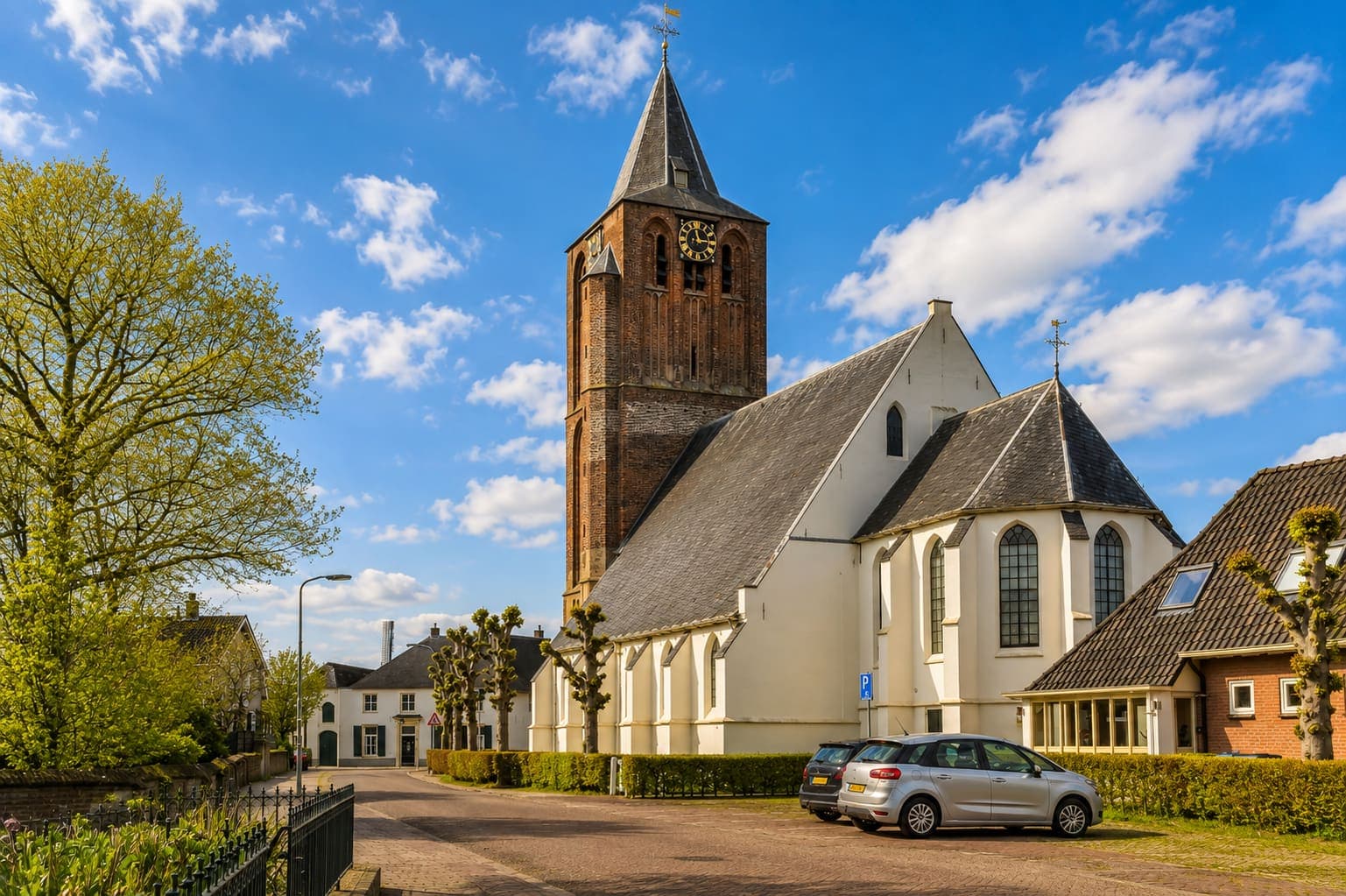
Utrecht · approx. 35 km from Utrecht
Sealant work in Veenendaal
Veenendaal grew out of turf. The peat was dug away and carried off by barge, and on that land came first a factory village and later a town with a string of business parks, from Het Ambacht and Nijverkamp to De Batterijen. That is why the sealant work here is mainly in industrial units, glazed facades and post-war homes.
Since 1959
Experience and craftsmanship from Utrecht
Clear communication
Short lines, clear agreements
100% satisfaction
We only leave once you are satisfied
Lasting quality
Top-quality materials for a long-lasting result
What matters in Veenendaal
The peat is gone, the work stayed
A ribbon along the Grift, post-war reconstruction districts from the 1950s, extensions from the 1970s to the 1990s, new build on the east side and business parks from Het Ambacht to De Batterijen.
Het Franse Gat is post-war reconstruction, built between 1952 and 1962: two-storey terraces with flats of three to four storeys at the edge. In part of the district the window frames have since been replaced, and then the joint between new frame and old brickwork is rarely the same width everywhere. Dragonder dates from the 1970s and 1980s, Petenbos from the 1990s; there the bathroom has often been renewed once by now, so there is sealant on top of sealant. Veenendaal-oost is new: Buurtstede has been lived in since 2010, Groenpoort since the end of 2024, with aluminium and plastic.
The business parks in Veenendaal come in every generation: Het Ambacht was laid out between 1962 and 1972, De Batterijen was added only much later. In a sixty-year-old industrial unit the joint is rarely still in its first life; on a younger park the chances of that are greater. Here that difference says more about the work than the year a residential district was built.
On the business parks the van is parked at the door: no time window, no exemption, everything within reach. In the pedestrian zone in the centre it is different. There a time window applies on Monday, Wednesday, Thursday and Friday from 07:00 to 13:00; outside those hours you need an exemption. On Tuesday and Saturday there is no time window at all: then you cannot get in all day without an exemption. So we do not schedule the centre on those two days.
The A12 takes you from Utrecht to the exit in 35 kilometres, and outside the rush hour that is half an hour's drive. Veenendaal itself is small on the map: from one business park to another district takes ten minutes. And the provincial border lies just beyond the built-up area: Ede, Bennekom and Wageningen lie directly behind it, in Gelderland.
What we do in Veenendaal
- Bathroom, sanitary & kitchenSealing of sanitary ware, showers, baths, washbasins and kitchens.
- Window frames & glazingNeat, durable sealant work around window frames and glass.
- Facades & structural jointsFacade joints, connection joints and expansion joints in floors and walls.
- Swimming pool & wellnessSealant work in swimming pools, saunas, steam rooms and spas.
- Renovation & maintenanceSealant work during renovation, repairs and periodic maintenance.
- Specialist sealant workFor specific requirements and specialist applications.
You will hear from us within 15 minutes on working days, and the work comes with a 2-year guarantee.
The work here
What we do most often in Veenendaal
Floor joints on Het Ambacht and Nijverkamp
On the oldest business parks there are concrete floors that have lasted sixty years already, with expansion joints that take a beating. If the sealant cracks in the middle of the joint, it was designed too narrow and refilling does not help: then it has to be wider, up to at most 30 mm, because above that sealant no longer works. We survey in the cold season, because then the building components are contracted and the joint is at its widest.
More about this serviceWindow frames in Het Franse Gat
Where in a post-war reconstruction district the window frames have been replaced while the brickwork stayed in place, the connection joint is wider on one metre than on the next. We size for the widest point and put a backing rod behind it, so that the sealant adheres on two sides and not on three. If the painter goes over it, it has to be paintable: silicone cannot be painted.
More about this serviceBathrooms in Dragonder and Petenbos
In homes from the 1970s to the 1990s the bathroom has usually been replaced once already, and then there is sealant on top of sealant. Nothing adheres to that. We take the old layer out completely and put in silicone or a hybrid with fungicide. Acrylic does not stay put in a shower corner: under prolonged exposure to water it disperses, it dissolves and washes away.
More about this serviceHow we approach it here
Which sealant on what, and what it costs
The substrate decides the sealant
What you get your hands on here is mainly concrete, coated steel and plastic. On the business parks there are concrete walls, sandwich panels and steel window frames. Acetoxy silicone does not belong on those: on alkaline concrete it loses its adhesion, and it has no place on bare aluminium, zinc and copper either. In the residential districts it is glazed tiling with plastic shower trays inside, painted timber outside that has to stay paintable, and in Veenendaal-oost powder-coated aluminium. If there is a bluestone sill, natural stone sealant goes on it: free plasticisers migrate into the pores and leave a dark edge that never goes away. That is why we carry OTTOSEAL S 125 in the van as standard, but choose the product based on the substrate.
Costs and lead time
The price is per linear metre, and the sliding scale depends on the size of the job. On the business parks that adds up fastest: the expansion joints in one industrial unit on Het Ambacht run from wall to wall, and all those metres are in the same job. In Het Franse Gat it works the same way, only per block: the window frame joints of a whole terrace at once are priced differently from one home on its own. You will not read an amount here, because the rates have not been fixed yet. Do count on replacement working out more expensive than new. In Dragonder and Petenbos there is sealant on top of sealant, and those layers have to come out completely first; that cutting out is most of the work. Curing is mainly a matter of planning. Sealant cures at roughly 2 to 3 millimetres per day, at room temperature and normal humidity. So after a sanitary joint, count on two days without showering, and longer if it is cold or very dry. If you have one bathroom in the house, you want to know that in advance. A floor joint is deeper and so is out of action for longer; do not schedule it on the day it has to be driven over again. When you send your request, say how many metres it is, what the substrate is and whether the building is in the pedestrian zone. On the business parks the van is parked at the door, in the centre the time window determines how the day goes. If you send your request on a working day between 09:00 and 22:00, you get a reply within 15 minutes. Our work comes with a 2-year guarantee. In an industrial unit that is driven over daily the load is heaviest, so we measure that joint up beforehand. And what no guarantee covers is movement of the structure itself: if the building settles or deforms, that falls outside it. That is why we first measure how much the joint actually moves and size it accordingly.
Two routes
Business or homeowner in Veenendaal
Business sealant work in Veenendaal is mainly on the business parks. Think of contractors and painters who outsource the sealing, managers of industrial units and offices, and installation companies with a plant room or server room that has to be sealed. Veenendaal has a relatively large number of IT companies, and they sit in office buildings with aluminium glazed facades. In a production area that is cleaned daily, the joint between wall and floor is the work: chlorine-based cleaners wash the anti-mould agent out of the sealant, so there we choose a product that can withstand that. If a contractor or painter outsources the sealant work, we join in as a subcontractor; the VAT on those invoices is reverse charged.
For businesses
Contractors, painters, homeowners' associations, property managers and interior fit-out.
See what we do for businessesAlso near Veenendaal
As the crow flies from the centre. By road it is further.
- Elst (Utrecht) 5 km
- Renswoude 5 km
- Rhenen 5 km
- Amerongen 8 km
- Scherpenzeel 8 km
- Bennekom 8 km
- Ede 9 km
- Wageningen 9 km
Is your town or city not listed? See the whole service area.
Questions from Veenendaal
What people in Veenendaal ask most often
The floor joints in our industrial unit keep cracking open. What is going wrong?
Walk along the joint and note where it gives way. If the sealant comes away along the flank, it is the adhesion: dirt, moisture or the wrong preparation. If it cracks in the middle of the sealant, the joint is too narrow for the movement it sees. Refilling does not solve that, widening does. We survey in the cold season, because then the building components are contracted and the joint is at its widest.
Our home in Het Franse Gat has plastic window frames in old brickwork. Does that joint need to be wider?
Yes, wider than it needs to look. PVC expands per degree roughly six times as much as concrete and roughly three times as much as aluminium. So the connection between a plastic window frame and brickwork sees a lot of movement, and with replaced frames in old work the joint is uneven on top of that. We size for the widest point: 8 millimetres is the lower limit, 30 millimetres the upper limit, and the depth is the width divided by three plus 6 millimetres.
Our 1980s bathroom is being refurbished. When can you do the sealing?
As soon as the tiling is dry and sound and the shower tray is fixed in place. After that, count on two days before you shower again: sealant cures at room temperature at roughly 2 to 3 millimetres per day, and a sanitary joint is at least 8 millimetres wide and 6 millimetres deep. If it is cold or very dry in the house, it takes longer. In a refurbishment we first remove all the old sealant, including the layer underneath the previous one. Otherwise nothing adheres to it.
Our business premises date from before 1994. Can the old glazing sealant just come out?
Not just like that. Glazing sealant and putty from before 1994 can contain asbestos, and such work falls into risk class 2 as standard. On Het Ambacht there are industrial units of that age, so there it is a real question. We cut nothing out as long as it has not been established what is in it. The removal then belongs with a licensed asbestos removal company and goes through a notification. If it turns out to be clean, we put the new joint in.
Our home in Veenendaal-oost has just been handed over. When should the sealant be checked?
Do not wait until you see something. The first check belongs within a year of handover, then every two years. Do it in the cold season: then the building components are contracted and every joint is at its widest, so you see the most. Outside and in places where water gets in, a closed-cell PE backing rod belongs behind the sealant, otherwise the filling soaks itself full.

