
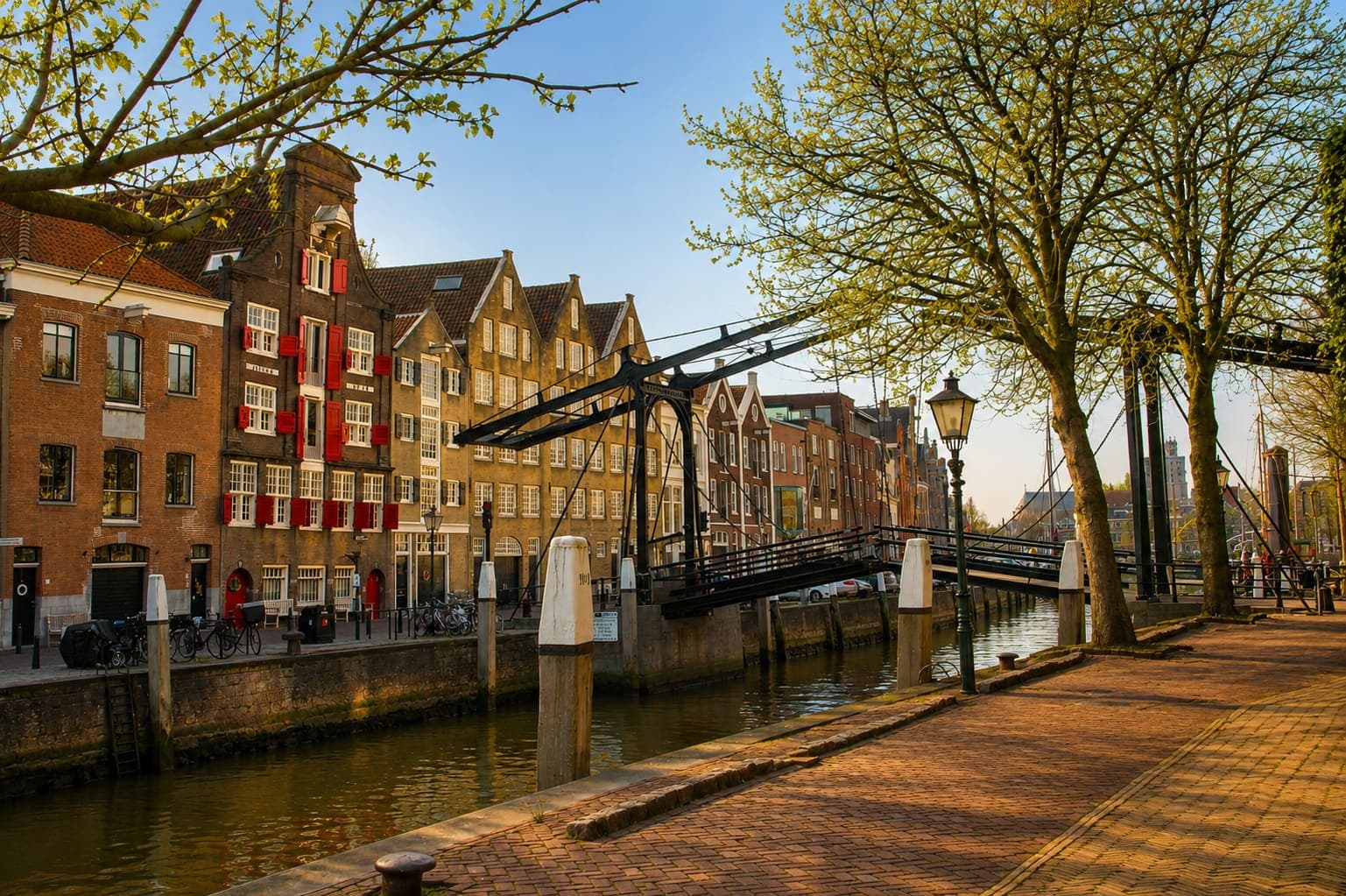
Zuid-Holland · approx. 70 km from Utrecht
Sealant work in Dordrecht
Dordrecht is surrounded by tidal water, and here that is not just scenery. The quays outside the dyke flood in a storm, the buildings in the old districts stand on timber piles in soft ground, and in the centre bluestone dominates. All three determine what belongs in the joint and how wide it needs to be.
Since 1959
Experience and craftsmanship from Utrecht
Clear communication
Short lines, clear agreements
100% satisfaction
We only leave once you are satisfied
Lasting quality
Top-quality materials for a long-lasting result
What matters in Dordrecht
High water, bluestone and settling ground
Almost nine hundred nationally listed buildings, most of them in the old centre, with a nineteenth-century belt around them, post-war walk-up flats from the fifties and sixties and expansions from the seventies to the nineties.
The city centre has been a protected townscape since 1987: bluestone steps, sills and plinths where only natural stone sealant may go. Oud-Krispijn and Nieuw-Krispijn are pre-war and stand on timber piles; there you also still find glazing sealant that may date from before 1994 and is then suspected of containing asbestos. Wielwijk got its first homes in 1957, Crabbehof followed between 1958 and 1961: walk-up flats with concrete expansion joints and access deck edges. Sterrenburg grew from 1966 onwards, Stadspolders from the eighties. There, in bathrooms and around window frame connections, it is usually sealant that has already been replaced once before.
Outside the dyke, the quays in the centre are periodically under water: in a north-westerly storm with a spring tide, the river comes over the quay and the municipality hands out sandbags. Joints in plinths, thresholds and cellar doors then face real water loading. Those need a closed-cell PE backing rod behind them, and no acrylic, because acrylic disperses under prolonged exposure to water. Inside the dyke, that water loading is not an issue.
The centre is largely car-free and works with time windows: until eleven in the morning you can get in with a van. After that the centre closes until the evening. In the pedestrian section there are rising bollards. There you need an exemption even within the time windows; maintenance companies apply for one after registering. Such an exemption does not extend the time window itself. The island has only a handful of access routes: the A16 through the Drechttunnel, the N3 and the Kiltunnel, where you pay a toll. If one of them is at a standstill, the whole day shifts. That is why we plan one address per day here.
From Utrecht it is 70 kilometres by road: the A27 to Gorinchem, then the A15 and the N3 onto the island. About an hour if all goes well. For a project we drive out here regardless. If you send a request on a working day, you have a reply within 15 minutes and you know which day we can get onto the island.
What we do in Dordrecht
- Bathroom, sanitary & kitchenSealing of sanitary ware, showers, baths, washbasins and kitchens.
- Window frames & glazingNeat, durable sealant work around window frames and glass.
- Facades & structural jointsFacade joints, connection joints and expansion joints in floors and walls.
- Swimming pool & wellnessSealant work in swimming pools, saunas, steam rooms and spas.
- Renovation & maintenanceSealant work during renovation, repairs and periodic maintenance.
- Specialist sealant workFor specific requirements and specialist applications.
You will hear from us within 15 minutes on working days, and the work comes with a 2-year guarantee.
The work here
What we do most often in Dordrecht
Bathrooms in the walk-up flats
Wielwijk, Crabbehof and Sterrenburg are full of small bathrooms with limited extraction. Acrylic does not hold there: under prolonged exposure to water it disperses. What belongs there is silicone or a hybrid with fungicide, at least 8 millimetres wide and 6 deep. If you then clean it with bleach, you wash the anti-mould agent straight out.
More about this serviceFacade joints on the river side
Across open water, driving rain hits the facade head-on. The connection joint between window frame and masonry is what catches that rain, and that joint is also subjected to the most movement, because two materials with different expansion meet there. Here we prefer to look in the cold season: the building components are then contracted and the joint is at its widest.
More about this serviceBluestone in the old centre
Around the harbours and canals there is bluestone in steps, sills and plinths. Free plasticisers and silicone oil migrate into the pores and leave a dark edge along the joint, often only visible weeks later. Polishing will not get it out again. Only natural stone sealant with chemically bound plasticisers goes on there; acetoxy silicone never comes near it.
More about this serviceHow we approach it here
Which sealant on what, and what it costs
The substrate decides the sealant
In the centre, bluestone dominates: steps, sills, plinths and facade bands. Edge-zone staining on it is irreparable, so only natural stone sealant goes on there. In the walk-up flats it is concrete, and concrete is alkaline: acetoxy silicone loses its adhesion there. It is kept off bare aluminium, zinc and lead too, because the acetic acid attacks those metals. The bathrooms are glazed tiling with a plastic bath: smooth and dense, so the adhesion comes from degreasing and priming and not from the brand on the cartridge. In the facades from the seventies and eighties, powder-coated aluminium sits next to plastic, and plastic expands well over six times as much as concrete. So that joint ends up wider than it looks. We choose the product based on the substrate, with OTTOSEAL S 125 as the starting point.
Costs and lead time
Because we plan one address per day here, a whole day goes into it regardless, whether we seal one sill or a whole walk-up block. That is why the size of the job counts extra heavily on this island. We charge per linear metre, and that price per metre drops as more metres go into a single job. If a housing association has the access deck edges and concrete expansion joints of a block in Wielwijk or Crabbehof done in one go, you notice that straight away. At the Zeehaven it works the same way: all the expansion joints in the industrial floor at once, not hall by hall. In Sterrenburg and Stadspolders it is usually replacement rather than new, and replacement costs more: the old sealant has to come out completely first, and that cutting out takes the most time. There are no amounts here yet, because the rates have not been fixed. If you outsource the sealant work as a contractor or painter, we apply the VAT reverse charge. If you send a request on a working day, you have a reply within 15 minutes and you know straight away which day we can get onto the island. What we seal comes with a 2-year guarantee. Movement and settlement of the structure fall outside it, and on this island that is no small print. That is why we measure the joint beforehand against the movement it will be exposed to, and say before we start which product goes where.
Two routes
Business or homeowner in Dordrecht
On the west side of the island lie the Zeehaven and the Krabbepolder: storage and transhipment and maritime manufacturing, with industrial halls, concrete floors and expansion joints that forklifts drive over. In the residential districts the sealant work is mainly in housing complexes, and that calls for a planned approach: one block at a time, not home by home. That takes a single point of contact and a single schedule, and that is how we go about it. In the centre the joint sits against bluestone. That is the work that restoration contractors and interior fit-out companies come up against, and there it has to be right first time, because it cannot be redone. If you outsource sealant work, we carry out a site survey first and say in advance which product goes where. Several addresses in one request are treated as one job, with one price per metre.
For businesses
Contractors, painters, homeowners' associations, property managers and interior fit-out.
See what we do for businessesAlso near Dordrecht
As the crow flies from the centre. By road it is further.
- Zwijndrecht 7 km
- Papendrecht 6 km
- Hendrik-Ido-Ambacht 8 km
- 's-Gravendeel 7 km
- Alblasserdam 10 km
- Sliedrecht 7 km
- Ridderkerk 12 km
Is your town or city not listed? See the whole service area.
Questions from Dordrecht
What people in Dordrecht ask most often
Does curing take longer here because of all the water around us?
No, if anything the other way round. Silicone cures with moisture from the air, so humid air helps rather than slows it down. What matters most is the depth of the joint and the temperature: count on 2 to 3 millimetres per day at 20 degrees. For a sanitary joint 6 millimetres deep, 24 hours is therefore tight. Allow two days before the shower can go back on. The point is that no shower water touches the fresh sealant in that time; the humid air itself is not a problem.
Our building stands outside the dyke on the harbour. What does that mean for the sealant at the bottom?
That the joint is genuinely under water now and then. In a north-westerly storm with high water, the river comes over the quay. You can forget acrylic there, because it disperses under prolonged exposure to water. Behind the joint belongs a closed-cell PE backing rod. Open-cell soaks itself full and holds the moisture against the joint. And the sealant must adhere on two sides, not to the base.
Our house in Krispijn stands on timber piles and has settled. The sealant cracks in the middle of the joint.
A crack in the middle of the joint is called cohesive failure. That does not mean the sealant was bad, but that the joint is too narrow for the movement in it. Refilling solves nothing there: the same crack is back within a year. We saw-cut the joint open to the width that goes with the movement: at least 8 millimetres and up to 30 millimetres. If the calculated width comes out above that, sealant is no longer the answer and we say so in advance. To be honest about it: if the building settles further, that movement simply carries on. Movement and settlement of the structure fall outside our guarantee, and no sealant can make up for that. What we do is measure the movement that is in the joint now and size the joint accordingly.
We are doing up a building in the protected city centre. There is bluestone in the steps and the sills. Can sealant go against that?
Sealant can go against it, but not just any cartridge off the shelf. Bluestone is porous, and the plasticisers in ordinary sealant migrate freely into the stone. You then get a dark edge along the joint, often only visible weeks later, and it never comes out again: polishing, sanding and cleaning, none of the three helps. On steps, sills and plinths, therefore, only natural stone sealant with chemically bound plasticisers goes on, and acetoxy silicone does not come near it. In a protected townscape you cannot simply redo a facade, so we say in advance which product goes on and put edge-zone staining outside the guarantee in writing.
We live in the largely car-free centre. Can you even get there with a van?
Yes, but on time. The car-free area works with time windows: until eleven in the morning we can get in, after that it is closed. An exemption does not extend that, because it too only applies within those times. So we unload in one go and then park the van outside the centre. In practice that means we want to know beforehand how many metres are involved, so that we bring the right material in one go.

