
Overijssel · approx. 90 km from Utrecht
Sealant work in Deventer
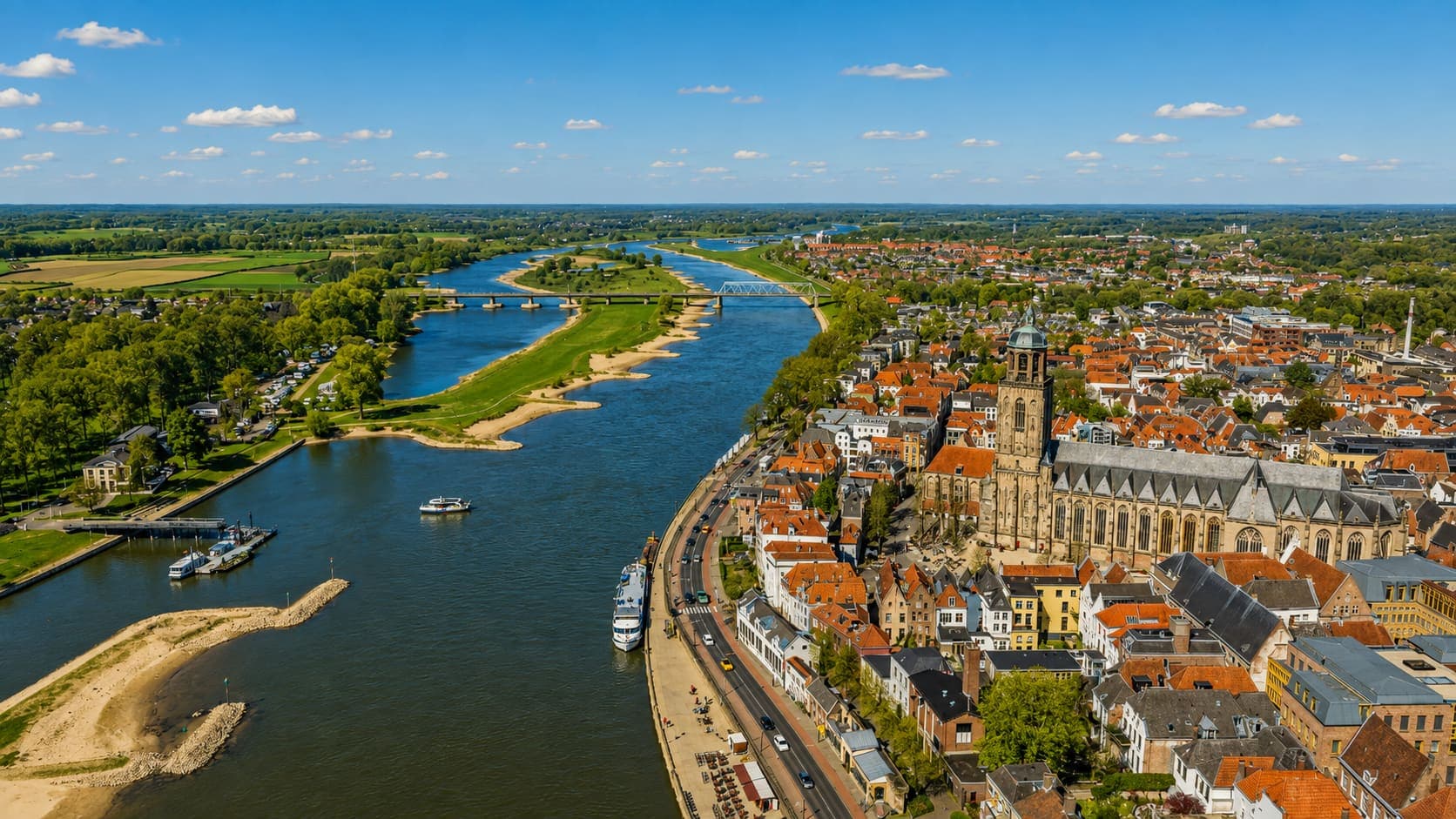
Deventer is built on a river dune, with a quay below it that is the first to close at high water. That difference in height steers the work here. Up top stands medieval timberwork that was saved from demolition at the end of the sixties; down below, the plinth stands in the water with some regularity.
Since 1959
Experience and craftsmanship from Utrecht
Clear communication
Short lines, clear agreements
100% satisfaction
We only leave once you are satisfied
Lasting quality
Top-quality materials for a long-lasting result
What matters in Deventer
High on the dune, low by the IJssel
A medieval core on a river dune, post-war reconstruction districts from the sixties around it, expansion on the sand to the east and a harbour area with industrial units on the IJssel.
The Bergkwartier was saved from demolition building by building at the end of the sixties: painted timber, bluestone sills, rebates that have been sealed shut ever since. Keizerslanden and Borgele-Platvoet are sixties: long facade surfaces with expansion joints in them, and those have to be redone every so many years. Colmschate has grown from 1970 onwards and De Vijfhoek was added as a Vinex district. There the work is in bathrooms and in connection joints around plastic window frames. And then there is the quay: Welle, Pothoofd and IJsselkade lie so low that they are the first to close at high water.
Two things at once, and each calls for a different product. The quay is the first to close at high water and then stands with its plinth in the water, and there a closed-cell PE backing rod belongs behind the joint, because that soaks up nothing. And up on the dune there is glazing sealant from the restoration years. If it dates from before 1994 it is suspected of containing asbestos, and then no knife goes in until a survey says what is in it and which risk class the removal falls under.
The core shopping area is pedestrianised with delivery windows: loading and unloading is allowed between 07:00 and 11:00, and not after that. The streets on the Berg are narrow. On the IJssel side there is also the height difference of the quay: if the water is high, you cannot work there and it gets pushed back. On Bergweide, Kloosterlanden and Bedrijvenpark A1 it is the other way round: there the van drives right up to the roller door. Diepenveen, Schalkhaar and Bathmen belong to the same municipality and all three lie within ten kilometres of the centre.
Deventer is ninety kilometres away by road. For one single job that is a fair drive, but it is not a no. It means that we plan here: several rooms, a block of homes, or a building where inside and outside are done in one go. For projects we drive all over the Netherlands.
What we do in Deventer
- Bathroom, sanitary & kitchenSealing of sanitary ware, showers, baths, washbasins and kitchens.
- Window frames & glazingNeat, durable sealant work around window frames and glass.
- Facades & structural jointsFacade joints, connection joints and expansion joints in floors and walls.
- Swimming pool & wellnessSealant work in swimming pools, saunas, steam rooms and spas.
- Renovation & maintenanceSealant work during renovation, repairs and periodic maintenance.
- Specialist sealant workFor specific requirements and specialist applications.
You will hear from us within 15 minutes on working days, and the work comes with a 2-year guarantee.
The work here
What we do most often in Deventer
Glazing sealant in old rebates
In the core you can come across timberwork that has not been opened since the restoration, with the sealant from that time still in the rebate. If it dates from before 1994, no knife goes in until it is established what is in it. If it can come out, we redo the rebate with a paintable product. Silicone is not one.
More about this serviceExpansion joints on Bergweide
Bergweide has been there since the twenties and is full of industrial units with concrete floors and concrete facade elements. Concrete shrinks and expands with the temperature, and the joint width follows from that movement, not from what looks good. Acetoxy silicone does not belong in it: on alkaline concrete it loses its adhesion.
More about this serviceBathrooms in Colmschate
The expansion on the east side was built from 1970 onwards, and those bathrooms are now due for their second or third round. If there is still a remnant of the previous one under the old joint, that has to come out completely, otherwise the new sealant adheres to sealant instead of to tile. Acrylic does not go in here: it disperses under prolonged exposure to water, and a shower corner in a home like that is used every day.
More about this serviceHow we approach it here
Which sealant on what, and what it costs
The substrate decides the sealant
In the core you work on painted timber, brick and bluestone. Bluestone sills are natural stone, and there the strictest rule we know applies: only natural stone sealant with chemically bound plasticisers. Free plasticisers migrate into the pores and leave a dark edge that only shows up weeks later and never comes out again. Polishing does not help. In Colmschate and De Vijfhoek it is mainly glazed tiling and plastic: PVC expands six to seven times as much as concrete, so there the joint gets wider. On Bergweide it is concrete and powder-coated aluminium. Three substrates, three products, and we choose on site.
Costs and lead time
You do not drive ninety kilometres for one joint, and that steers the sums here. What it costs depends on the number of linear metres, and there is a sliding scale on the size of the job. If the expansion joints of a block in Keizerslanden or Borgele-Platvoet are done in one round, that sliding scale really counts. One shower joint in Colmschate is not a trip on its own; with the rest of the bathroom and the connection joints around the window frames added, it is. On the other hand, here it is usually replacement work. The old joint has to come out over its full length before anything can go in, and cutting out takes more time than applying. So replacing is more expensive than new. You will not find amounts here: the rates have not been fixed yet, so you get them in the quote. After a sanitary joint, allow for two days without showering. That is on the safe side; exactly how long it takes depends on the product and the depth of the joint, and you are told that at the same time. Sealant cures at roughly 2 to 3 millimetres per 24 hours, and at this distance we do not pop back the next day to touch up. You get a reply within 15 minutes on working days. If we work as a subcontractor for a painter or contractor, the VAT is reverse charged. Our sealant work comes with a 2-year guarantee. Movement of the building itself falls outside it: settlement, deflection, or a joint that moves more than the sealant can take. What we do do is measure the joint beforehand against the movement it is exposed to, so that it is not made too narrow. If that width is not right, you hear it beforehand and not when the joint is already open.
Two routes
Business or homeowner in Deventer
Business sealant work here is in three places. Renovation in the core and planned maintenance in Keizerslanden and Borgele-Platvoet: if you are a painter or contractor, you can place that sealant part with us separately. Sixties blocks where the exterior work is done in one round: if you are a property manager for a homeowners' association (VvE) or work at a housing association, you can register it per block. And the business parks Bergweide, Kloosterlanden and Bedrijvenpark A1, with expansion joints, floor junctions and sealing at handover. We come as a subcontractor, manage the sealant work ourselves and hand over with videos of what has been done.
For businesses
Contractors, painters, homeowners' associations, property managers and interior fit-out.
See what we do for businessesAlso near Deventer
As the crow flies from the centre. By road it is further.
- Schalkhaar 5 km
- Diepenveen 5 km
- Twello 6 km
- Bathmen 9 km
- Olst 11 km
- Zutphen 13 km
- Apeldoorn 16 km
Is your town or city not listed? See the whole service area.
Questions from Deventer
What people in Deventer ask most often
Our building is in the Bergkwartier and is a listed monument. The glazing sealant from the restoration is still in it. Can you just replace it?
Not just like that. Many buildings in the Bergkwartier are national monuments, and then the appearance of the joint counts too: we fix colour and width beforehand and not afterwards. If there is glazing sealant from before 1994 in it, it is suspected of containing asbestos, risk class 2, and no knife goes in until it is established what is in it. Check with the municipality whether you need a permit; we supply the technical description.
Our home in Colmschate dates from 1988. What is due first?
The joint around the shower tray and bath. In a home from that period, that joint has probably been replaced once already. If that was done on the old sealant instead of on the tile, it comes away along the flank; that is called adhesive failure. If the crack is right in the middle of the joint, it was designed too narrow and refilling does not help: it has to be opened up wider. We seal that up to 30 millimetres. If more is needed, it is no longer sealant work and a different solution is called for.
The quay here floods at high water. What does that mean for sealant work?
That the plinth and the lowest connection joints regularly stand in the water. A closed-cell PE backing rod belongs behind those. That is the foam cord the sealant sits against, and closed cell does not soak up water. Open-cell PU is for indoors only. What also counts here is the substrate: no sealant adheres to stone that is still wet from high water, so around the quay we plan more generously.
We are in an industrial unit at the harbour. Can you work while we keep running?
Yes, we can. We do it in sections, so that only one lane is closed at a time. On a concrete floor it is mainly the curing time that counts: roughly 2 to 3 millimetres per 24 hours, and a floor joint is deeper than a sanitary joint. So allow several days before a forklift drives over it again. If you are working towards a handover date, say so straight away: then we schedule the floor joints at the start and not in the final week.
How do you get to our building in the city centre with the van?
Usually not right up to the door. The streets on the Berg are narrow and the city centre is largely low-traffic, so we park the van further away and carry the materials. That takes time, and that time is in the quote and not in a surprise afterwards. Say beforehand which floor the work is on and whether there is a staircase or an alley in between.

