
Noord-Holland · approx. 80 km from Utrecht
Sealant work in Alkmaar
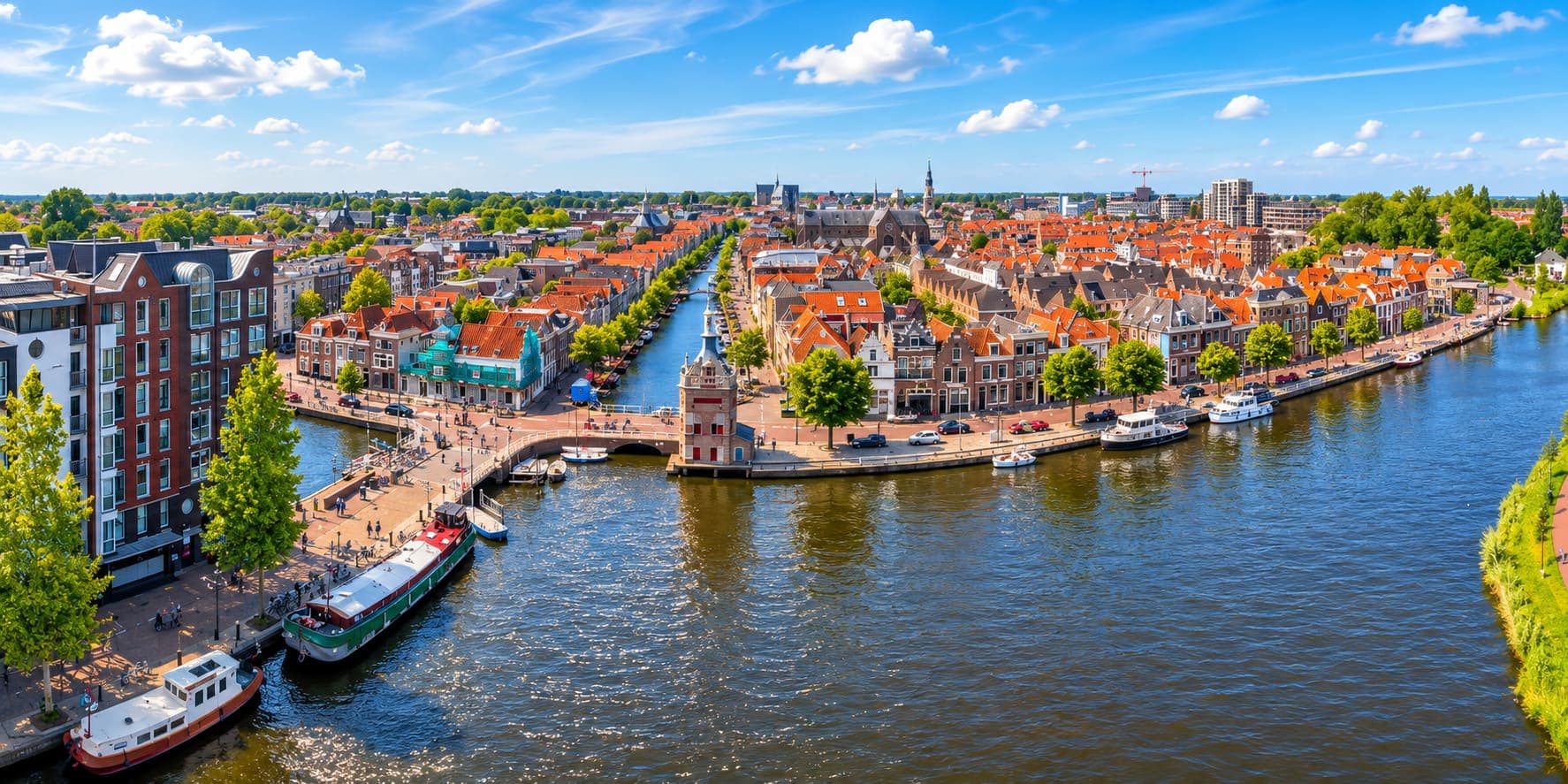
Alkmaar stands with its old centre on a beach ridge and with the rest in the drained lakes around it. Two kinds of ground, two kinds of movement in the facade, and that movement determines how wide a joint needs to be. The sea is just over eight kilometres away, so driving rain and salt play a part here too: they determine not the width but the adhesion.
Since 1959
Experience and craftsmanship from Utrecht
Clear communication
Short lines, clear agreements
100% satisfaction
We only leave once you are satisfied
Lasting quality
Top-quality materials for a long-lasting result
What matters in Alkmaar
Sand in the centre, clay around it
More than one in six homes dates from before 1945, almost a quarter from 1975-1985, and four in ten homes are flats. Three generations of sealant work in one city.
The city centre around the Waag is full of listed buildings: painted timber, bluestone sills, window frames that are sometimes still original. Oud-Overdie dates from the 1920s, Nieuw-Overdie from the 1960s, with walk-up flats and small tiled bathrooms. Huiswaard came in the 1970s, De Mare in the 1980s: long rows with the same window frame connection over and over. On Overstad stands the newer building along the canal, in concrete and powder-coated aluminium. And since 2015 De Rijp, Graft and the Schermer have been part of Alkmaar, with timber facades that are painted along with the rest: the centre of De Rijp is a protected village conservation area, and in Graft almost every house is a municipal listed building. So the joint there has to be paintable.
The North Sea is just over eight kilometres away and the wind here comes from the west. So driving rain and salt end up on the same facades, and those call for a clean, dry flank before any sealant goes in. If a joint there comes away along the edge, it is not worn out but poorly adhered. You check in the cold season: the building components are then contracted and the joint is at its widest.
In the closed-off city centre there are loading windows: loading and unloading from 07:00 to 11:00 and from 17:00 to 19:30, and on a cheese market Friday until 10:00 in the morning. The bollards are gone; a camera reads the number plate. Within those hours you can drive in with anything; outside them you need an exemption from the municipality. On the quays of Verdronkenoord and Luttik Oudorp it is tight: there we carry the materials in. In the polder villages there is no closed-off centre and no loading window.
From Utrecht it is 80 kilometres by road, just over an hour via the A2 and the A9, and longer in the morning rush hour. Alkmaar falls within our area for work at people's homes. Let us know how many metres it is, and you will hear what fits into a single trip. Projects we do throughout the Netherlands.
What we do in Alkmaar
- Bathroom, sanitary & kitchenSealing of sanitary ware, showers, baths, washbasins and kitchens.
- Window frames & glazingNeat, durable sealant work around window frames and glass.
- Facades & structural jointsFacade joints, connection joints and expansion joints in floors and walls.
- Swimming pool & wellnessSealant work in swimming pools, saunas, steam rooms and spas.
- Renovation & maintenanceSealant work during renovation, repairs and periodic maintenance.
- Specialist sealant workFor specific requirements and specialist applications.
You will hear from us within 15 minutes on working days, and the work comes with a 2-year guarantee.
The work here
What we do most often in Alkmaar
Window frames on the windward side
On the west and south-west sides the window frames stand in the driving rain all year round. When sealing, the drainage slots in the sill stay open: that rebate has to remain pressure-equalised, and a slot smeared shut wrecks the double glazing in the long run. A sill of up to 600 mm needs at least one opening, above that two.
More about this serviceBathrooms from the growth years
Almost a quarter of Alkmaar's homes date from 1975 to 1985. Those bathrooms are due for their second round: glazed tiling, a shower corner and a joint that turns black. Acrylic does not belong there, because it disperses under prolonged exposure to water. Silicone or a hybrid with fungicide goes in, at least 8 mm wide and 6 mm deep.
More about this serviceExpansion joints on the business parks
On Boekelermeer and Beverkoog there are industrial halls made of prefabricated concrete elements. Concrete expands by 10 to 12 millionths per degree, aluminium by more than double that, so the connection between the two is exposed to the most movement. The width follows from that movement and not from the eye: designed too narrow, it cracks down the middle.
More about this serviceHow we approach it here
Which sealant on what, and what it costs
The substrate decides the sealant
In the city centre you come across painted timber and bluestone: sills, plinths and steps. No acetoxy silicone goes on natural stone, and certainly no sealant with free plasticisers. Those migrate into the pores and weeks later leave a dark edge that never comes out. Polishing does not help. If paint has to go over the joint, it becomes acrylic or a paintable hybrid, because silicone does not take paint. In the post-war districts, glazed tiling in small wet rooms predominates. On Overstad and the business parks it is powder-coated aluminium, plastic and concrete. OTTOSEAL S 125 is the standard, but which product goes in follows from the substrate.
Costs and lead time
In Huiswaard and De Mare the homes in a row have the same window frame connection. If you have a block like that checked in one go, the linear metres add up and the price per metre comes down with them: that is where the sliding scale is. Three separate homes in that same street do not get there. For a homeowners' association (VvE) that has all the bathrooms of one stairwell done at the same time, it works the same way. Replacing an existing joint comes out higher than new work, because the old sealant has to come out completely first. In the tiled bathrooms from the growth years, that cutting out takes more time than the application. What it comes to per metre is not on this page: the rates have not been fixed yet, so you get a price on your own metres. Allow for curing time too. Sealant cures at roughly 2 to 3 millimetres per day, so after a new shower joint it is two days without showering. In a walk-up flat in Nieuw-Overdie there is no second bathroom to fall back on; put in your request which days suit you, and you get an answer on that straight away. If a contractor on Boekelermeer wants to hand over on a fixed date, we count back from that day: an expansion joint is deeper than a sanitary joint and needs more days. Let us know roughly how many metres it is, or how many homes it concerns; you get a reply within 15 minutes on working days.
Two routes
Business or homeowner in Alkmaar
Four in ten homes in Alkmaar are flats, so much of the sealant work here belongs in planned maintenance: checking facade joints and expansion joints block by block. If you are a property manager for a homeowners' association (VvE), a housing association, a painter or a maintenance contractor, you can place that part with us separately. On Boekelermeer and Beverkoog it is about industrial halls with expansion and floor joints. Our work comes with a 2-year guarantee. Movement of the structure itself is not covered. As a subcontractor we apply the VAT reverse charge. Send the specification or work description along, and you get a price per metre with a sliding scale.
For businesses
Contractors, painters, homeowners' associations, property managers and interior fit-out.
See what we do for businessesAlso near Alkmaar
As the crow flies from the centre. By road it is further.
- Heiloo 5 km
- Bergen 5 km
- Heerhugowaard 8 km
- Broek op Langedijk 6 km
- Egmond aan Zee 9 km
- Castricum 12 km
- Schagen 17 km
- Hoorn 22 km
Is your town or city not listed? See the whole service area.
Questions from Alkmaar
What people in Alkmaar ask most often
We live a few kilometres from the sea. Does sealant last less long here?
The sealant itself no, the adhesion yes. Salt and driving rain end up on the same facade and dirty the flank; leave that, and the joint comes away along the edge instead of cracking. So have the west facade checked more often than the rest, preferably in the cold season. The first time within a year of handover, then every two years.
Our extension in the polder is sinking. Is resealing worth it?
First look at where the joint has failed. If the crack is in the middle of the sealant, the joint is too narrow for the movement it is exposed to. Refilling then solves nothing; it cracks again within a year. In the drained lakes a light extension settles differently from the main house, so the joint between them is chiselled out wider and gets a backing rod, so that the sealant adheres on two sides only.
Our house is timber and gets painted. Which sealant can go over that?
Not silicone. Paint does not adhere to it, and you see that at the first repainting cycle afterwards. On painted timber, acrylic or a paintable hybrid goes in, and the joint is painted along with the rest. In De Rijp and Graft whole facades are timber, and there the joint is simply part of the paintwork. In a wet room it is the other way round: acrylic disperses under prolonged exposure to water.
Our window frames date from before 1994. Can you just cut those out?
No, and we do not. If there is putty or old glazing sealant in a window frame from before 1994, it is suspected of containing asbestos and the work falls into risk class 2 by default. So no knife goes in until it is established what is in it: first a survey, and only with that result and the accompanying notification may a licensed company remove it. In the centre around the Waag the original window frame is sometimes still in place, and Oud-Overdie dates from the 1920s, so in Alkmaar this is no exception. If you do not know the year the glazing was put in, assume it is older.
Our homeowners' association (VvE) wants the facade joints checked in a single round. Is that possible?
Yes, and per metre that is more favourable, because the sliding scale runs over the total. We first survey the whole block: which joints are really finished, which can go another season and where the width is wrong. That produces one work description, so that the VvE knows what happens this year and what later. The work carried out comes with a 2-year guarantee. Movement of the building itself is not covered, and we say so in advance. What we do for it: during the site survey we measure per joint how much movement it is exposed to, so that it is not laid too narrow. If the width is wrong, it is in the work description and you do not hear it afterwards.

