
Noord-Brabant · approx. 90 km from Utrecht
Sealant work in Eindhoven
Eindhoven stands on sand. Houses settle far less here than on peat or clay, so a cracked joint here is rarely down to the ground. What does move is the buildings themselves: industrial units of steel and concrete, facades of aluminium, old factories with steel windows.
Since 1959
Experience and craftsmanship from Utrecht
Clear communication
Short lines, clear agreements
100% satisfaction
We only leave once you are satisfied
Lasting quality
Top-quality materials for a long-lasting result
What matters in Eindhoven
The ground stays still, the buildings do not
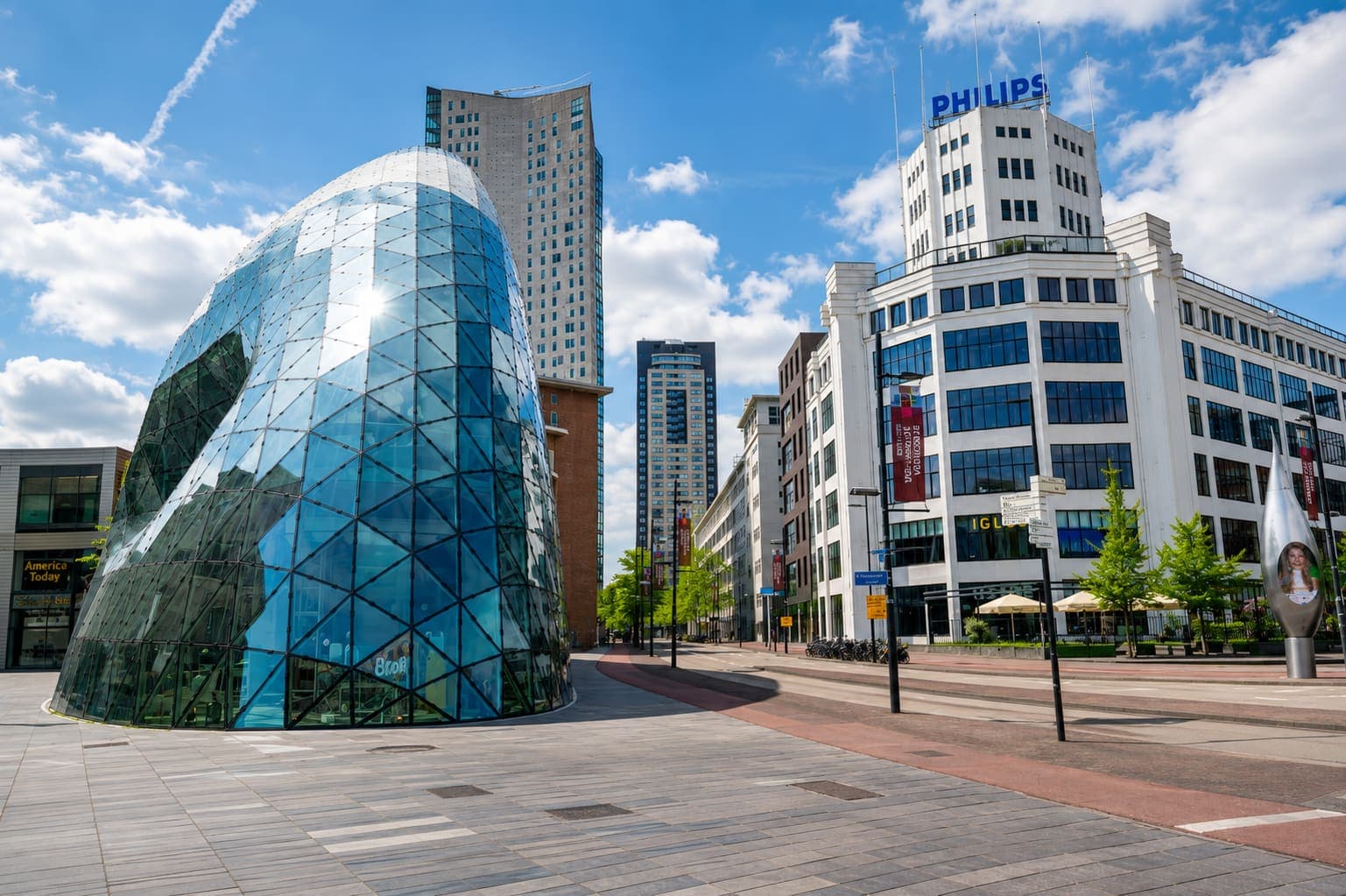
Large post-war districts such as Woensel, post-war reconstruction in the centre, converted Philips sites and around them business parks with industrial units, offices and production spaces. Little old city centre, a lot of building from after 1945.
Philipsdorp and Drents Dorp were put up between 1910 and the thirties for Philips staff: painted timber window frames, and those take a paintable sealant, because paint will not go over silicone. Woensel-Noord is the big expansion from 1960 to 1975: walk-up flats where the bathrooms were built in series, and where the sealant is therefore also worn out in series. At Strijp-S the gates of the Philips site opened in 2000: factory buildings with steel windows, now lofts and offices. Meerhoven dates from after 1999, with plastic window frames.
Eindhoven has a lot of commercial buildings, and they call for different sealant work from a home. In an industrial unit, an office or a production space, the load determines the joint: forklifts over it, cleaning agent on it, liquid that must not run away. A joint behind a washbasin has nothing to do with that, and what goes in differs just as much.
Since 1 January 2025 a zero-emission zone for vans and lorries has applied inside the Ring. For existing vans the transition runs until 1 January 2027 (Euro 5) or 1 January 2028 (Euro 6), for existing lorries until the end of 2029. That counts in the planning: inside the Ring, stopping outside the door is not a given, so it is useful to know beforehand where you can load and unload. Outside the Ring, on the sites along the motorways, you simply park next to the work.
Ninety kilometres by road, well over an hour's drive. That makes the size of the job weigh more heavily here than at an address round the corner. For an industrial unit, a block of homes or a handover, that drive disappears into the whole. For three metres in a shower corner, the drive is a large part of the work, and you notice that in the price.
What we do in Eindhoven
- Bathroom, sanitary & kitchenSealing of sanitary ware, showers, baths, washbasins and kitchens.
- Window frames & glazingNeat, durable sealant work around window frames and glass.
- Facades & structural jointsFacade joints, connection joints and expansion joints in floors and walls.
- Swimming pool & wellnessSealant work in swimming pools, saunas, steam rooms and spas.
- Renovation & maintenanceSealant work during renovation, repairs and periodic maintenance.
- Specialist sealant workFor specific requirements and specialist applications.
You will hear from us within 15 minutes on working days, and the work comes with a 2-year guarantee.
The work here
What we do most often in Eindhoven
Expansion joints in industrial floors
In the industrial units on the sites along the motorways there are concrete floors with expansion joints that forklifts drive over. The width of such a joint follows from how much the concrete moves, not from what looks good. If the sealant cracks in the middle of the joint, the joint was designed too narrow and refilling solves nothing.
More about this serviceSteel windows on the factory sites
The old Philips buildings are full of steel windows, and sometimes the original glazing sealant is still in them. If it dates from before 1994, it counts as suspected of containing asbestos, risk class 2. Then no knife goes in until it is established what is in it. Removal is done by a licensed company; we take on the new sealing work afterwards.
More about this serviceBathrooms in the walk-up flats
In the walk-up flats of Woensel the bathrooms were built in series: often the same size, and sealant of the same age. We make a sanitary joint at least 8 mm wide and 6 mm deep; anything narrower is not enough for the movement and cracks again. Allow two days before anyone showers again, because sealant cures at around 2 to 3 mm per 24 hours.
More about this serviceHow we approach it here
Which sealant on what, and what it costs
The substrate decides the sealant
Concrete and powder-coated aluminium are what you come across most often here: prefabricated walls, floors and facade cladding. On alkaline concrete, acetoxy silicone loses its adhesion, so a neutral-cure sealant goes in there. Aluminium expands well over twice as much per degree as concrete and plastic six to seven times; it is precisely at the junction between two of those materials that there is the most movement, and so the widest joint. In the homes it is glazed tiling in the wet rooms and painted timber in the older districts. That timber takes acrylic or a paintable hybrid, because you cannot paint silicone. There is little natural stone here, but where there is, the rule is: natural stone sealant only, because edge-zone staining never comes out again.
Costs and lead time
What you pay here depends mainly on how you bundle it. We charge per linear metre, with a sliding scale on the size of the job. In the walk-up flats of Woensel you notice that straight away: the bathrooms are all the same size and the sealant is the same age everywhere, so a whole stairwell in one go works out lower per metre than one home on its own. The same goes for an industrial unit on the sites along the motorways: all the expansion joints in one round, instead of a section each time. There are no amounts on the site yet, because the rates have not been fixed. Replacing costs more than new: the old sealant has to come out completely first, and for a trafficked floor joint that includes the backing rod underneath. And with glazing sealant suspected of containing asbestos on the factory sites, the removal is not in our price at all. That part is done by a licensed company. Also plan around the curing, roughly 2 to 3 mm per 24 hours. If you want to hand over on Friday, you do not lay the last sanitary joint on Thursday. The curing determines the order. In a block of flats it is therefore sensible to plan per stairwell, so that the whole block is not without a shower at the same time. And because we do not just drop by here: you have a reply to your request within 15 minutes on working days, so that you can fix the day. Our sealant work comes with a 2-year guarantee. What the building itself does falls outside it: settlement, deflection, or a joint that moves more than the sealant can take. That is why we measure beforehand how much movement a joint is exposed to, so that it is not made too narrow. If an existing joint is too narrow for that movement, you hear it beforehand and not after the first crack.
Two routes
Business or homeowner in Eindhoven
If you are a contractor, installer, interior fit-out company, manager of commercial buildings, housing association or property manager for a homeowners' association (VvE), you can place the sealant work with us separately. That means expansion joints in floors, connection joints at facade elements, joints in production and clean rooms and the sealing at handover. In the post-war districts that work is mainly in planned maintenance; on the business parks, in maintenance of the unit itself. We come as a subcontractor, with a fixed team of tradespeople that we manage ourselves, and for subcontracting we apply the VAT reverse charge.
For businesses
Contractors, painters, homeowners' associations, property managers and interior fit-out.
See what we do for businessesAlso near Eindhoven
As the crow flies from the centre. By road it is further.
- Veldhoven 7 km
- Waalre 7 km
- Nuenen 7 km
- Geldrop 8 km
- Son en Breugel 8 km
- Best 8 km
- Valkenswaard 14 km
- Helmond 14 km
Is your town or city not listed? See the whole service area.
Questions from Eindhoven
What people in Eindhoven ask most often
Forklifts drive over our floor joint. What goes in it?
Not ordinary facade sealant. A trafficked joint gets a harder, wear-resistant filling and tight flanks, because every wheel crossing loads the edges. The width follows from how much the concrete moves, not from what is there now. And the joint may adhere on two sides only: if it also grips the base, the middle cannot stretch and it cracks open. That is why a backing rod goes behind it, closed-cell PE where there is moisture.
Our building on Strijp-S still has original steel windows. Are you allowed to take that sealant out?
Not just like that. Glazing sealant and putty from before 1994 are suspected of containing asbestos and fall under risk class 2 by default. A survey has to come first, and removal is done by a licensed company following the prescribed method. As soon as that is complete, we do the new sealing work. If you do not know the year the glazing was installed, assume it is old until the opposite is established.
Our house stands on sand and is not settling. So why does that facade joint still crack?
Because most joint movement does not come from the ground but from temperature. Aluminium expands roughly twice as much per degree as concrete, plastic six to seven times. If the crack is in the middle of the joint, the joint was designed too narrow; refilling does not solve that, the joint has to be made wider. Elastic sealant works between 8 and 30 mm; if more is needed, it no longer takes sealant but an expansion joint profile. If the sealant comes away along a flank, it is about adhesion and preparation. Look in the cold season: that is when the joint is at its widest.
The sealant in our flat's bathroom keeps turning black. What helps?
Look at the air first, not at the sealant. For a new-build bathroom the requirement is 14 dm3 per second; if the extraction does not achieve that, the wall stays wet and all sorts grow on it. Do not use bleach: it washes the anti-mould agent out of the sealant and makes the edge porous. And acrylic does not belong here, because it disperses under prolonged exposure to water. In a wet room, silicone or a hybrid with fungicide goes in.
Our production space is machine-cleaned every day. What does that mean for the joint?
That the cleaning agent counts in the choice, not just the moisture. Chlorine-based and aggressive cleaners wash the anti-mould agent out of a sealant and make the edge porous; in a space that is rinsed down every day, that happens fast. It then takes a sealant that is resistant to that agent, and a joint applied so that no moisture can get behind it. Damage from chlorine-based, abrasive or aggressive cleaning does fall outside the guarantee, even with a sealant like that. Send us the cleaning protocol, and we choose on that basis.

